Software
Houzz Logo Print
mojome007

Japanese Maple, leaf scorch?

4 years ago
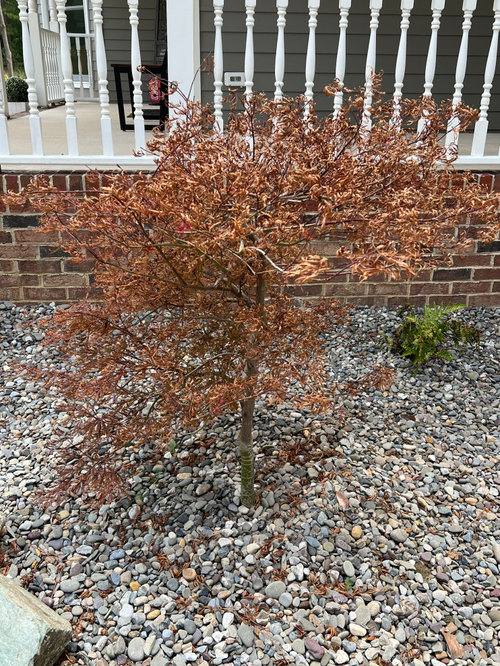
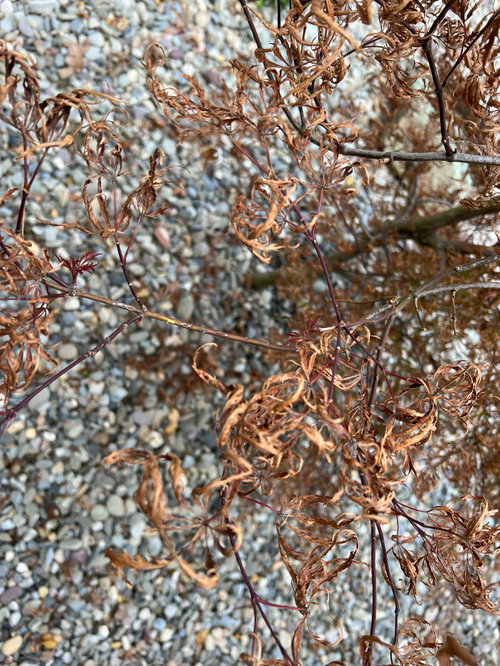
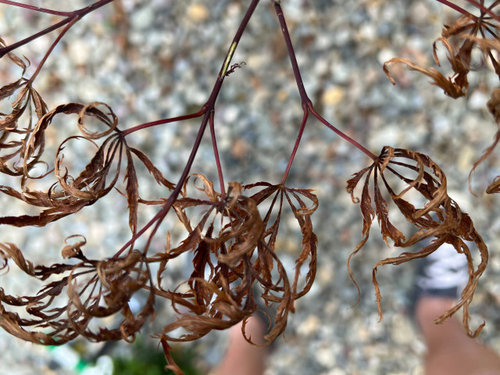
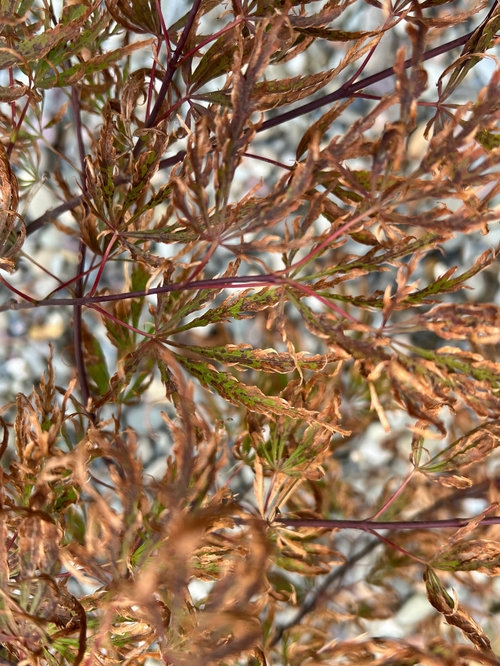
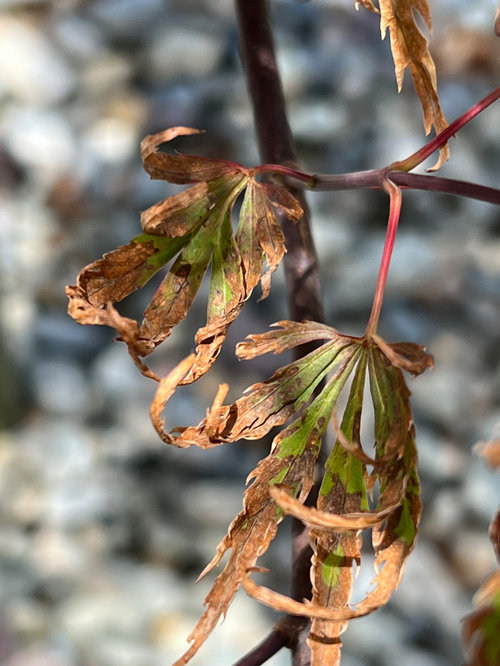
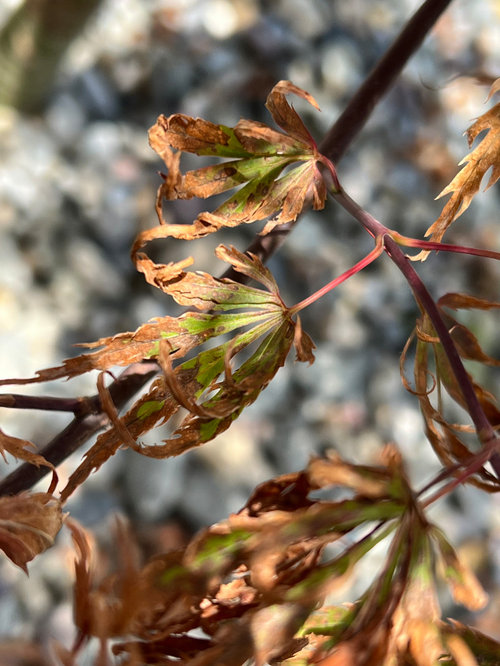
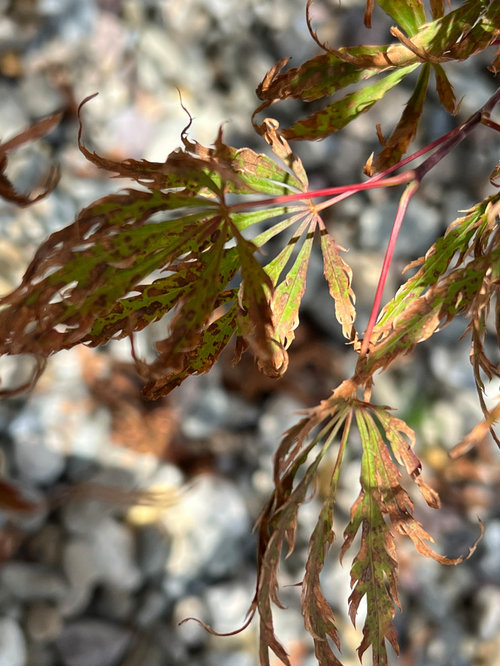
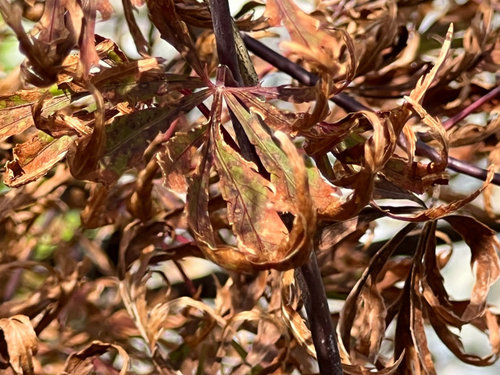
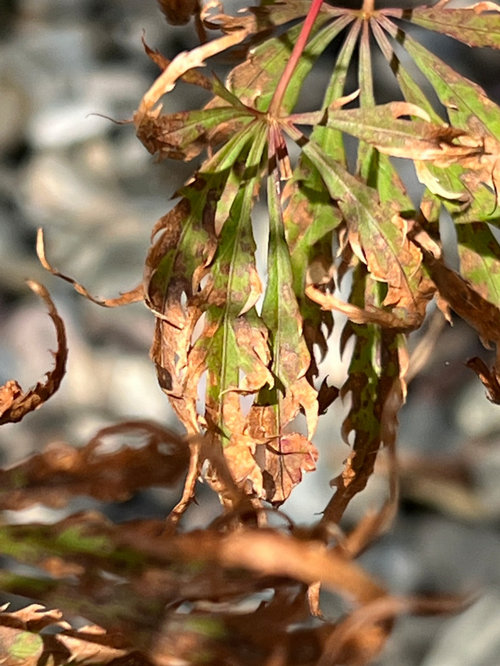
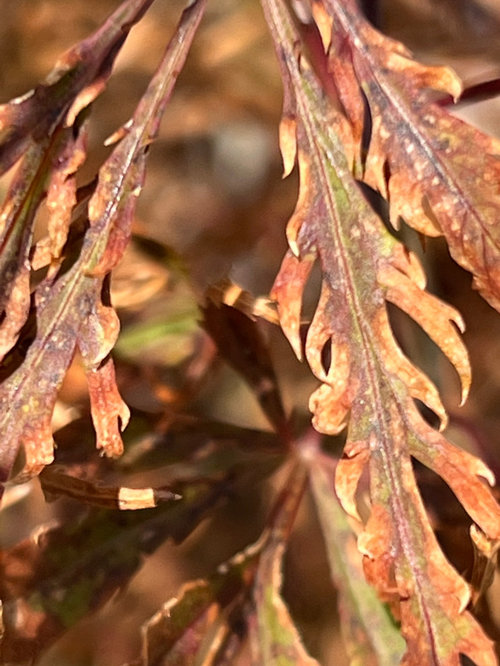
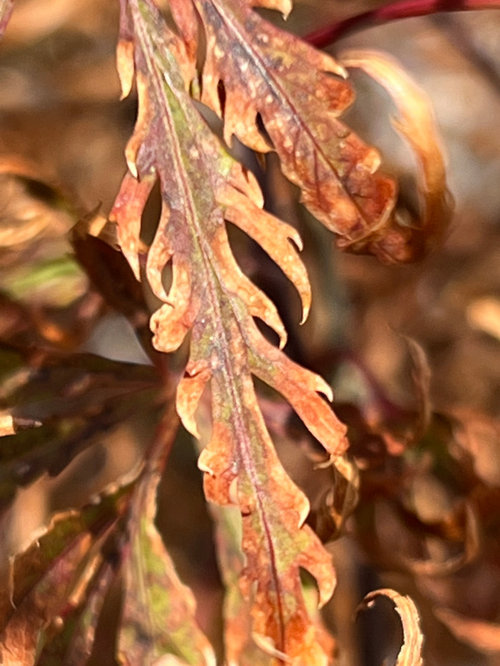
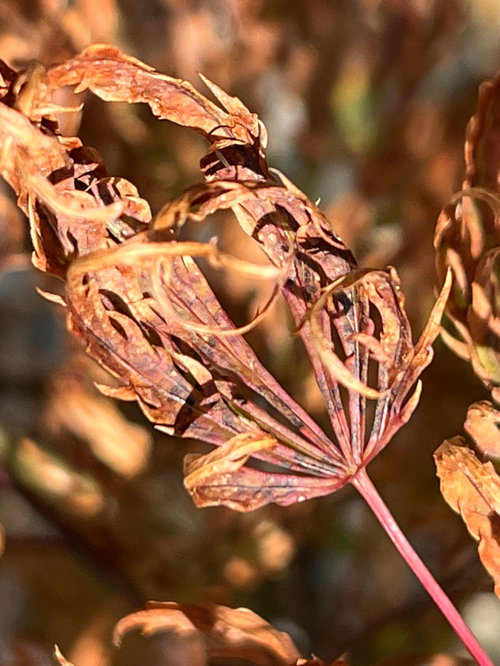
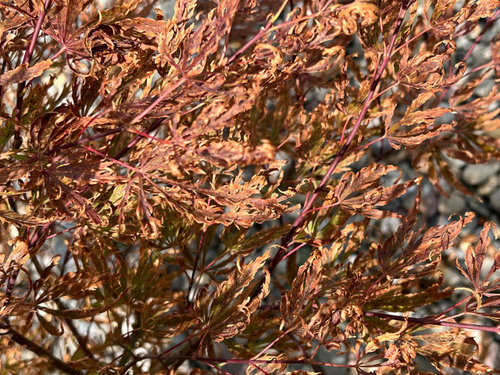
Hello, This tree is Red Dragon Japanese Maple. It was planted in March of this year (2022). It adjusted well & had looked good ever since up until about a week ago. Seemingly overnight the leaves turned brown & started dropping. Upon closer inspection today, I see some of the leaves are green or turned green or maybe new growth? but size-wise are the same as the older red/crimson leaves. It is planted in the space between the driveway and the front porch of the house that has rock mulch. Drainage is good, the ground is soft & my husband says he waters it about every other day by standing over it until run off then going to the other plants & doing likewise then coming back around to do the same twice more. It is in the shade all morning until around noon time when the shade from the porch/house is back far enough that the maple is then in full sun for 4-5hrs until the sun goes behind the tall pine trees as it sets. We are in Zone 7A in North Carolina. Wondering if it's leaf scorched because leaves that are very much in the center of the tree or at the very bottom or on the house side of the tree still show green & dont seem as completely fried as the leaves on the driveway side of the tree. It could also be not enough water for the week we were out of town & it got watered maybe once? In one of the pictures you can see the results of the scratch test. What ails this tree and how do we treat it going forward?


Comments (9)

  • 4 years ago

    Is your husband watering with a spray or a slow trickle? Have you dug into the rootball 4-6 inches to check for moisure? Is there landscape fabric under the stone?

    tj

  • 4 years ago

    Not leaf scorch. That's water stress. And if it happened overnight - or seemingly so - it could be water stress brought on by a compromised vascular system. And that most often translates to Verticillium wilt, marked by the wilting and drying/browning of the foliage, often very rapidly.

    It is difficult to diagnose accurately outside of a pathology lab but I've encountered it often enough in my career to be pretty familiar with it (unfortunately).

    There is no cure or treatment and if the pathogen is confirmed, you should not replant with a VW susceptible species.

    Contact your local extension office and send photos or describe the situation. They will explain how take a sample for diagnosis and where to send it.

  • 4 years ago

    It adjusted well


    ==>>


    no it didnt.. and its being severely underwatered .... you basically burned all the leaves off it ..


    if you perfect watering ... it can and will releaf ..


    dig 4 holes with a hand trowel or tablespoon.. in the gob planted.. and in native soil .. check moisture 6 inches down.. WHERE THE ROOTS ARE ... and when you find out it is dry.. then put a hose on trickle for a hour.. then move it 180 degrees around the tree and leave it on for another hour..


    in the mean time.. perk your soil and find out how your soils drains ... and then you might be able to know when to waer it again .


    it will take a tree that size.. 2 or 3 years to settle in.. and to be rather free range ... it has to regrow the lost root mass if it was ball and burlap ... or overcome severe potting issues ... ergo.. it did not adjust well since planting a few months back... it was basically coping.. until the heat of summer started drying out the soil at depth ...


    ill add a link to a good planting primer.. in case your interested ... did you bare root the tree at planting.. and take care of any root issues ...??


    ken


    https://duckduckgo.com/?t=ffab&q=perc+garden+soil&iax=videos&ia=videos


    https://sites.google.com/site/tnarboretum/Home/planting-a-tree-or-shrub

    mojome007 thanked ken_adrian Adrian MI cold Z5
  • 4 years ago

    ^^^ I would not take the above as gospel :-) The only way to detect if you have been under watering is to physically check the soil moisture at rootball depth. But based on your description of your watering practices, that sounds somewhat unlikely to have produced that degree of desiccation. Or that fast.

    I suspect something a bit more sinister than just a lack of adequate irrigation. Get it accurately diagnosed.

    Also, even if the issues was under watering - which I doubt - there is no guarantee it will releaf with that degree of desiccation present. It is likely too far gone :-((

    mojome007 thanked gardengal48 (PNW Z8/9)
  • 4 years ago

    I would say it's moisture stress...even if you watered adequately...it was unable to take up enough water to keep itself hydrated in this hot summer we're having. Japanese maple, especially the thread leaf cultivars are somewhat sun sensitive until establishment...some even after establishment. You just planted it 4 months ago, in a gravel bed, getting the hottest sun of the day from noon to 5, and you're in zone 7 in an abnormally hot summer for much of the country. That's a tough situation for a Japanese Maple. The week without water could have been too much...or even if you kept the root ball consistently moist, it didn't have enough roots to take up enough water to keep with moisture loss at the leaves.

    Those leaves will soon shrivel and fall off. It may or may not sprout a few leaves later this summer...they may be smaller than usual. Even if it doesn't sprout new leaves, monitor the root ball moisture and keep it adequately watered all season. By fall, you should be able to easily tell if it has lived...by looking for green doing the scratch test, and you should start seeing next years tiny buds forming.

    Verticillium wilt is always a possibility for any maple...however having only been planted 4 months ago it would be highly unlikely in my experience. It has barely put out any root growth in that time frame, and is still living off the soil in the root ball and whatever moisture you give it.


    mojome007 thanked Joe Williams
  • 4 years ago

    Thank you for your responses. I think you all are right about lack of water/moisture stress. I will dig the root ball as described, do the drainage test described in the Google article and talk with the extension service. (I have to ask them about the grass as well, Southern Blend Tall Fescue seeded in October that came up beautifully, was green through the winter & spring. Nevertheless spring didnt bring ANY new growth or any "bouncing back" while it was still cool. Instead it began to turn from green to brown and now all that new grass is completely dead-but that's another post). Anyway I'll answer your questions to see if you have any further instructions for me.

    Husband is watering with a spray from a position of standing over the plant. I haven't dug down but did stick a long screwdriver in the dirt near the root ball and the soil is soft and seemingly moist, as dirt stuck to the screwdriver. There was supposed to be landscape fabric under the rocks but the landscaper forgot until after all the plants were in and I let him slide since laying fabric after the fact would mean doing it around 400 plus plants, likely take them forever and I was ready for them to be done.


    And "adjusted well"...the other trees, (Deodar cedar, 3 Yoshino cherries, Torulosa Juniper) all showed more severe signs of stress after planting, Some areas of the leaves/needles turned brown and dropped.


    It was not a ball and burlap, rather a fairly large pot. Since it was planted by the landscaper I assume they addressed any root bound issues as I saw them doing this with other plants.


    If the issue is under-watering or bad technique and finding the balance between keeping the rootball moist by providing enough water and the inability of the unestablished rootball to take up enough water to compensate for water loss at the leaves, this location is probably not favorable. Your're right of course that 4-5 hours of the days hottest sun will keep the tree stressed. That being the case is it best to leave it here through the fall so it has a chance to recover and live then move it to a new location? Or not move it until the spring? Would providing some temporary shade help?

  • 4 years ago

    Yes I got that since that is what the Google article endorses.

  • 4 years ago

    I dug down 12” next to the root ball. It was moist 7.5” down. But I also found there was an air pocket around at least 3/4 the base of the root ball & about 1/3 of it also had an air pocket underneath the root ball. I corrected this without disturbing the rootball to a large degree & closed up the holes. I then exposed the beginning of the flair at the base of the trunk & watered by slow trickle for an hour twice at 180 degrees from each other. We’ll see. It is already pushing new growth but as described in the responses the leaves are smaller & burning up after a few days. The way everything is watered changed today with investment in soaker hoses. Thank you everyone!