Software
Houzz Logo Print
cathy_cokley

MG Cactus & Succulent Soil

I just repotted some Sans in Miracle Grow Cactus and Succulent potting soil in Terracotta pots. It dries out daily. Should I repot and mix with regular potting soil?

Comments (6)

  • 4 years ago

    May I suggest you add 50% perlite and or pumice to your mix of MG cactus soil. The problem with that soil, it’s high in peat moss. Peat moss is not ideal for succulents because most succulents need a dry out period, and when peat moss dries out it turns to concrete and becomes hydrophobic. So your succulents never really get a chance to absorrb water. It also chokes the roots because the peat gets so hard.

    On the other side when peat moss gets water on the regular it stays soggy.

    By adding about 50% of perlite or pumice it breaks up the peat so it can’t turn hydrophobic and rock hard. Perlite/pumice adds drainage and aeration for the roots.

    When you do repot be sure to clean as much of the old soil off the roots.

    Hope that made sense🙂.

    Cathy Cokley Shilow z8 SC thanked Kara 9b SF Bay Area CA
  • 4 years ago
    last modified: 4 years ago

    What's written and depicted on the outside of a bag of grow medium is more often than not an unfair representation of what's in the bag; and, designed to trigger a purchase rather than provide the grower with information essential to making an informed decision. So, caveat emptor!

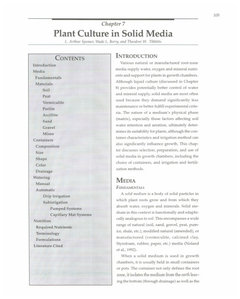
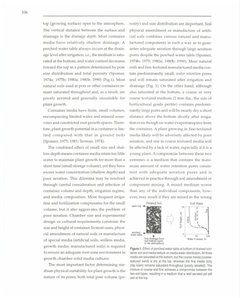
    Trying to "amend" a poor soil by adding an arbitrary fraction of coarse material like perlite, pumice, scoria, ....., doesn't work well. Here's why: While adding these ingredients judiciously can reduce o/a water retention, it is actually counterproductive when it comes to aeration. In fact, adding 'some' coarse material actually causes a decrease in aeration. Let's say you have a quart jar of sphagnum peat moss and a pint jar of marbles, each filled to the brim. You know the marbles are capable of adding lots of large air pores because you can look at the jar and see all that wonderful space between the marbles. Your assessment is, the peat doesn't provide enough aeration, so it seems logical that adding marbles to the peat (like adding perlite, pumice, scoria, Haydite, ..... to a water-retentive potting mix) will increase aeration. So, when you add the first marble to the quart full jar full of peat, the jar overflows by a volume of peat exactly equal to the volume displaced by the marble. If the marble displaces .5 cu in of peat, the volume of peat in the jar is decreased by that amount. By the time you have added the pint of marbles to the peat, the amount of peat in the quart jar has been reduced by 1 pint minus the air space between the marbles. Unfortunately, the marbles not only displaced the p[eat, they displaced the air between the peat particles, which means the o/a aeration in the quart jar has been reduced considerably. The roots can only grow into the peat, and the fraction of peat only, of the peat/marble mix, has roughly the same degree of aeration it had before the marbles were added. So essentially, adding chunky material to poor soils yields a poor soil with chunky material, the only saving grace of which is, it holds less water.

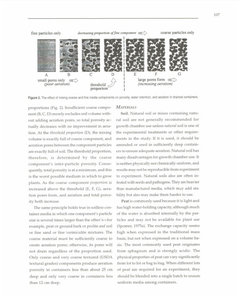
    When materials of widely divergent size are combined to make a grow medium, there is a point at which the mixture will have exactly enough fine material to fill all air spaces between the chunky material. The term used to describe this ratio or proportion is 'the threshold proportion', and it is the most difficult combination of contrasting (in size) materials to grow in. In order to best take best advantage of the blessings to be had from using highly aerated and fast draining media, it is essential that the fraction of coarse material in the mix is by far the largest fraction, which ensures there will not be enough fine material to fill all the air space between the large particles. Usually, this threshold proportion is somewhere in the neighborhood of 80-85% material that won't fit through a 1/8" screen, with enough finer material to satisfy the grower's desire to extend the intervals between waterings.

    What I shared here is less true in very small containers like pill bottles or tiny pots, but becomes more apparent as pot volumes continue to increase beyond a pint or so.

    Fig 2 below provides good progressive visual evidence of how the 'threshold proportion' impacts aeration.


    Cathy - I'm not sure if you have interest in learning more about how important your choice of grow media is to your plant's ability to realize as much of their genetic potential as possible, but understanding how water behaves in container media is most likely the most important tool in a container grower's skillset.

    Al

  • 4 years ago
    last modified: 4 years ago

    Never mind. I moved my question to a more appropriate thread. But I learned something just by reading the comments in this one. Thanks.

  • 4 years ago

    Cathy, Good choice. I used to use the same with excellent results. Now I would not recommend this for other succulents but I find it works very well with my Sans.

    Al, good answer but for most of us I use what works. Just watch the water. They can handle dry but not moist except in hot summer time.

    Cathy Cokley Shilow z8 SC thanked Stush2049 Pitts. PA, zone 6
  • 4 years ago

    Thanks all. I'll see if I can mix a little perlite in it. I'll check first to see if its dried all the way first.

Sponsored