Software
Houzz Logo Print
mlee1976

Crawl Space Moisture

4 years ago

I live in South Carolina in a house built with a fairly low crawl space. We have redone our HVAC duct work and it (the 1st story duct work) does run through the crawl space. House was built in 1969. We have lived here 10 years, have a termite bond, and have used the same company for insect control throughout the 10 years. Today, our insect control contractor came by and said that the moisture reading under our home was elevated. He said that the wood underneath the house was damp and the only way we could fix this is to incapcilate the crawl space and add a dehumidifier to the tune of $9000. In a perfect world, I would do this. However, we have a child leaving for college and lots of other expenses. We just cant afford this. What are our options? No moisture or smell on the inside of the house. No chance we can swing an unexpected $9000.

Comments (18)

  • 4 years ago

    Have you thought about a second opinion, since you havent had this problem before?

  • 4 years ago

    Its never been a problem in the past. I smell a rat!

  • 4 years ago

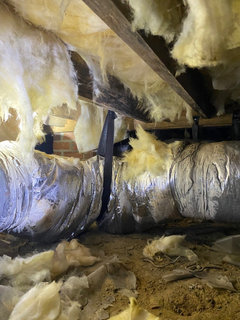
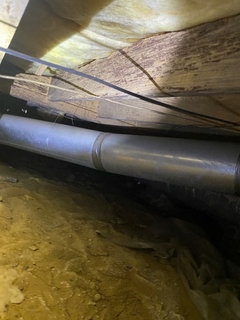
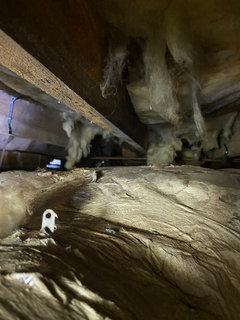
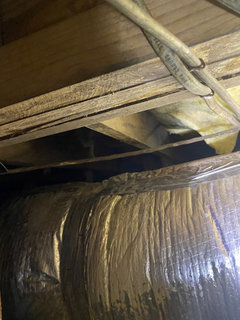
    He just sent me some pictures and I can see evidence of moisture. My house does not smell or feel damp. Our duct work has always been under the house (since the house was built). I cant deny that its hot and humid where we live. Ideally, he’s probably right- it would help. We just do not have the money to throw at this right now. Im wondering if there is anything else we could do. BTW- he said all of the homes in town have the same problem including brand new homes.

  • 4 years ago

    And when I mean “always been under there”- we replaced the duct work since we moved in but the prior work was there. We have not had any leaking pipes or considerable rain.

  • 4 years ago

    Im wondering who to seek a second opinion from since other companies probably sell this product/service too.

  • 4 years ago

    Also, he said the moisture was 25-30% but was at 20% in the past.

  • 4 years ago

    Place a dehumidifier down there.

  • PRO
    4 years ago
    last modified: 4 years ago

    Hi, mlee1976,

    Based on your description, you have a conventional, vented crawl space. If these are a good idea anywhere (and I don't think they are) it's certainly not in the humid American south.

    Moisture in a crawl space can be the product of a variety of sources including improper grading and improper management of storm water (which should be directed away from the foundation,) leaky pipes or ground water. Another source of moisture is moisture in outdoor air which enters the crawl space and condenses on surfaces at or below its dew point. If you check weather data for your area of SC, you'll probably find the dewpoint of outdoor air today was 70F +/- If the temperature of surfaces in your crawl space were lower than that (any exposed air conditioning duct work would likely be around 50F and wood surfaces would likely be lower than 70 F) condensation can occur.

    Wood has the ability to adsorb and desorb moisture. The moisture content of wood in your crawl space is a function of both outdoor conditions and crawl space conditions so the moisture content will vary both seasonally and from day to day. The pest management tech could very well have measured 20% moisture content in the past and 25% moisture content today. He's not inventing your problem, but the prescription is likely to be overkill.

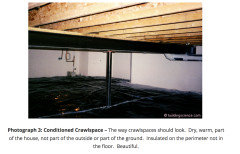
    The key to converting your crawl space to a conditioned crawl space is to stop outdoor air from entering the space and installing an appropriate soil vapor retarder like 10 mil polyethylene sheeting. You don't need the 50 mil reinforced vinyl liner they are likely to prescribe unless you expect elephants to regularly traverse your crawl space (yeah, they'd need to be really, really short--er--make that vertically-challenged elephants.) I like to spray the rim joist with 1 1/2" of urethane spray foam insulation and block the foundation vents with a combination of rigid and spray foam. I also like to introduce a continuous, low flow of air from the living space. The code specifies 1 cfm/50 sq. ft. of crawl space area. If you do that, I don't think you'll need a dehumidifier and junior can still go to college.

  • 4 years ago

    Thank you very much. This is great information.

  • 4 years ago

    My house is fairly old and crawl spaces must have been “the thing” when my house was built. All of my neighbors have them too. You dont see any basements in my neck of the woods and houses built on slabs seem to be below a certain price point. You do see some houses built up with open parking underneath (like typical beach houses)- this is more expensive buy perhaps a better idea than a crawl space.

    For those of you that suggested a dehumidifier- can anyone suggest a brand? I mentioned this to my insect contractor and he said it wouldnt work because the dust and dirt would clog abd break the machine (Im really starting to doubt his advice anyway).

    I would like to redo the plastic sheeting down there and add a dehumidifier. Any ideas on cost range of this? We have a 2 story, 4500 square foot home.

    Im reading mixed information about whether to open the crawl space vents. Can someone comment on this?

  • 4 years ago

    These are the pictures he took of the wood under the house.

  • 4 years ago

    He is convinced that the moisture is a combination of the duct work and humid weather.

    I dont want mold or hardwood floors that cave in. Ideally, I would do what they are suggesting. We just cannot do it right now.

    I guess what Im looking for is a cheaper alternative and advice on how bad it is not to do something now. We do not plan to sell this house anytime in the next 10 years.

  • PRO
    4 years ago

    @mlee1976,

    I included a less-expensive prescription for converting your crawl space to a conditioned crawl in my post above. You won't need a dehumidifier, and you don't need an expensive vinyl liner, but you will need to seal up the crawl space and provide a continuous supply of conditioned air.

  • 4 years ago

    Oh ok! I need to re-read this. Do I need to hire a contractor to do this? How do you “introduce a continuous low flow of air from the living space”?

  • 4 years ago

    Also, the wood can “deabsorb” moisture (from your comment) so as soon as we fix the issue, nothing will need to be done to the wood, right?

  • 4 years ago

    Condition the crawl, as described above.


    Here's the long version from Building Science Corp. BTW, get rid of the fluffy stuff.


    If you can do some of the work yourself--not claustrophobic or subject to vertigo--a big savings.

  • 4 years ago

    I've used stego wrap and their entire product line is great - if you can do it yourself - you'd save tons and not have to worry.