Software
Houzz Logo Print
colleen_ogrady87

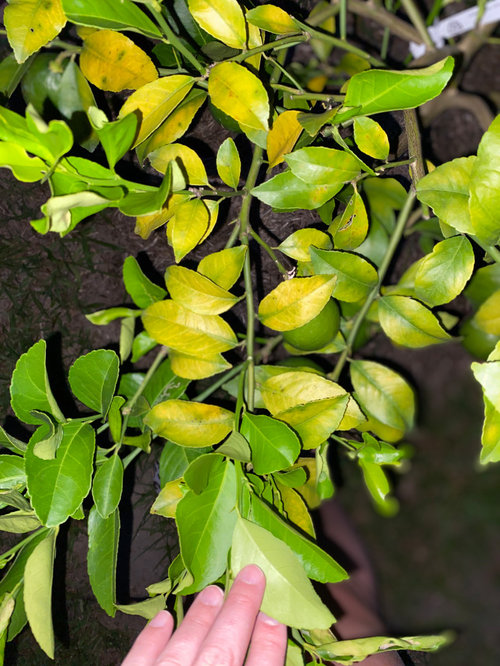
What’s wrong with my lemon tree?!

3 years ago


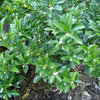
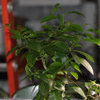
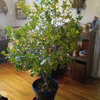
I got this Meyer Lemon when I was pregnant with my baby… she’s now 3 months and the plant is turning yellow! There are tons of lemons… i thought it may be under fertilized. i then used Miracle Grow citrus fertilizer and it hasnt seemed to help. I’m in central Florida, close to the river and beach. Could i have some sun scorching? am i using the wrong fertilizer? SOS

Comments (17)

  • 3 years ago
    last modified: 3 years ago

    The yellowing leave will probably not regreen much. The idea is to keep new leaves from fading. Miracle Gro lacks calcium. Is this tree in a pot. Is your new born baby turning yellow

  • 3 years ago

    Thanks! Any idea why they are turning yellow though?

  • 3 years ago

    My meyer lemon leaves started turning yellow about a month after I bought it. The yellow pattern was very similar to yours. I fixed it by doubling the amount of liquid fertilizer in each watering. I water it every day due to the high drainage of the 5-1-1 soil mix.


    I use Dyna-Gro Foiliage-Pro liquid fertilzer. I was using the lower feeding recommendation on the bottle and switched to the higher feeding one. The leaves stopped turning yellow immediately.


    Is the tree in a container? How often do you water it? The yellow could also be from under or overwatering but I think you’d see more droopy leaves if that was the case.


    Colleen thanked Jeff
  • 3 years ago

     Could be a nutrient  deficiencies

  • 3 years ago

    Thanks Jeff! i will try that fertilizer!!

  • 3 years ago

    You’re welcome. Start with a low feeding in case your tree is getting some nutrients from the citrus fertilzer you already added. If the leaves are still turning yellow after a couple of weeks, try increasing the feeding amount. If there’s still no results after a month, the issue might be the amount of water the tree is receiving.

    Colleen thanked Jeff
  • 3 years ago

    Hi Colleen, A lot of people in Central Florida who work in landscape and the citrus industry also moonlight at the garden centers at box stores. They are a treasure trove of advice that is specific to Florida. There is a good full-service garden center in Naples Florida called Golden Gate Nursery. The University of Florida has some very good publications. Anyone growing citrus in Florida should subscribe to the citrus industry news which has the latest and best practices for growing citrus in Florida. https://citrusindustry.net I can't tell from the photograph but being Central Florida this is highly likely in-ground (?) and you are likely to get a thundershower every day. Make sure it was planted at the right depth, back-filled properly and the soil is draining. To choose a fertilizer it would help to do a soil analysis. The fertilizers in Florida are specific to correct soil deficiencies and achieve correct PH. Citrus always requires foliage fertilizer spray like Southern AG as well to achieve its full potential. For Florida, Citrus Gain is a good in-ground fertilizer as a starting point. Big issues in Florida are poor soil, poor drainage, insects, and disease. Always a good idea to vet advice by looking at what the author grows in their idea book.

  • 3 years ago

    Could be a nutishtion problem

  • 3 years ago

    Instead, water correctly and use an appropriate fertilizer regularly - maybe every 3rd of 4th time you water in summer, and every 4th or 5th time you water in winter.


    @tapla (mid-Michigan, USDA z5b-6a), you think it's even better to fertilize with each watering using low doses, right?

  • 3 years ago

    Fertilizing at every watering session is a viable option if one is watering correctly/ flushing the soil each time a planting is watered, and I imagine it's slightly superior to fertilizing at longer intervals. I utilize that option on the 100 or so plants I maintain over winter under lights and controlled humidity. I put the 9-3-6 fertilizer in an empty contact lens solution container and use it to fill a 1/4 tsp measuring spoon which goes into a gallon of water - takes seconds. I've had no plants show any indication of rebellion, using that method. In summer, the number of temperate plants I care for doubles the total to about 200. I'm not willing to water that many plants every day or so with a watering can, so I try to fertilize weekly when temperatures allow at about 3 tsp/gallon. I've had no adverse reactions using either method, even though when I water weekly the solution strength is 3X the recommended production rate. I'm sure it's because the lion's share of my plants are bonsai, so the combination of the small volume of grow medium they are in and the very porous nature of the medium I use, they require watering daily, every other day, or every 3rd day depending on the plant and weather conditions.

    Al

  • 3 years ago

    @tapla (mid-Michigan, USDA z5b-6a), what do you mean when you write "when temperatures allow"?

  • 3 years ago

    I stop fertilizing when temps rise above 80-85*. High temps make roots and the above ground parts of plants very lethargic when they need water most. How readily water moves into cells depends on the level of solutes within the cell. The higher the level of solutes in the cell, the easier it is for water to pass through the semi-permeable cell membrane and into the cell. Conversely, the lower the level of solutes in the soil solution (free water in soil), the easier the cell solution passes the membrane into the cell.

    For a high % of terrestrial plants other than cacti, root function begins to drop off at root/soil temps of about 80*. If the pot is shaded, root/soil temps usually lag ambient air temps by 10-15*F due to evaporative cooling, so as long as the soil is moist, air temps in shade would need to be in the mid 90s before there was a serious issue with root function. In full sun pounding the pots, soil temps can be much higher - at least 15* higher than ambient air temps in most cases, though that varies too with soil moisture levels and air movement.

    High root temps are a stealthy attacker. Most often, you won't even realize the damage done to roots (especially trees) on the sunny side of the pot until late fall or even early spring when branches on what was the sunny side of the tree start dying and root rot becomes an issue to deal with. So to be safe, I stop fertilizing at 80*F which facilitates water uptake and movement in the plant. That is also why I try to use controlled release fertilizers sparingly. Their release rate is driven primarily by temperature, so when temperatures reach the point where you want to pull back on the level of salts in the soil solution, controlled release fertilizers will have rendered the grower with no control other than trying to scrape the fertilizer prills off of the top of the soil. I like and feel as though I need the control over nutrition offered by synthetics like Foliage-Pro 9-3-6 in order to achieve the best results. I do use Osmocote-Plus sparingly for younger plants which need to develop more mass before they are started along the path to becoming a bonsai, but not on the trees which are in the stage where I have started developing finer branching and am reducing leaf size. That and beyond is when control is most important. For other hobby growers not saddled with the concerns that come with bonsai, it's simply trying to make it easier for the plant to get water when it needs it most.

    Al

  • 3 years ago
    last modified: 3 years ago

    @tapla (mid-Michigan, USDA z5b-6a), thanks for the explanations. Indeed, I had already read that you shouldn't fertilize in the summer. I have two other questions. 1. What you wrote also applies to potted ficus benjamin (I'm not talking about bonsai) even if they are tropical plants? 2. Temperatures here in southern Italy are above 80-85 F (26-29 C) from early May to late September: isn't that too many 4 months without fertilizer?

  • 3 years ago

    Remember that when the pot is shaded, the root/soil temp will lag ambient air temps by at least 10-15*F, so long as you keep the soil moist to take advantage of evaporative cooling. I follow that guideline for all my tropicals and subtropicals as well.

    Al

  • 3 years ago

    Interesting article on Central Florida Citrus industry. https://www.orlandomagazine.com/once-upon-a-time-when-citrus-was-king/

  • 3 years ago

      I'm no expert  maybe change the soil soil in the flower pot  and then watch the amount of  fertilizer and watch the strength of fertilizer   this could make a  difference and make sure it's not a fungus hitting the leaves  it looks like a fungus to  me  not  fertilizer burn maybe sunburned from too much sun  or to low of fertilizer strength  but I'm no expert like many on this forum Are


    HOWARD