Software
Houzz Logo Print
abby_nelson83

Fiddle leaf fig problems!

3 years ago
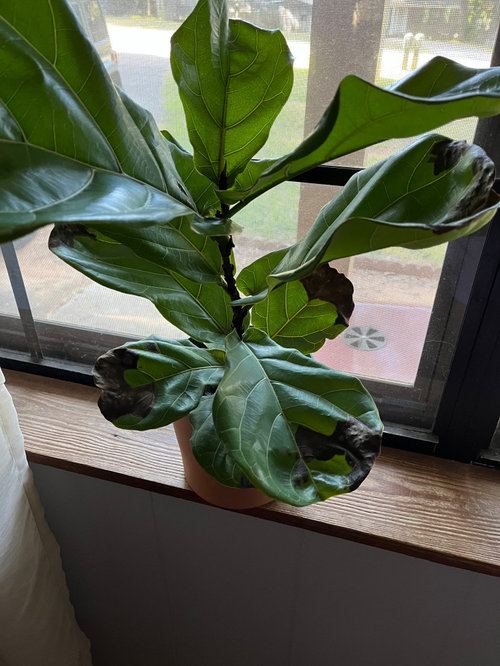
Hi! I bought this fiddle leaf fig just about a month ago. i have noticed some of theleaves have started to brown at the edges! its still in the original nursery pot. i only have two, well three,options when it comes to light. 1. north facing window 2. south facing window but theres an air vent right by it and 3. i have a grow light for my other house plants in the north facing window. when i put it under the grow light thats when i noticed the browning. so i removed it from that spot a couple days ago thinking the grow light was burning the leaves. but i havent seen any decline in the browning. i have watered once from the top and once via bottom watering. what am i doing wrong?! any advice greatly appreciated!!!


Comment (1)

  • 3 years ago
    last modified: 3 years ago

    Hi, Abby - Since the damage is on older leaves, the plant was probably chronically over-watered at its POS (point of sale) location. You can limit further concerns to any spoilage of foliage that grew after you acquired the plant. Had the plant been severely under-watered, it would have shed it's older leaves.

    It wants very bright light. It would really appreciate being outdoors for some full sum mornings and evenings, and spending days in dappled or open shade. Be sure to acclimate the plant to a brighter spot so you minimize the risk of sunburn on the foliage.

    How you water is a key element in keeping the plant's level of vitality high. This link to An Overview of Good Growing Practices should be helpful. So should this link to something I wrote about Long Term Care of Ficus in Containers.

    For best results, you should be fertilizing regularly. If you're watering correctly (explained in the links) you should be fertilizing every 3rd or 4th time you water in summer, and about every 5th or 6th time you water in winter months. I have about 45 Ficus and I use Foliage-Pro 9-3-6. It is an excellent fertilizer and makes a good 'go to' choice for almost anything you might grow in containers.


    It provides complete nutrition from a single source, and puts control in the growers hands.

    Be sure to read about watering (in the links) as it IS critical to maintaining a high level of vitality. I'll end for now with something about using a "tell" to determine appropriate watering intervals.

    Using a 'tell'

    Over-watering saps vitality and is one of the most common plant assassins, so learning to avoid it is worth the small effort. Plants make and store their own energy source – photosynthate - (sugar/glucose). Functioning roots need energy to drive their metabolic processes, and in order to get it, they use oxygen to burn (oxidize) their food. From this, we can see that terrestrial plants need plenty of air (oxygen) in the soil to drive root function. Many off-the-shelf soils hold too much water and not enough air to support the kind of root health most growers would like to see; and, a healthy root system is a prerequisite to a healthy plant.

    Watering in small sips leads to avoid over-watering leads to a residual build-up of dissolved solids (salts) in the soil from tapwater and fertilizer solutions, which limits a plant's ability to absorb water – so watering in sips simply moves us to the other horn of a dilemma. It creates another problem that requires resolution. Better, would be to simply adopt a soil that drains well enough to allow watering to beyond the saturation point, so we're flushing the soil of accumulating dissolved solids whenever we water; this, w/o the plant being forced to pay a tax in the form of reduced vitality, due to prolong periods of soil saturation. Sometimes, though, that's not a course we can immediately steer, which makes controlling how often we water a very important factor.

    In many cases, we can judge whether or not a planting needs watering by hefting the pot. This is especially true if the pot is made from light material, like plastic, but doesn't work (as) well when the pot is made from heavier material, like clay, or when the size/weight of the pot precludes grabbing it with one hand to judge its weight and gauge the need for water.

    Fingers stuck an inch or two into the soil work ok for shallow pots, but not for deep pots. Deep pots might have 3 or more inches of soil that feels totally dry, while the lower several inches of the soil is 100% saturated. Obviously, the lack of oxygen in the root zone situation can wreak havoc with root health and cause the loss of a very notable measure of your plant's potential. Inexpensive watering meters don't even measure moisture levels, they measure electrical conductivity. Clean the tip and insert it into a cup of distilled water and witness the fact it reads 'DRY'.

    One of the most reliable methods of checking a planting's need for water is using a 'tell'. You can use a bamboo skewer in a pinch, but a wooden dowel rod of about 5/16” (75-85mm) would work better. They usually come 48” (120cm) long and can usually be cut in half and serve as a pair. Sharpen all 4 ends in a pencil sharpener and slightly blunt the tip so it's about the diameter of the head on a straight pin. Push the wooden tell deep into the soil. Don't worry, it won't harm the root system. If the plant is quite root-bound, you might need to try several places until you find one where you can push it all the way to the pot's bottom. Leave it a few seconds, then withdraw it and inspect the tip for moisture. For most plantings, withhold water until the tell comes out dry or nearly so. If you see signs of wilting, adjust the interval between waterings so drought stress isn't a recurring issue.

    Al

Sponsored
HomeCraft Remodeling
Average rating: 5 out of 5 stars5 Reviews
Custom Craftsmanship & Build Solutions in Franklin County, Ohio