Software
Houzz Logo Print
kery12000

Arborvitae trees (Thuja) have a problem. What should I do?

4 years ago

The Summer has been very dry. For the first part of the Summer, I was watering the Thuja trees almost daily. But it became so hot, the watering schedule broke down. Perhaps for July the Thujas were being watered once a week. Then there was a big rainstorm. A week later I noticed some changes in the trees. The leaves are very dry. Some are yellowing, others are green but very dry and practically breaking off. Some branches turned grey with the leaves completely gone or the leaves very fragile. My one healthy Thuja tree is bright green. The leaves aren't wet, but they certainly aren't dry and breaking off on that tree. If there is anyone who has some experience and knowledge about arborvitae trees, let me know. If you respond, I will send some pictures to assist you coming to an assessment in the problem and a possible solution. What I have done now is I pulled out any weeds near the base of the trees. I pruned the low branches and shook out dead needles or cut very sickly/weak branches and leaves. I raked the material away ffrom the base, and will daily prune any brown leaves. I have watered them, but now I will wait 3 or 4 days, or perhaps one week to water again, depending on how dry the soil is at the base of the tree.


Comments (9)

  • 4 years ago

    post the picture in a reply here ...


    there is no reason a fully established mature arb.. would need to be watered .. ever ... i dont understand why yours were needing that much water ....


    if they are recent transplant.. you left that put ...


    and in the meantime.. stop cutting off parts of the tree ..


    they are trees.. they are conifers ... treat them as such ...


    and dont get me wrong.. something must be going on.. im just not sure its the water issue you think it is ...


    now get your pix posted here.. i dont give out my email in the forums.. sorta defeats the purpose of having a group of peeps to answer questions... eh???


    ken

  • 4 years ago

    ANY tree can require irrigation if in an extended period of heat and no rainfall. Arborvitaes are no exception, as they are rather intolerant to drought and have a common name of "swamp cedar", indicating their preference for growing in damp or at least consistently moist locations.

    We need more information from you in order to help:

    • photos
    • geographic location
    • when the arbs were planted
  • 4 years ago

    Unless they're growing in a pot, they shouldn't be watered every day. If it doesn't rain, they should get 1 deep watering a week at most.

  • 4 years ago


  • 4 years ago

    Thanks everyone for your answers. Here are some pictures. These trees were planted about a year ago, I think in Sept.. They were already about 115 cm tall (4 feet) and now about 2 metres tall (6 ft). Generally, I was really pleased with their condition and growth until this late Summer (July, August). Normally, I did not water daily (for winter and Spring I didn't water at all even until about June), but this part of Europe (Hungary) has had little rain all Summer, and the drought is expected to go on until November. The Laurel bushes and rose bushes were wilting in the heat, and the grass was basically unsaveable. The Thujas didn't seem to grow at all. So, yes, at that point I did water almost every day in June and July. The Laurel bushes signigicantly increased in growth, and the rose bushes as well. The Tuthja trees did better as well, very lush and green.


    But even so, I like a lot of other people, couldn't keep up with the watering due to the heat (I just have a garden hose), so between July 15, and August 20th, watering was intermittant. Still, the Thujas looked fine until about two weeks ago when we finally had a large rain.. The heat continued, and is still continuing. One other factor is that I had used a weedeater (string trimmer) near the Thuja trees about once a week for the last two or three weeks which may (or may not be a factor) in what happened.


    One of the Thuja trees is perfectly healthy. It is planted just 1 metre away from the other sickly ones. (the Thujas are planted together about a metre or a little more from each other). The healthy Thuja had the same watering, and lack of, as the others ones. I know grapevines are not anything similar to a Thuja tree, but I found they did a lot better when their base was dry and kept free of too much moisture and particularly free of weeds that might get a fungus/mold that would spread to the vines. In the case of the Thuja trees, I had left the grass cuttings/weed cuttings on the ground near the area. The hot summer made it difficult to stay out too long and the Thujas seemed to be doing fine. I think the grass and weed cuttings may have conttibuted to a fungus. However, I don't really know.


    Currently, I have raked out the debris from their bases, and removed weeds. Drought conditions are still here, with regularly hot days (it was over 30 degrees centigrade daily, and even 40 or more in July). Now it is 28, and daily cooling down, but the heat feels hotter than that, and it is easy even now to get sunburned. Earlier I removed the dead branches, and the brown needles. The surgery was significant on two of them, and maybe I took too much off of them. But believe me, the negative change with the Thuja trees was very quick. I left them alone for a few days (before cutting anything), but their condition seemed to be rapidly worsening. In the case that removing dead/diseased branches is the wrong approach, I have stopped that. But what I left was the green, or greenish branches so there is no percieved need to do that at this time. My watering regimen (due to the drought) is to give each tree a bucket of water at its base every 3 or 4 days, only if the ground at the base of it is dry.


    At this time, one Thuja is inexplicably very healthy and lush. A second one is medium healthy with significant lush parts. Two were really in bad shape. At this time, all seem stable, with the worst off seemingly not getting worse. They are not turning brown, not turning more yellow. I hope nature, and rain, will cure them.


    One more thing is that most people here have Arborvitae trees. Two of the neighbors have some of these trees that are two or three times taller than mine (been there longer or a different type). The neighbor behind my home (40 metres from my trees) has 7 Arborvitae trees. Of the 7, three have serious levels of brown/diseased branches with one the entire top 30% of the tree is brown. The other neighbor (30 metres away) has 17 of these trees with 6 or 7 of them very brown (some completely) and two or three of these may be completely dead as all the needles have fallen off and there are just bare branches.


    I am providing some pictures of my trees and will gladly listen to any constructive thoughts. Thanks for your time and your help!


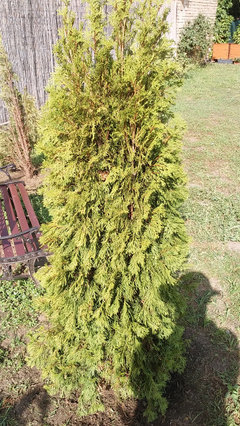
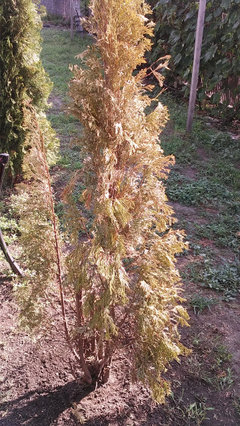
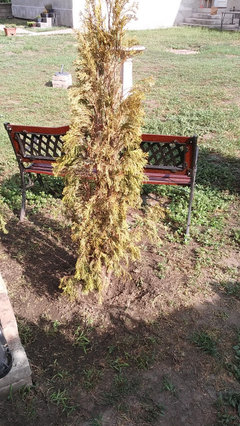
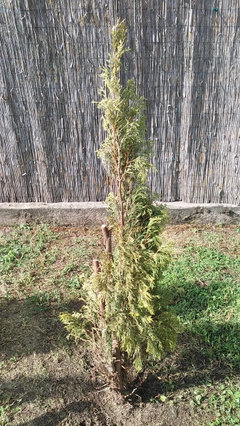
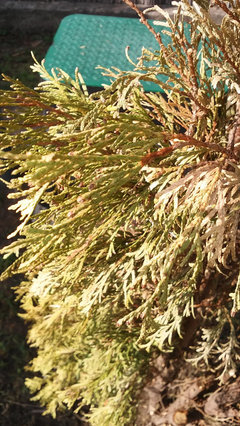
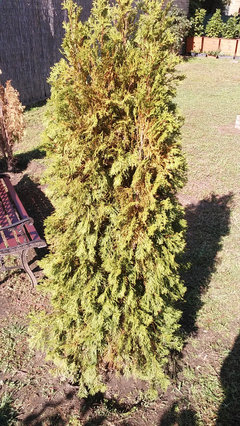
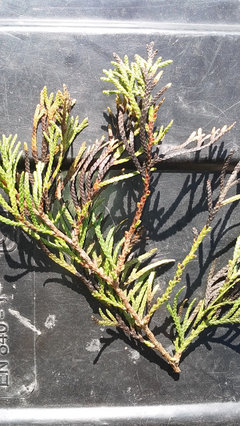
    The first picture is the healthy Thuja of the four. The second and third pictures are the sickest one. The fourth picture is the other sick Thuja. (A third Thuja is somewhat sick, but I have shown you the two worst). And the last picture shows a closeup of the needles. Some of what I cut out was bare branches or very brown or weak needles that were just falling out. A lot of the needles and smaller branches were so dry that they would fall out at the touch. The healthy Thuja is completely unlike that, with lush needles.


  • 4 years ago

    Maybe the water isn't soaking into the ground and is just running off. For the ones that are really dry, I suggest digging into the ground and see if the soil is dry. If it is, dig a little hole near the base and put the water in there. Like a little pond. The water won't be able to run off. It has no choice but to seep into the ground.

    kery12000 thanked charles kidder
  • 4 years ago

    kidhorn2 thanks for the idea about making a kind of basin near the base. I did that when I first planted them about a year ago, and I think it has worked well until this serious drought. However, what you (and ken_adrian) have said, has made me think that perhaps the dirt near the base has become more compacted than usual, possibly due to the drought. In another part of the garden the ground was so baked it cracked.


    With that in mind, I will break up the dirt at the base and around the roots (to some significant depth) carefully to help make sure that water can get to the roots successfully.


    Thanks ken_adrian for your answer as well. I will try your experiment and hope for the best. There are 4 Thujas. One is in nearly perfect condition. A second has some damage but is still pretty green. These first two I am fairly confident about.


    The other two have significant damage as you know. Fortunately, we had a 5-6 hour slow drizzle rain that started in the night and continued until even about an hour ago. So, I'm going out there now to try some of these ideas.


    I am optimistic, but as I said the last two are kind of iffy. Let's keep our fingers crossed. I will probably post again here in a few weeks to let you know what happened. Thanks again.

  • 4 years ago

    Hey Guys,,


    Here is an update. There are 4 Thuja trees. Three are pretty brown, as you know, but one was in almost perfect condition. Bright green and the leaves seemed lush. But this one has had a recent change.


    We have had regular rain since we last spoke, two, or even three times a week, good long rains. Not just a sprinkle. Because of that fact, I stopped watering the Thujas. Also the temperature has dropped and is now 62 fahrenheit in the day to 40 at night.


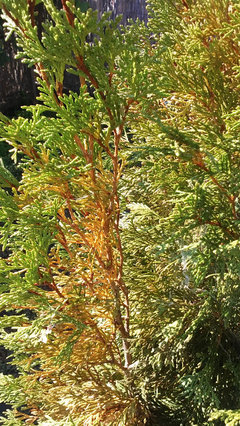
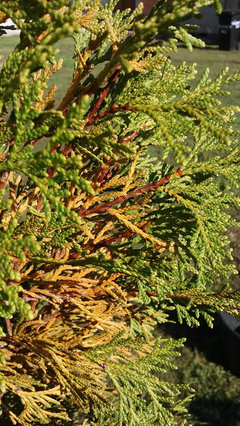
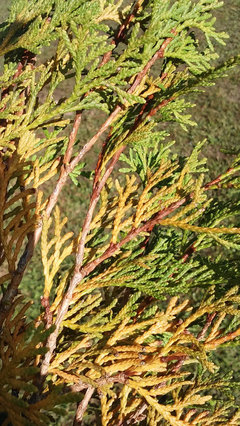
    Because of what happened to the others I was weary of cutting out brown leaves or any other leaves on the seemingly healthy Thuja. And as I said, basically, it was so healthy there wasn't much of anything to cut it I had wanted to. So, about five days ago or maybe a week ago, I saw some brownish or yellow colour leaves on it. Not everywhere but in a few places. It seems to have increased, this yellowing. So, I did an inspection of the tree and took some pictures. Please look at the pictures. What do yout think these colours mean and should I do anything about it? Thanks!


    Picture 55, the whole tree

    07 Near the bottom of the tree, and only there, I found some (not many) black leaves.

    52 yellow leaves

    27 and 50, closeups of the yellow leaves