Software
Houzz Logo Print
sky_hem

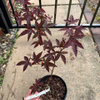
How can i revive this olive tree?

4 years ago
last modified: 4 years ago

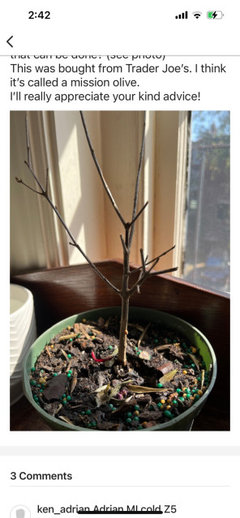
I was out sick for three days and when I returned home all the leaves had dried out.

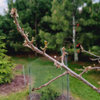
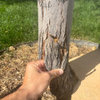
Is the tree still alive and is there anything that can be done? (see photo)

This was bought from Trader Joe’s. I think it’s called a mission olive.

I’ll really appreciate your kind advice!


Comments (17)

  • 4 years ago

    did you forget to post the pic.. we cant do much without one.. or two..


    you should be able to walk away from a tree for a month or two.. 3 days shouldnt have mattered .. but give us more facts also.. was it outside in sun?? .. in a small pot. etc ..


    ken

  • 4 years ago

    For trees in containers, it's unrealistic to think one could ignore a tree for a month or two and expect it to remain viable. 3 days dry is enough to kill many containerized trees as 'dry in a container' is much more serious (in most cases) that going through a period of drought in situ.

    It's unclear whether it had been 3 days since the last watering, or if you returned home to find that someone else had neglected the tree for weeks or months.

    Olive trees can enter a consequential dormant period if the soil they grow in becomes too dry. This is a survival mechanism trees use to conserve enough water to ensure viability. If the tree was dry for only a few days, and was reasonably healthy before the leaf loss, odds highly favor a recovery. If the plant was struggling and low on energy reserves when it went dry, it might not have enough stored energy to push a new flush of foliage.

    You'll need to wait and see. Watch for new buds to appear immediately distal to (above) where the now dead leaves are/were attached. Be very careful not to over-water. Your tree's water uptake will have slowed significantly due to the loss of it's foliage. I suggest you use a "tell" to "tell" you when it's time to water.

    Using a 'tell'

    Over-watering saps vitality and is one of the most common plant assassins, so learning to avoid it is worth the small effort. Plants make and store their own energy source – photosynthate - (sugar/glucose). Functioning roots need energy to drive their metabolic processes, and in order to get it, they use oxygen to burn (oxidize) their food. From this, we can see that terrestrial plants need plenty of air (oxygen) in the soil to drive root function. Many off-the-shelf soils hold too much water and not enough air to support the kind of root health most growers would like to see; and, a healthy root system is a prerequisite to a healthy plant.

    Watering in small sips leads to avoid over-watering leads to a residual build-up of dissolved solids (salts) in the soil from tapwater and fertilizer solutions, which limits a plant's ability to absorb water – so watering in sips simply moves us to the other horn of a dilemma. It creates another problem that requires resolution. Better, would be to simply adopt a soil that drains well enough to allow watering to beyond the saturation point, so we're flushing the soil of accumulating dissolved solids whenever we water; this, w/o the plant being forced to pay a tax in the form of reduced vitality, due to prolong periods of soil saturation. Sometimes, though, that's not a course we can immediately steer, which makes controlling how often we water a very important factor.

    In many cases, we can judge whether or not a planting needs watering by hefting the pot. This is especially true if the pot is made from light material, like plastic, but doesn't work (as) well when the pot is made from heavier material, like clay, or when the size/weight of the pot precludes grabbing it with one hand to judge its weight and gauge the need for water.

    Fingers stuck an inch or two into the soil work ok for shallow pots, but not for deep pots. Deep pots might have 3 or more inches of soil that feels totally dry, while the lower several inches of the soil is 100% saturated. Obviously, the lack of oxygen in the root zone situation can wreak havoc with root health and cause the loss of a very notable measure of your plant's potential. Inexpensive watering meters don't even measure moisture levels, they measure electrical conductivity. Clean the tip and insert it into a cup of distilled water and witness the fact it reads 'DRY'.

    One of the most reliable methods of checking a planting's need for water is using a 'tell'. You can use a bamboo skewer in a pinch, but a wooden dowel rod of about 5/16” (75-85mm) would work better. They usually come 48” (120cm) long and can usually be cut in half and serve as a pair. Sharpen all 4 ends in a pencil sharpener and slightly blunt the tip so it's about the diameter of the head on a straight pin. Push the wooden tell deep into the soil. Don't worry, it won't harm the root system. If the plant is quite root-bound, you might need to try several places until you find one where you can push it all the way to the pot's bottom. Leave it a few seconds, then withdraw it and inspect the tip for moisture. For most plantings, withhold water until the tell comes out dry or nearly so. If you see signs of wilting, adjust the interval between waterings so drought stress isn't a recurring issue.

    Al

  • 4 years ago

    I’m not sure why the photo didn’t show up. Could you see it here?

  • 4 years ago

    Thank you for all this information. Yes it was neglected for 3 days under filtered light at a window facing east. I’ll keep watering and wait and see…

  • 4 years ago

    As I noted - be careful not to over-water. Using a "tell" to indicate when it actually needs water is a very good idea. You cannot rely on sticking a finger into the soil as an indicator as it will almost certainly lead to over-watering. Best place for your tree is outdoors in full sun.

    ..... wishing you the very best of luck.


    Al

  • 4 years ago

    “Best place for your tree is outdoors in full sun.”


    Absolutely. Olives do not make good houseplants. I suspect it might not have been happy even before you went away. You refer to filtered light. Olives need full sun and fresh air. If you live somewhere with very cold winters, at least keep it outside as long as possible before bringing it indoors. When it has to come in give it the brightest spot you can, in a relatively cool room, preferably without dry air.

  • 4 years ago

    I also bought an olive tree in Trader Joe a few weeks ago. i knew it would be a hard plant to keep indoors, but could not resist. The plant looked so healthy. I have put it at the south window. Hopefully it will be all right

  • 4 years ago

    I have two olive plants that stay outdoors in full Sun during Summer. During winter here I do bring them indoors under lights in an enclosed patio that does not have any additional heat. So it stays cool most of the winter. Admittedly they do not much like being indoors but they hang on. In Fall I let them be outdoors till it is about consistently hitting 40F but not freezing. The first opportunity I get to get them outdoors I situate them there even if it is cold but not freezing.

  • 4 years ago

    A small point. Olives can stand a short freeze. Many are grown outdoors here and do withstand freezing temps for short periods in winter. So it’s unlikely to be a disaster if they’re briefly left out below 40.

  • 4 years ago

    Yes olives can stand short freeze but since mine is in a small pot I am more concerned about roots freezing. I just try to extend the period it stays outside as much as possible.

  • 4 years ago

    Should the tell method be used for plants in the ground? Thank you.

  • 4 years ago
    last modified: 4 years ago

    Organized testing of a variety of kinds of decorative trees and shrubs used outdoors in cold winter climates once showed an across the board tendency for plants in pots to be damaged by temperatures about 20 degrees F. above those which would affect the same kinds growing in the ground. So if a given olive plant would be hardy to say, 15 when established in the ground a potted example of same should not be subjected to anything below 35. Otherwise when any kind of plant is summering outside and destined to be returned to an ordinary heated interior kept from dropping below the 50s or more it should go back inside when outdoor temperatures are still in a similar range. In order to avoid it experiencing a sudden dramatic temperature change.

  • 4 years ago

    There are a couple of points I would address there. The twenty degree figure I am sure refers to a period of time, not a single episode. And when the olive is taken inside it should preferably not be into an ’ordinary heated interior’. An unheated or cool room would be better. Somewhere like a glazed porch. I keep my houseplants outside until an actual frost is forecast. ie 32f. Then they go into the porch. If I brought them inside at 50 they'd get about two months less outside than they do currently.

  • 4 years ago

    Btw hu many numbers. You could use a tell outdoors but its much less likely you’ll over or under water outside.

  • 4 years ago
    last modified: 4 years ago

    Cold damage to plants occurs within a few hours. The fact that Floral is putting their left-out-late plants into an intermediate area before they come into the fully heated living space is a key point. And does not change the fact that the much more likely and usual situation where house plants are either in the house or fully outdoors at any given time means any left out until there is a wide difference between indoor and outdoor temperatures will be subjected to effects of this differential when brought in. In addition to other associated issues like growth made outside not being adjusted to indoor light levels and any invertebrate guests coming inside with the plants bailing soon after detecting the change in circumstance. So that it has been argued that house plants are really best remaining in the house throughout the year.

  • 4 years ago

    That's a brush too broad in several ways. Whether a pot rests on the ground or is on a deck over winter can make a significant difference in whether or not the plant can maintain its viability; this due to the advantage of geothermal heat conduction through the bottom of the pot. If the pot is elevated above the grade surface, the root temperatures will eventually be equal to ambient air temperatures.

    Plants are no stranger to sudden temperature changes. It's not uncommon (in MI) for temperatures to change as much as 50* in a 24 hr period and suffer no ill effects; though, there is one outlying condition I could think of where a sudden decrease in temperature from warm to cooler can cause chill injury at temperatures as high as 50*F.

    Many plant species are said to have a "killing low temperature, which means the root system will die if temperatures reach a certain low. Japanese maples are said to have a killing low of 14*, but there are a number of secondary factors that can influence the degree of damage which can start when temps are in the mid to upper 20s. Roots don't die once a certain temperature is reached, and "killing low temperature" doesn't mean that any temperature above the "killing low" is ok. The young/tender roots that do all the plants heavy lifting are affected at temperatures much higher than the larger and more lignified (woody) roots. Then, as temperatures drop, larger and larger roots will be affected. If the temperatures are allowed to drop to near the published killing low temp, and, if the plant is still viable, it might start it's spring push much later than trees than it would if protected from near killing low temps. Essentially, if all the fine roots are killed by cold, the plant almost starts the new growth cycle as a cutting.

    Another broad rule of thumb is: Containerized plants are usually hardy in pots directly resting on soil and mulched in, to 1 zone lower/colder than that in which the plant's caregiver lives. If the plant is over-wintered outdoors and is not resting on the ground, it should remain viable if it's hardy to at least 2 zones colder than where its care giver lives. This too is a brush too broad and not carved in stone.

    Al

Sponsored
J.Holderby - Renovations
Average rating: 5 out of 5 stars4 Reviews
Franklin County's Leading General Contractors - 2X Best of Houzz!