Software
Houzz Logo Print
westmichiganflorafau

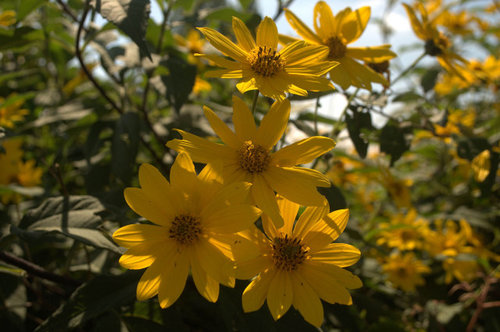
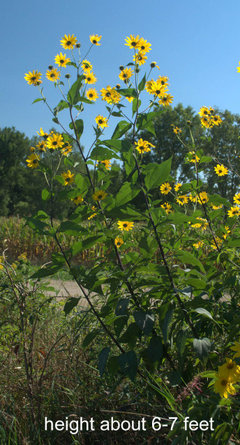
Is this Helianthus maximilliani?

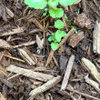
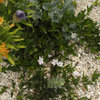
Is this Helianthus maximilliani? SW Michigan. edge of a cultivated field near the road, Sept.18, 2022.


Comments (13)

  • 3 years ago

    No. But can't tell you what..they're LOTS of sunflower species.

  • 3 years ago

    H maximilliani has much narrower leaves and blooms arranged up the length of the upper stems, not in clusters at the ends. Looks like H tuberosus to me but I don’t know much about sunflowers.

  • 3 years ago

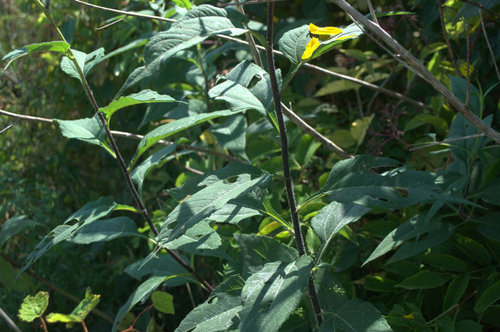
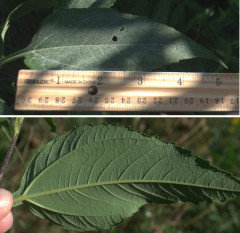
    You need to show the phyllaries on the other side of the flowers and close up of stems, and leaves, upper and lower surfaces.

  • 3 years ago
    last modified: 3 years ago

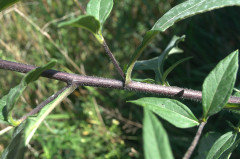
    The stem shot you submitted is sufficient, but I need to see the involucre/phyllaries to be certain what species it is. And run your fingers across both surfaces of the leaves to see if they are rough or smooth.

    I agree with floral that it looks like Helianthus tuberosus, but a look at the phyllaries would confirm it. Definitely not Helianthus maximiliani.

  • 3 years ago

    Floral, I'm thinking your Jerusalem Artichokes don't bloom because your climate is too mild? Any chance of yours blooming this year with the record breaking heat waves over there?

  • 3 years ago

    I don’t have them any more. I got rid of them because we didn’t eat many and they take up space. But they never flowered in all the years I had them whatever the weather.

  • 3 years ago

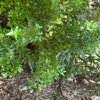
    It does not appear to be artichoke, no sign of a tuber. The upper leaf surface catches on your skin when you rub across it, the lower surface is smooth, except for the veins. As you may see there is some downy mildew forming. I included another photo of the entire plant to better show how the flower heads and leaves are arranged.


  • 3 years ago

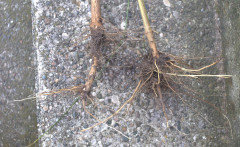
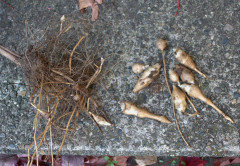
    I still don't see much of a "tuber" in my pix of the roots but then again I have only ever seen photos online which picture something much larger and more "potato-like". Thanks Jay 6a Chicago for the ID.

  • 3 years ago
    last modified: 3 years ago

    There are 7 different varieties,(human bred and selected cultivars, not taxonomic) of Jerusalem Artichoke and some are horticultural and others are for food. You have a horticultural variety that doesn't produce large tubers. I also have a horticultural variety and the roots on my plants look the same as yours. I do wonder if some tubers stayed in the ground when I pulled all of my plants out, because they are all growing back. As long as I keep pulling them they shouldn't spread any further. I also have them covered with a tarp.

    westmichiganflorafau thanked Jay 6a Chicago
  • 3 years ago

    I did some more investigation, prior to reading your comment, and found exactly what you are saying. Most often the "tubers" are not much more than just a thickening in the roots. A large tuber is regarded as about 10cm x 6cm dia. The roots can be up to 50" long and offshoots can emerge from each tuber so it is very likely that by just pulling up the plant that most, if not all, of the root structure remains in the ground. So unless you deliberately dig them up, the tubers will detach and remain in the ground.

  • 3 years ago


    I returned to the group of Jerusalem artichoke to try and get some roots/tubers to start some plants in my flower garden. This confirmed the fact that the tubers rarely form at the root ball at the base of the plant. As you can see in the pix, there are a few small tubers within the root ball I dug up today but all of the larger tubers were scattered away from the plant base, quite shallow, and very easily broke away from the roots because few had any sign of roots attached to them.

  • 3 years ago

    Jerusalem artichokes don't really start growing tubers until late in the season so it's not surprising you wouldn't find any a month ago when you created this post. Not widening out the search area around the base of the plants probably didn't help but they were likely just tiny nodules at that time anyway. Within the next month here in Michigan when the stalks have died down is when you'll find the tubers at their largest size. The tubers themselves won't have roots growing from them, at least not in the fall while they are forming, rather they will be attached to the root ends of the plants. And yes, they are easily broken off when digging for them or pulling plants.


    Rodney

0