Software
Houzz Logo Print
travisaz

Do you thin kumquat harvest?

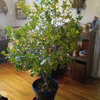
My meiwa kumquat looks to be keeping her first fruits. Many of them are clustered close together. I know it's common to thin stone fruit, is the same true for kumquat?

Comments (9)

  • 3 years ago

    no! It take 27 kumquats 1 inch diameter to have the same mass as 1 orange 3 inch diameter. If you thin kumquats you will have very little volume of fruit.

  • 3 years ago

    Thank you Steve! How are your grafted meiwas doing?

  • 3 years ago

     Maybe at first but sometimes it maybe nessacary to thin out  them to make  some of the branches  from crossing  each other a recipe for diseases and fungus

  • 3 years ago

    I think it depends on the perspective from which you view things. If your primary concern is the well-being of the plant (in a pot), you should thin. Fruit are powerful energy sinks and can use a lot of energy which can leave the plant vulnerable to insect herbivory and disease pathogens. The pecking order of a plants energy sinks in order of strength: Energy is first allocated to respiratory function, i.e. to maintenance of living tissues, then, to production of fine roots, followed by flower and seed/fruit production, then primary growth (extension of both roots and shoots), then secondary growth (thickening), and finally, the synthesis of defensive chemicals. When large fractions of energy are devoted to fruit, both primary and secondary growth are limited, and perhaps more important is the fact that defensive chemical synthesis can suffer.

    As a bonsai practitioner, I remove reproductive parts on all developing trees as soon as they appear, because of the amount of energy that could otherwise be directed toward growth and a higher level of stored energy for the spring push, which is probably when any issues will be made known.

    If your focus is on fruit production at any cost, observe carefully the results and compare to trees that have been thinned or only allowed to fruit in alternate years.

    Al

  • 3 years ago

    All my NZL trees flower so heavily and so long that the trees kill themselves in a half year. I let a set amount of fruit set and I pluck off all new flowers when they are smaller than a pin head so I get fruit as well as growth.

  • 3 years ago
    last modified: 3 years ago

    I have four kumquat trees (Meiwa, Nagami, Fukushu and Marumi) growing in 13 gallon air root pruning containers. .I've grown kumquats for over 10 years, and have never thinned the fruit load. What they set they set. I eat from the trees as I pass by throughout the season. The trees never have any any problem

  • 3 years ago

    Thank you everyone for the responses!

  • 3 years ago

     Thinking the fruit  may not be nessacary  but thining the branches  might be  for tree strength   and remove any crisscrossing branches  to cut down the risk for diseases and fungus growth 


    Howard

  • 3 years ago
    last modified: 3 years ago

    @Travis in PHX (9b) In case you wonder about the validity in thinning fruits or removing them altogether from developing trees:

    Reciprocal Relations between Vegetative and Reproductive Growth

    "The size of a fruit or seed crop typically is negatively correlated with the amount of vegetative growth. This is dramatically shown in some biennially bearing fruit trees, with vegetative growth suppressed during the fruiting year and sometimes in the subsequent year or even years. In bearing peach trees, vegetative growth was suppressed over a 3-year period. The size of an apple crop and cambial growth showed a negative linear correlation. A similar correlation was shown between crop yield and fruit growth of citrus trees. Root growth commonly is reduced more than shoot growth by fruiting. When the fruit growth is unusually large, root growth may be reduced so much that the tree eventually dies. In forest trees, vegetative growth is greatly reduced during good seed years." (Kozlowski and Pallardy, Physiology of Woody Plants). This confirms what I said above.


    Plant pathologists often describe the disease process using a 4-sided figure called the disease tetrahedron (think “pyramid – 3 sides + the bottom). Each side of the tetrahedron represents an essential part of the infection process - pathogen/ host/ environment/ time. There must be a virulent pathogen which is genetically capable of recognizing its host and capable of infecting the plant. Either the environment must be conducive to the development of the pathogen, or the pathogen must be able to stress/weaken the plant. The 4th requirement is the time required for diseases to develop and spread. Whenever conditions are such that any one (or more) of the 4 requirements is missing from the equation, there is no immediate threat.

    Crossing branches really don't do anything to promote disease unless they are rubbing on another branch and providing an entry point for pathogens at the interface where the branches make contact. Leaf and branch congestion do have an impact because they limit air movement within the canopy, which leads to foliage remaining wet longer after a rain or watering, which in turn increases the probability that fungal spores will germinate - wet leaves/ branches = longer incubation periods for spores of fungal pathogens.

    Although thinning and pruning branches is an important part of keeping trees healthy and maintaining their eye appeal, removal of living leaves and branches is always a limiting factor for continued vegetative growth and ontogenetic (see ontogenetic next paragraph) development. The reason is, each leaf is a mini factory in which the tree's true food (sugar - glucose) is made. Reducing the amount of food the tree is capable of making represents lost potential which can never be regained. I'm not saying the plant can't recover or return to the level of vitality it had before the leaves/branches were removed, just that the growth and development that would have occurred can never be regained, it's lost forever.

    Thinning and pruning is something of a balancing act. It can't be denied that removing living branches/ leaves slows growth and development. This is a major consideration when working with a seedling that has to go through all the growth stages before it becomes sexually mature. The more we prune a young tree, the longer it will take to flower and fruit, phases which are determined by the tree's ontogenetic age, not it's chronological age, which is how we measure age in humans/ animals. Ontogenetically, the newest growth to appear on a tree is the oldest, and to simplify, how old the 'new growth' is can be thought of in terms of how many cell divisions it took for this growth to occur.

    Al

    Travis in PHX (9b) thanked tapla (mid-Michigan, USDA z5b-6a)