Software
Houzz Logo Print
aron_fisher

Leaves on new tree look suspect

3 years ago
last modified: 3 years ago

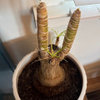
Yellow with black specs, just got this tree/plant a couple days ago. No drainage on the pot. Soil feels dry after a day. Temp in room up to 84.

Comments (11)

  • 3 years ago


  • 3 years ago
    last modified: 3 years ago

    Get it in a pot with drain holes. There is likely a soupy mess in the bottom. You may want to add the House Plants Forum as it is much more active.

    tj

  • 3 years ago

    Looks like a Plumeria. Do you live in a hot climate? If so it would be easier to grow outdoors. Inside it will need warmth, humidity and a lot of very bright light.

  • 3 years ago

    I agree with what Tsugajunkie said, but, you can use the same pot, just remove the collection saucer and heat up the head of a large nail or bolt and melt a hole through the bottom of the pot where it transitions to the sidewall, or through the sidewall where it transitions to the bottom. Having the hole at these locations, at the perimeter of the pot, better allows you employ a simple trick which helps to remove excess water after a thorough watering. Compare B to A below. The simple act of tipping the pot to a 45* angle after watering thoroughly will remove a considerably larger fraction of the excess (perched) water that tends to accumulate in virtually all commercially prepared mixes based on fine particulates like peat, coir, compost, ...... . By having the drain hole at the sidewall to bottom transition point allows more water to drain than when there is a single drain hole in the center of the pot bottom

    Also, what the soil feels like at the top is rather meaningless. It's how wet/soggy the soil is at the bottom of the pot that gets you in trouble. If your pot is 10" deep, the top 2" of the soil might be dry, while the bottom 6" or more could still be 100% saturated. Using a homemade tell made from a 5/16" dowel rod will help you determine appropriate intervals between waterings; and, don't forget you'll need to fertilize regularly.

    Using a 'tell'

    Over-watering saps vitality and is one of the most common plant assassins, so learning to avoid it is worth the small effort. Plants make and store their own energy source – photosynthate - (sugar/glucose). Functioning roots need energy to drive their metabolic processes, and in order to get it, they use oxygen to burn (oxidize) their food. From this, we can see that terrestrial plants need plenty of air (oxygen) in the soil to drive root function. Many off-the-shelf soils hold too much water and not enough air to support the kind of root health most growers would like to see; and, a healthy root system is a prerequisite to a healthy plant.

    Watering in small sips leads to avoid over-watering leads to a residual build-up of dissolved solids (salts) in the soil from tapwater and fertilizer solutions, which limits a plant's ability to absorb water – so watering in sips simply moves us to the other horn of a dilemma. It creates another problem that requires resolution. Better, would be to simply adopt a soil that drains well enough to allow watering to beyond the saturation point, so we're flushing the soil of accumulating dissolved solids whenever we water; this, w/o the plant being forced to pay a tax in the form of reduced vitality, due to prolong periods of soil saturation. Sometimes, though, that's not a course we can immediately steer, which makes controlling how often we water a very important factor.

    In many cases, we can judge whether or not a planting needs watering by hefting the pot. This is especially true if the pot is made from light material, like plastic, but doesn't work (as) well when the pot is made from heavier material, like clay, or when the size/weight of the pot precludes grabbing it with one hand to judge its weight and gauge the need for water.

    Fingers stuck an inch or two into the soil work ok for shallow pots, but not for deep pots. Deep pots might have 3 or more inches of soil that feels totally dry, while the lower several inches of the soil is 100% saturated. Obviously, the lack of oxygen in the root zone situation can wreak havoc with root health and cause the loss of a very notable measure of your plant's potential. Inexpensive watering meters don't even measure moisture levels, they measure electrical conductivity. Clean the tip and insert it into a cup of distilled water and witness the fact it reads 'DRY'.

    One of the most reliable methods of checking a planting's need for water is using a 'tell'. You can use a bamboo skewer in a pinch, but a wooden dowel rod of about 5/16” (75-85mm) would work better. They usually come 48” (120cm) long and can usually be cut in half and serve as a pair. Sharpen all 4 ends in a pencil sharpener and slightly blunt the tip so it's about the diameter of the head on a straight pin. Push the wooden tell deep into the soil. Don't worry, it won't harm the root system. If the plant is quite root-bound, you might need to try several places until you find one where you can push it all the way to the pot's bottom. Leave it a few seconds, then withdraw it and inspect the tip for moisture. For most plantings, withhold water until the tell comes out dry or nearly so. If you see signs of wilting, adjust the interval between waterings so drought stress isn't a recurring issue.

    Al


  • 3 years ago
    last modified: 3 years ago

    , just got this tree/plant a couple days ago.

    ==>> return it and demand a plant that is not stressed out of its mind.. for some unknown reasons ...

    i would never buy form the seller again.. if they sold this poor of stock ...

    nothing .... and i mean NOTHING should happen in a few days.. period.. something happened to this plant weeks ago ... probably in the shipping process ... and it should cost me.. you.. money to fix that ...

    i cant tell from the pic.. but is that dirt in that pot.. or real potting media??? if its mother earth.. that is why you cant water it properly ...

    ken

  • 3 years ago
    last modified: 3 years ago

    Leaves look virused, whether actually infected or having had something else adverse happen that produced a similar appearance. As previously mentioned plumerias are plants for bright and humid conditions; they are commonly seen growing outdoors in the full hot sun of places like Honolulu. With it being the case with flowering house plants in general that these must have much greater illumination than many foliage house plants will put up with.

    Plumeria Forum - GardenWeb

  • 3 years ago
    last modified: 3 years ago

    This is a classic opportunity to apply Occum's Razor, which in essence says "start with the simplest solution the current data permits, while remaining open to allowing for greater complexity as additional information becomes available". We use Occam's Razor regularly without even realizing it. For instance, if when staring at the night sky we see a seemingly stationary prick of bright light, do we think it's likely a star or a UFO? If you go to your closed garage in the morning and discover your car has a flat tire, do you decide your tire was probably slashed or it might have been punctured by a nail?

    The grow medium looks like mud, the pot has no drainage, presentation of symptoms is consistent with over-watering. So it must be what, low light, low humidity, a virus? While it's true we should always remain open to the cause of the condition and loss of foliage being more complex than Occam's Razor allows, I'd give serious odds the issue is chronic over-watering; this, based on the visual cues noted and an understanding of the effects of saturated media.

    Al

  • 3 years ago

    It did not say its poor condition was caused by low light and humidity. I said it would need good light and humidity. Tsuga had already mentioned watering. I was adding further information.

  • 3 years ago

    I did not say you did.

    Al

  • 3 years ago

    Ok. But that’s how your comment read.

  • 3 years ago
    last modified: 3 years ago

    No, that's how you read the comment. Sorry, but I had to scroll up to your comment to figure out what you were even talking about.

    Al

Sponsored
Landscape Management Group
Average rating: 4.9 out of 5 stars33 Reviews
High Quality Landscaping Services in Columbus