Software
Houzz Logo Print
leanne_lawson9

New Janet Craig growth sprouting from the side?

3 years ago
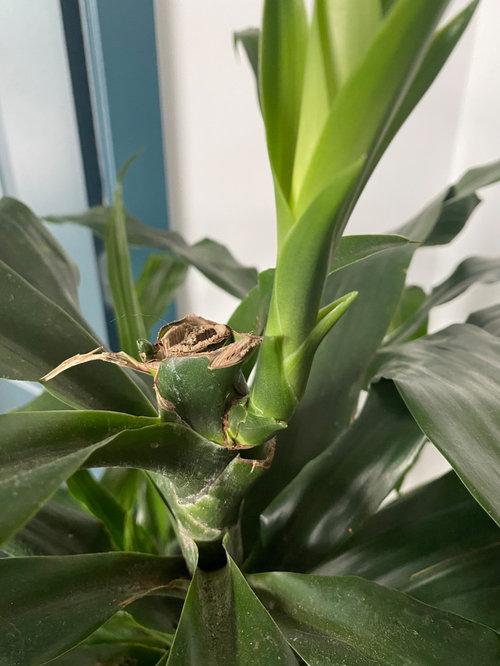

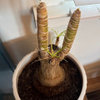
Plant newbie here! I recently acquired a very large Janet Craig. I wanted to shorten one of the stalks a little bit and read that you can cut the stalk directly from the top and new growth would eventually sprout. Well, its been a couple of months since I gave my Janet Craig a haircut, and the new growth is sprouting out from the side of the stalk instead of the top.


Does anyone know what I did wrong or how I might prune it differently so it sprouts from the top? :)

Comments (4)

  • 3 years ago
    last modified: 3 years ago

    This is a natural and obligate reaction to pruning. In branches and stems/trunks that are putting on extension growth (growing longer), the extension growth occurs at the end of a branch in a region called the apex or more specifically, the apical meristem. A growth regulator (auxin) is primarily synthesized in this area near the branch tips, and one of its jobs is to suppress lateral growth or side branching on branches and stems as they grow. When you cut the branch tips off, you remove the source of almost all of the flow of this branch-suppressing growth regulator, which allows another growth regulator which stimulates side branching to become dominant. This forces new growth immediately proximal (behind/below/closer to the trunk or roots) to the pruning cut, which is what you are seeing.

    The image below is a ficus cutting rooted in a plastic medicine container. From the stub, you can see the branch tip has been removed. This forced growth of the 2 new branches you can see in the crotch formed by the leaf stem and the branch it's attached to. This area, just above where leaves are attached is called the leaf axil. In it are a row of buds, just waiting to be activated. As noted, this will always occur in almost all plants capable of branching. How enthusiastically your plant responds to pruning depends on several factors. The 3 most important influences re the response are the subject's species, the amount of stored energy in the plant, how much food the plant is currently making (plants make their own true food [simple sugar/ glucose] during photosynthesis), and when the pruning cut is made. The most enthusiastic response will occur in the week before to the week after the summer solstice (21 June in the northern hemisphere)

    It might be difficult to see because the leaves are so close together, but if you look closely you'll see the branch you're referring to is growing in the axil/crotch of a leaf that was cut or broken off. That the leaf was broken has extremely little to no impact on the branch growing there, the branch is there because the branch was removed. When we intentionally remove a branch tip with the express purpose of causing new branched below/behind the pruning cut, it's commonly referred to as 'pinching'. Looking closely will also reveal a second but which was activated by your pruning cut almost immediately opposite the new branch. At least that's how it appears in the image. If you don't want the branch there, remove the bud. If you think your plant will still be too tall in light of where the new branch is growing, you can cut your dracaena back as bar as you want - as far as the soil line if you like. The plant will do what it's obligated to do and back-bud from just below the new pruning cut. The best time to do that would be a week or two before the summer solstice - now wouldn't be the best time.

    Plants have natural rhythms. the most significant is the growth cycle. Learning to work with the plant's natural rhythms by doing serious work like hard pruning and repotting is best done around the summer solstice is easier on the plant, provides much better results, ensures MUCH faster recovery than if doing the work during the dark months fall through mid-spring, and makes the grower feel like a better nurturer, and deservedly so.

    Questions or thoughts?

    Al

  • 3 years ago

    cutting the top.. stimulated dormant buds to trigger growth ...


    those dormant bud are never where the cut is ..


    usually a cut is made just above there a dormant bud is known to be ... often where a leaf attaches to the stem ... as noted in Als picture ...


    this is the easy to remember version without all the fancy words that most of us cant remember .. learn the concept.. then learn the fancy words ... or do both at once.. what the heck ..


    your next step.. would be to figure out.. iof the new pice can be rooted ... so that you can get the plant you want ... which you cant do .. but cutting the top off.. as you learned .. lets see if there are any vids on that ...


    note that your plant is a dracaena ... and that is what you use to search info;.. not jenny craig .. lol ... janet must have been her mother?????


    https://duckduckgo.com/?q=Dracaena+propagation&t=ffcm&iax=videos&ia=videos


    ken

  • 3 years ago

    Doesn’t this also apply to other plants and even some trees? I notice this on my LL Hydrangea tree, some vegetables and my burning bush as well.

    debra

  • 3 years ago

    Most, but not all plants typically activate buds in leaf axils. Here you see it has occurred (low branch/ bottom right) and is occurring (above the scars where leaver were formerly attached - you can see the buds.


    Example of plants that don't necessarily back-bud from leaf axils: Burning bush readily forms a number of adventitious buds at the wound site left after pruning and from the root crown. An adventitious bud is one that does not form where you would normally expect buds to form - in leaf axils. Cherry and the rest of the Prunus genus happily form adventitious buds on root cuttings.

    You can make some very interesting plants by changing their growth habit with a form of pruning call;ed 'pinching'. Pinching consists of judiciously pinching out the branch tips to force new branching behind the pinch. The growth habit of the 3 coleus shown is weeping/ pendulous/ trailing, but with some judicious pinching, they become a very tight/ compact mass.


    The aeonium below was pinched to force a number of stems so the plant had very close branching and a mass of rosettes. It's normal growth habit is 1 long stem with a rosett, some occasional branching, and the entire plant eventually falls over and roots along the length of the stem.


    The portulacaria bonsai and all 4 species of mint ^^^ are pinched to keep them neat


    streptocarpella ^^^


    J maple - pinched ^^^

    You get the idea. Pinching is a simple form of pruning, and a tool every grower needs in their toolbox.

    Al