Software
Houzz Logo Print
bkay2000

I may have screwed up

3 years ago
last modified: 3 years ago

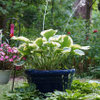
I bought the wrong potting mix this spring. It seemed pretty heavy, so I added a bag of perlite. I've moved my hosta around where I can get to them, and I'm afraid some of my hosta are not drying out soon enough.

The problem is mostly the "new to me" plants purchased this year. I decided to knock out the ones with the problem and just replace the medium that isn't filled with roots with a lighter mix. When I got home with a bag of my usual, I realized it has fertilizer in it. I think it's too late to fertilize with anything that is not water soluble.

Even though we don't have freezes like you guys up north do, I have lost small young hosta in a cold, wet spring. The potting mix didn't freeze, it just stayed wet.

The two that seem to be the worst are two I got accidentally in a screwed up order. One is Empress Wu and the other is Brother Stephan. They were such big plants that I may have "over" potted them. They are both multi-eyed plants. They ended up giving them to me, as I would never have ordered such a big plant, so I don't have much invested.

So, would you just wait and see what happens and move them to cover if it is a cold and rainy spring? Or, would you go back and some some potting medium without fertilizer in it, as was my original plan?

Our average first killing frost is Nov. 15. I'm in Texas in 7b.

bkay

Comments (11)

  • 3 years ago

    Are you seeing new growth?

    bkay2000 thanked lindalana 5b Chicago
  • 3 years ago

    Are you able to tip these pots on their sides, or perhaps you already do that? Or maybe you don’t have room? How do you normally overwinter your hostas, given you don’t really have a winter?

    debra

    bkay2000 thanked djacob Z6a SE WI
  • 3 years ago

    The two mostly in question arrived in July at the height of 100 degree days and 85 degree nights. They have not put out any new growth. I was feeling around in the soil this morning and they are making new roots. No leaves have died, although they have some burned edges (almost all the hosta have some). That long hot, dry spell really took it's toll.

    I do not get freezing pots that stay frozen. They may freeze, but usually thaw by the next day. I generally leave them where they are, under the pecan tree. I only water them if we have a month or so without rain.

    The nursery had some organic potting soil that I've never used, but it is organic - so, no fertilizer.

    bkay

  • 3 years ago
    last modified: 3 years ago

    Undoubtedly, the best option would be to use an appropriate grow medium. I think it's reasonable to establish a bar re whether or not any given medium should/ shouldn't be considered 'good' or 'appropriate' based on whether or not you can water correctly w/o concern that the soil column will remain soggy for periods long enough to notably impact root function and/or affect root health. So, if you can wet the entire soil column so it is moistened completely and at least 20% of the total volume of water applied exits the drain hole w/o jeopardizing root function/ health, you're golden.

    You can turn your pots into mini raised beds (from the perspective of hydrology) if you set them directly on mineral soil such that the grow medium within the container is in direct contact with the mineral soil below. This turns the Earth into a giant wick which will in most cases pull all excess (perched) water from the planting. The critical part of making this function favorably is the bridge between the grow medium in the pot and the mineral soil below the pot. It must be continuous/ unbroken.

    Al

    bkay2000 thanked tapla (mid-Michigan, USDA z5b-6a)
  • 3 years ago

    Thanks Tapla, it's not soggy, it's just damp. I don't think I have perched water. There is probably too much peat in my soil mix. Several years ago, I got rhizoctonia root rot in my hosta, so I'm paranoid. Cold and wet is a perfect environment for rhizoctonia root rot and it's almost incurable. I lost 90% of my hosta.

    I think I'll remove them from the pot gently and mix the medium that comes off easily with some some extra perlite (and hope for the best).

    bkay

  • 3 years ago

    What I have done with pots in previous house is to cover them up once they froze. In you case it would be dormant. Put in deepest north shade and slightly cover just to prevent water accumulation. Since there is no new flush of leaves I would not worry about fert messing up dormancy.

  • 3 years ago

    "There is no credible evidence that fertilizing into late fall interferes with dormancy or forces activation of buds that later freeze."

    That's really interesting, Tapla! So, a question would be: when would you stop fertilizing your pots? Would you use the same fertilizer throughout the season?


    I had a heuchera of mine die a few weeks ago. The manager at a garden nursery told me that after planting I should be applying Transplanter fertilizer (5-15-5) every two weeks for two months---even if that means going until the end of October! What! Actually the bottle doesn't say that. It says to apply after planting. I assumed you did it one time. Would this be good to do for all perennials?


  • 3 years ago

    Fertilizing, and in particular, fertilizing with nitrogen cannot force activation of buds being suppressed by photoperiod and/or chilling. Once the duration of the dark period reaches a certain point, buds are pretty much dormant, and additional chilling seals the deal by ushering the plant into deep dormancy. Whether or not one fertilizes in fall, growth that hasn't hardened off is going to die back to the buds that began developing during the summer. When plants become fully dormant, it takes a varying amount of chill units to release a plant from its dormant state. From dormancy, plants normally pass into a period of quiescence, during which buds are fully capable of being activated, but are inhibited from doing so by ongoing chill. Usually, the onset of spring growth occurs after dormancy has been 'broken' and temperatures have remained at levels greater than about 42*.

    I fertilized this past Wednesday, 10/5, and I think that will likely be the last time unless we get at least 2 weeks of additional temps above freezing at night and into the 60s during the day. If you're using organic forms of nitrogen like hoof/ horn/ feather/ blood/ fish/ cottonseed/ ..... meal, you should stop fertilizing before mean temps drop below 55* to guard against ammonium toxicity.

    I had a heuchera of mine die a few weeks ago. The manager at a garden nursery told me that after planting I should be applying Transplanter fertilizer (5-15-5) every two weeks for two months---even if that means going until the end of October! I assumed you did it one time. Would this be good to do for all perennials?

    Another horticultural myth. First, plants use about 6X more nitrogen than phosphorous, so if the plant is in a container, it would be virtually impossible to justify supplying 5-15-5 fertilizer. If the plant is being planted out in the landscape, the only way that much phosphorous could be a benefit is if there was an existing phosphorous deficiency. which would be a rarity anywhere other than heavily farmed fields.

    The idea that nitrogen is for above ground parts, phosphorous is for roots, and potassium is for the general well being of the plant is well wide of the mark. You might have heard the ditty "up, down, all around" to "help you remember" what N, P, and K are supposed to do, but the truth is, all nutrients (absorbed by the root pathway) are equally essential to all plant parts. Fertilizing should be a more holistic effort with an eye toward balancing NPK % ratio to the ratio at which the plant actually uses the nutrients. This will allow you to fertilize at the lowest concentrations possible w/o deficiencies. Using 5-15-5 means you would be supplying about 7.8X more P than the plant can/will use, based on the % of N it supplies.

    Al

    bkay2000 thanked tapla (mid-Michigan, USDA z5b-6a)
  • 3 years ago

    Tapla, so what you are saying is that plants (in the garden or in a container outdoors) can be fertilized late into the season depending on outdoor temperatures. Also the 5-15-5 transplanter fertilizer is supplying considerably more phosphorous than most plants will ever need. Very interesting.

  • 3 years ago
    last modified: 3 years ago

    Plants use about 6x as much nitrogen as phosphorous, so a fertilizer containing 5% nitrogen (like 5-15-5) would be better for use in containers if the middle number (phosphorous) was 2. If the high-P fertilizer is used on plants in the ground, w/o a soil test, any fertilizer you choose would be a crap shoot; this, because the only way application of any nutrient can be a benefit to the plant is if the nutrient is deficient at the time of application, and that can only be determined precisely by way of a soil test. While we can't say with certainty (w/o a soil test) that an application of a high-P fertilizer to plants in the ground will be a benefit or limitation, the odds are that it would be a limitation if only for the fact that phosphorous is only rarely deficient in soils other than those used consistently to grow crops. An excess of any nutrient has the same potential to be limiting as as a deficiency, so anything in the soil solution beyond what is needed by the plant has only the potential to be a limitation.

    Certainly some of you have come across this before. First, there are 6 factors that affect plant growth and yield; they are: air, water, light, temperature, soil/media, nutrients. Liebig's Law of Limiting Factors states the most deficient factor limits plant growth and increasing the supply of non-limiting factors will not increase plant growth. Only by increasing the most deficient factor will the plant growth increase. There is also an optimum combination of the factors and increasing them, individually or in various combinations, can lead to toxicity for the plant.

    Al