Software
Houzz Logo Print
a_remodeler

Unknown Maple in Northern NJ

4 years ago
last modified: 4 years ago
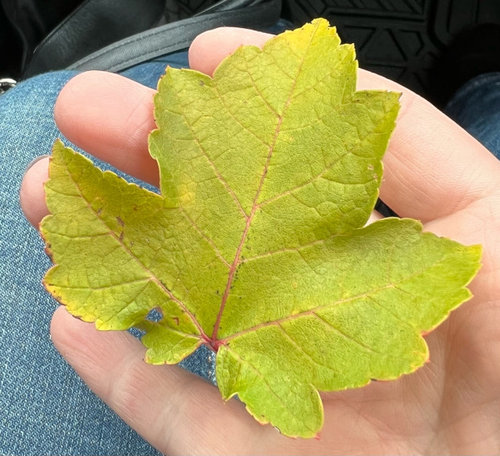
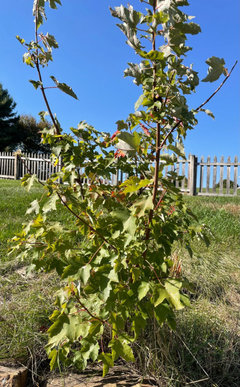
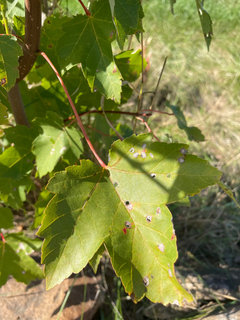
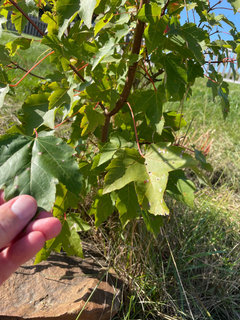
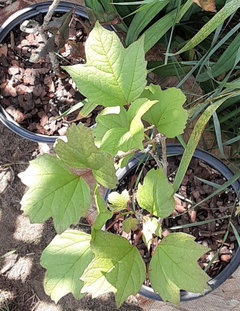
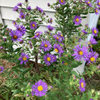
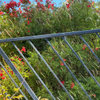
This tree was a volunteer in a suburban yard. The tree is small and I don’t believe it has ever flowered. The last photo shows the leaf next to some red maple leaves (Acer rubrum.) I have a few ideas but they’re probably all wrong.


Comments (31)

  • 4 years ago

    Any stems or buds to look at?

    The leaf appears to be Hydrangea quercifolia (oak leaf hydrangea).

  • 4 years ago

    I don't believe it is the hydrangea :-) The leaves are much too small, lack the characteristic lobing (look like oak leaves, not maple) and the hydrangea would not have red petioles or veining. And northern NJ is well north of any native range, so any "volunteer" is unlikely.

  • 4 years ago
    last modified: 4 years ago
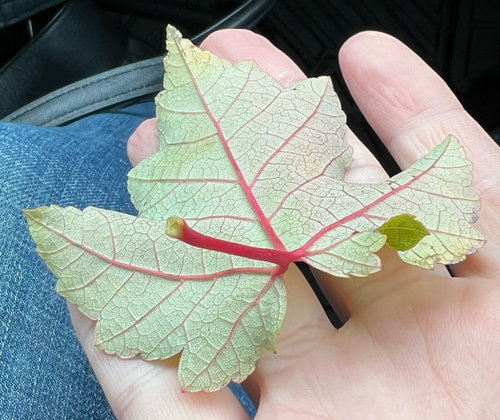
    Yes, not much to go by. A single leaf?

  • 4 years ago
    last modified: 4 years ago
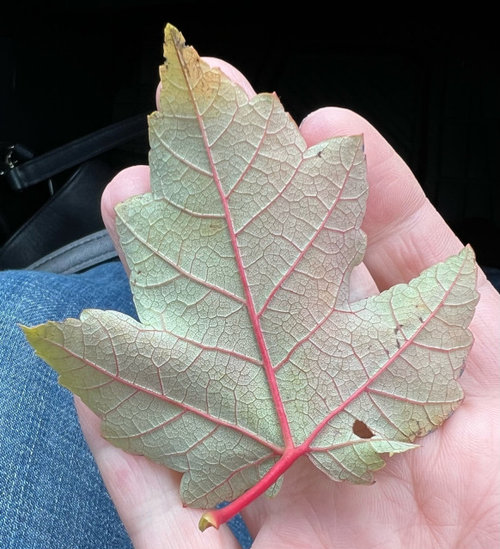
    These photos were sent to me by a friend and I was unsure of the species, so they brought me the single leaf, which I photographed.


  • 4 years ago

    red maple?

  • 4 years ago
    last modified: 4 years ago
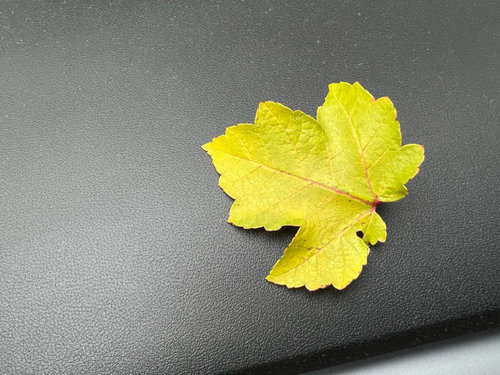
    I would agree. A form of red maple. I pull tiny seedlings all the time in my yard during summer. ;-)

    You probably have some larger trees in that neighborhood that produce seeds.

    From what I understand Reds and Silver maples can, in nature 'hybridize' so the appearance of leaves can vary somewhat depending on the percentages of parentage.

    Yours looks to be more 'Red maple' than anything, imo.

  • 4 years ago

    One of my guesses was Acer x fremanii which is a cross between red maple and silver maple. Red maple is a common native tree here, although there is not a lot of ‘natural’ area in the neighborhood, and silver maple is a common planted tree. But I am unsure if that is what it is. It doesn’t quite look like red maple to me, which is why I included the picture with the red maple leaves side-by-side with the unknown leaf.

  • 4 years ago

    I think it was the coloration and more rounded lobes that threw me off.

    But the first picture you showed is a pretty good example of leaves on an immature tree. They can show other than textbook form and the fact that we're getting to the end of season, the leaves can get pretty 'beat up' and discolored.


    I don't know enough about reds to say but I don't think that they readily hybridize with silver, otherwise there wouldn't be many pure reds left.


    And Freemanii maple is known to be (for the most part) a sterile hybrid.


    It's just good practice to get as much information as you can before making identifications.

    If that first picture of a leaf came from that little tree you posted, it's a red maple. :-)

  • 4 years ago

    " I don't know enough about reds to say but I don't think that they readily hybridize with silver, otherwise there wouldn't be many pure reds left."

    From Wikipedia: "Acer × freemanii, Freeman maple or Freeman's maple, is a naturally occurring hybrid maple that is the result of a cross between Acer rubrum (red maple) and Acer saccharinum (silver maple). Wild specimens are found in eastern North America where the parent species overlap. The cultivars are typically deliberately hybridized and selected in nurseries, not drawn from the wild specimens."

  • 4 years ago

    Thanks GG.

    What I meant about readily hybridizing, is that there must be a limiting factor because on my land out in the country, we have silvers growing in bunches in the lower wetter areas and <50 yards away, Reds growing on the higher, sandy grounds. If they readily hybridized, wouldn't there be nothing but hybrids growing there? After all these years?


  • 4 years ago

    Yes, the tree is immature. That’s why my other guesses were Amur Maple and Tartan Maple because I read that the immature leaves of those trees can be lobed. I’ve seen a lot of red maples in the wild and it just doesn’t seem like red maple to me, or any other native maple. My guess was that it was either a non-native maple or Acer freemanii. Unfortunately, I’ve not see any of my guesses in person, and since the tree is immature, it may be ever harder to identify based on the leaves.

  • 4 years ago

    A,

    The pictured tree (3) you posted last, has all the characteristics of red maple. There is no doubt in my mind about that. If the first leave posted (pictured) that you questioned, is from that same tree, then that settles it.


  • 4 years ago

    Bill, I read alittle about hybrids, and read that for some situations, successful pollination between different-but-compatible species is often less effective/common than between straight species, especially when there are alot of the same species near each other. Of course that's a very general statement & it didn't explain anything in detail (perhaps not known why other than the obvious issue of differing flowering times.)

  • 4 years ago

    Yes, I'm sure there is a very specific detailed, scientific explanation for all that. :-)


    And when you look at the fact about the hybrids being, for the most part sterile, I suppose it's possible that when hybridization is done on purpose at a nursery, there might be only a small percentage of the seeds that do germinate, producing a 'Freemanii', but when you deal with thousands of seeds, you probably still get a fair amount that 'grow'.


    All speculation on my part but ime: when you dig into things, you will for the most part, find that there is a reason for the madness. ;-)

  • 4 years ago

    This is a red maple.

  • 4 years ago

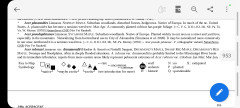
    More background on the hybrid and a comparison photo showing picked leaves of the parents with leaves of an example of the hybrid between. And showing the expected intermediate characters: Acer × freemanii | Landscape Plants | Oregon State University

  • 4 years ago

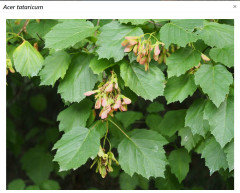
    Looking at that leaf again, it just doesn't look like red or red x silver maple -- more like Amur or Tartar maple as the OP suggested.

  • 4 years ago
    last modified: 4 years ago
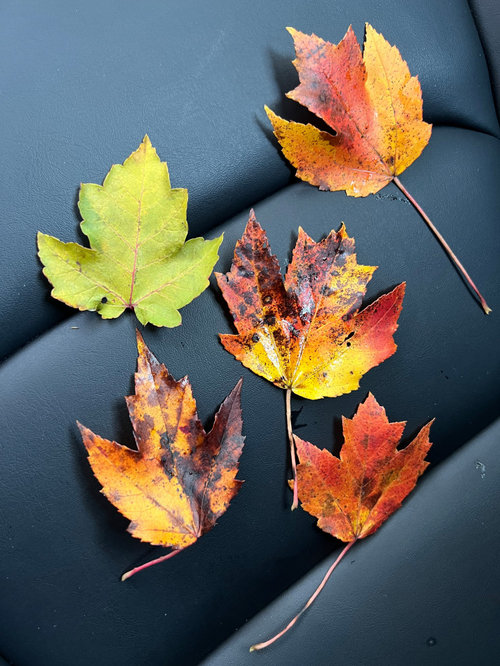
    When you look at this example of 'Tatar' maple from NC university, it could very well be.

    https://plants.ces.ncsu.edu/plants/acer-tataricum/

    There are many subspecies of Tatar, I've never seen such a broad spread on the leaves before.


  • 4 years ago
    last modified: 4 years ago

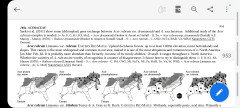
    ' There are 3 varieties of Acer rubrum. '

    Thanks Jay. The light is coming on (in my mind anyways).

    I didn't think that the 'red maple' leaves in the comparison photo of the original post, didn't look quite right to be red maples, but more of a variety of such.

    Below is a picture of a 1 ft. tall, woods dug, 'red maple' from my area. Most likely Acer rubrum var. rubrum. Note how variable the leaf margins are on this seedling.


    Oh, I think your reference of ' Acer saccharum and Acer rubrum ' should have been ' Acer saccharinum and Acer rubrum '.

  • 4 years ago
    last modified: 4 years ago

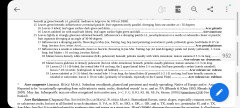
    😳🙈Oh, thanks for the spelling correction Bill! I was more concerned about the 2 C's in the 1st sylable that I overlooked the rest. There is a genus of grasses called Saccharum, and my autocorrect remembers scientific names, but I have to disable my autocorrect if I want to comment here lately. Lol.😬😆 Your new maple pic is either A. r. trilobum or A. r. drummondii.


  • 4 years ago

    " Actually saccharum Is the correct name. "

    Only for sugar maples, Acer saccharum :-) Acer saccharinum, silver maple, is the correct name when discussing the freemanii hybrids, either natural or intentional.

  • 4 years ago

    Oh C'mon. I knew what you meant Jay.

    The only reason I mentioned it was, well... now I don't know why I mentioned it! lol

    It's no big deal, just that saccharum is a different tree than saccharinum, so it's just for keeping the record straight for the unwary. :^)


  • 4 years ago
    last modified: 4 years ago

    Below is a picture of a 1 ft. tall, woods dug, 'red maple' from my area. Most likely Acer rubrum var. rubrum. Note how variable the leaf margins are on this seedling.

    Actually you are showing Viburnum opulus.

  • 4 years ago
    last modified: 4 years ago

    When I went back to the flora, I saw saccharum, and I thought "I am right", then I realized it was Sugar Maple. I could swear I deleted that sentence, but I didnt.😁 ✌️✌️✌️

  • 4 years ago

    ' Actually you are showing Viburnum opulus. '

    Really? I never did take a good look at it under the plant table, then it died over winter.


  • 4 years ago

    Ignore my previous statement.😬 If it was a maple it would be one of those 2. The blind leading the blind.🤣 There was a time delay.

  • 4 years ago

    Looks more like Viburnum trilobum,( native, formerly V. opulus var. trilobum) or a hybrid of V. opulus and V. trilobum.

  • 4 years ago

    Let him with no mistakes cast the first....oh nevermind.

    Mislabeled photo.

  • 4 years ago
    last modified: 4 years ago

    Fooled me, but I had maple on the brain.🤯 They have really nice fall color too. Maybe you'll luck out and find an Oak Leaf Hydrangea next time.

  • 4 years ago

    haha!


    I never had an interest in Viburnum but when I found this seedling of interest during late summer, I simply marked it with a red tape like I always do and then went back when it was leafless/dormant the next spring and dug it out and brought it home with several other finds.


    Put it under the plant table and later took a picture after leaving out, must've had maple on the brain too, but looking at those icons didn't help when I renamed the photo.


    When Embo said Viburnum opulus, I thought it funny that a European native would be found 16 miles from the nearest town, in the wild woods of north central Minnesota. So thanks for explaining that.

    My northern climate would probably not have any native Hydrangeas but idk. :p


    I've just been too busy, flying around trying to do too much. I need to cut back on something. Identifying plants on an internet forum might be one of them. ;-)