Software
Houzz Logo Print
manic_gardener_socal_10a

5-1-1 for fruit trees in containers?

I have been reading some discussions about the 5-1-1 mix as being the best draining mix for container plants, but I mostly see it discussed in terms of indoor plants. I'm wondering if this would also be a good mix for citrus and pomegranates growing in pots?

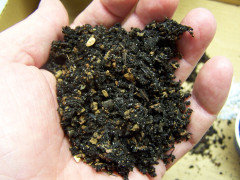
or would I be better off using 50/50 citrus&palm/potting soil mix?

or something else?

also I would eventually like to make raised beds for some of these trees and move them into beds, and I'm wondering if the 5-1-1 mix would be good for raised beds as well, or what you would suggest.

I know that 100% straight citrus & palm mix might be great for all trees, given how well it drains, but filling an entire bed with that would be extremely costly! So I'd love to hear some other ideas if 5-1-1 would not work.

Comments (28)

  • 3 years ago

    My trees that I planted outside were grown in 50% topsoil from the yard and 50% compost from my compost pile. In the cold season I had to pull the extra water out and aerate the roots.

    aerating the roots and eliminating the perched water table in heavy dirt

  • 3 years ago

    I'm wondering if this would also be a good mix for citrus and pomegranates growing in pots? It would work very well, though the gritty mix would work better.

    or would I be better off using 50/50 citrus&palm/potting soil mix?

    or something else? Probably not. What makes media like the 5:1:1 and gritty mixes so productive lies in the fact that they hold little to no perched water. Perched water is water held between soil particles which refuses to exit the pot, defying gravity and creating a layer of 100% saturated soil at the pot's bottom. Soils that hold little to no excess water in the form of a perched water table offer greater opportunity for plants to realize more of their genetic potential.

    also I would eventually like to make raised beds for some of these trees and move them into beds, and I'm wondering if the 5-1-1 mix would be good for raised beds as well, or what you would suggest. It won't work well in a raised bed for 2 main reasons. First is the fact that the earth below the bed will tend to act as a wick, pulling water from the mix, and given the high air porosity of the 5:1:1 mix, it would dry down very quickly. I would make your soil from about 70% native soil and maybe 15% each of pine bark and reed/ sedge peat, sometimes called Michigan peat.

    This is the medium in my RBs ^^^. It's about 25% topsoil + pine bark, Turface (tan particles), reed/ sedge peat. It's very productive, and fortunately, because I repot about 150 trees each year, I have lots of old soil I can spread on the beds, which makes up for the shrinkage.

    Also, during the first year or so, you'll need to be prepared to provide extra nitrogen to limit immobilization of nitrogen due to high populations of soil biota. The second reason is, you would se a considerable amount of soil shrinkage if using the 5:1:1 mix in beds. As the mix breaks down, much of the carbon will gas off as CO2

    I know that 100% straight citrus & palm mix might be great for all trees, given how well it drains, but filling an entire bed with that would be extremely costly! So I'd love to hear some other ideas if 5-1-1 would not work. The primary driver of water retention is particle size. If a medium is comprised of all fine particles, it's not going to work all that well (in containers), no matter what it says on the bag. In order to take advantage of the added potential offered by highly aerated, fast-draining media, it is essential that a VERY large fraction (>75%) of any container medium is made up of coarse particles larger than will pass 1/10" mesh. Also, trying to increase aeration by amending a large fraction of fine material with coarse material actually reduces aeration until you get to the point where there is no longer enough fine material to fill the large air spaces between the coarse material. The most difficult soil to grow in is one which consists of some coarse material with just enough fine material to fill all spaces between the large particles; yet, this is what a large number of growers habitually put into practice.

    Getting back to the RBs now, the citrus/palm mix will dry down much too quickly in RBs. You'll need a large fraction of sand or mineral soil as the base of whatever you end up using in your RBs.

    Al

    manic_gardener_socal_10a thanked tapla (mid-Michigan, USDA z5b-6a)
  • 3 years ago

     Even though I'm no expert this might work is  a 50/50 clay sand mix

  • 3 years ago

    tapla, thanks a lot, your response was super helpful and I was able to learn a lot from all the detial you provided.


    I hadn't read about the gritty mix yet; I just discovered the 5-1-1. I think for the time being I'll probably stick with the 5-1-1 for pots, simply because the pots would be so heavy with the gritty mix I'm not sure I'd be able to move them! I already have one citrus I recently potted using EB Stone Citrus and Palm mix. Do you recommend repotting it in 5-1-1?


    Also, could I substitute coco coir for peat in the 5-1-1 recipe or is peat vastly preferable? I grow microgreens so I always have lots of coco coir on hand.


    What are your ideal proportions for the rest of the ingredients you list for your raised bed mix after the 25% topsoil? I think it would be a lot harder for me to acquire and mix the huge quantities of materials needed for filling raised beds - but who knows, maybe I will feel compelled to tackle this project


  • 3 years ago

    I already have one citrus I recently potted using EB Stone Citrus and Palm mix. Do you recommend repotting it in 5-1-1? How about if you decide what you think works better.

    Also, could I substitute coco coir for peat in the 5-1-1 recipe or is peat vastly preferable? I grow microgreens so I always have lots of coco coir on hand. Most growers think coir and peat are simply interchangeable, but that isn't so. Something I wrote comparing coconut products (coir and CHCs) to peat and pine bark:

    Peat vs. Coir

    Sphagnum peat and coir have nearly identical water retention curves. They both retain about 90-95% of their volume in water at saturation and release it over approximately the same curve until they both lock water up so tightly it's unavailable for plant uptake at about 30-33% saturation. Coir actually has less loft than sphagnum peat, and therefore, less aeration. Because of this propensity, coir should be used in mixes at lower %s than peat. Because of the tendency to compact, in the greenhouse industry coir is primarily used in containers in sub-irrigation (bottom-watering) situations. Many sources produce coir that is high in soluble salts, so this can also be an issue.

    Using coir as the primary component of container media virtually eliminates lime or dolomitic lime as a possible Ca source because of coir's high pH (6+). Gypsum should be used as a Ca source, which eliminates coir's low S content. All coir products are very high in K, very low in Ca, and have a potentially high Mn content, which can interfere with the uptake of Fe. Several studies have also shown that the significant presence of phenolic allelochemicals in fresh coir can be very problematic for a high % of plants, causing poor growth and reduced yields.

    I haven't tested coir thoroughly, but I have done some testing of CHCs (coconut husk chips) with some loose controls in place. After very thoroughly leaching and rinsing the chips, I made a 5:1:1 soil of pine bark:peat:perlite (which I know to be very productive) and a 5:1:1 mix of CHCs:peat:perlite. I planted 6 cuttings of snapdragon and 6 cuttings of Coleus (each from the same plant to help reduce genetic influences) in containers (same size/shape) of the different soils. I added dolomitic lime to the bark soil and gypsum to the CHC soil. After the cuttings struck, I eliminated all but the three strongest in each of the 4 containers. I watered each container with a weak solution of MG 12-4-8 with STEM added at each watering, and watered on an 'as needed basis', not on a schedule. The only difference in the fertilizer regimen was the fact that I included a small amount of MgSO4 (Epsom salts) to provide MG (the dolomitic lime in the bark soil contained the MG, while the gypsum (CaSO4) in the CHC soil did not. This difference was necessary because or the high pH of CHCs and coir.) for the CHC soil.

    The results were startling. In both cases, the cuttings grown in the CHC's exhibited < 1/2 the biomass at summers end as the plants in the bark mix.

    I just find it very difficult for a solid case to be made (besides "It works for me") for the use of coir or CHC's. They're more expensive and more difficult to use effectively. The fact that some believe peat is in short supply (no where near true, btw) is easily offset by the effect of the carbon footprint of coir in its trek to the US from Sri Lanka or other exotic locales.

    That's the view from here. YMMV

    Coir Study: https://sites.google.com/site/plantandsoildigest/usu-crop-physiology-laboratory/coconut-coir-studies

    What are your ideal proportions for the rest of the ingredients you list for your raised bed mix after the 25% topsoil? I think about 70 - 80% native soil + 10-15% each of fine pine bark and reed/ sedge peat would be all the organic products you'd want.

    When I started my beds I layered cardboard right over the grass, layered the rest of the ingredients at 1 layer each (7" total), then used a spade and spade fork to mix everything. Since much of what you'll be using will be bagged, you could rent a cement mixer if you think your project is ambitious enough to warrant it.

    Al

    manic_gardener_socal_10a thanked tapla (mid-Michigan, USDA z5b-6a)
  • 3 years ago

    " What are your ideal proportions for the rest of the ingredients you list for your raised bed mix after the 25% topsoil? "

    I was about to respond to this question as well, but Al beat me to it ! 😊

    First, let me say that there is nothing magical or mysterious about a raised bed. It is just an elevated planting area, whether for personal convenience, or to keep critters out, or to avoid tree roots. Or because the indigenous soil conditions are not suitable (heavy clay, poor drainage, pH out of whack, etc.). And they do not need to be of any formal construction - a mound or a berm also qualify as a 'raised bed'.

    Because they are just an elevated planting area in full contact with the underlying soil surface, there is no compelling need for any special soil mix. And in fact since you are essentially just growing in the ground, any decent mineral-based ground soil - eg. topsoil - should work perfectly well. Since topsoil tends to be devoid of much in the way of organic matter, adding a small percentage of the total volume will help. Many gardeners use compost, composted manures or leaf mold for this purpose. Like Al, I also recycle my used container soil into my raised beds (and elsewhere in the garden).

    Where I live, bulk soil suppliers are plentiful and bulk will always be cheaper than bagged - by a very wide margin. Look to see if any offer what is typically known as triple or 3-way mix. Or sometimes garden planting mix. This is a blended mix of primarily mineral based soil, a small percentage of organic matter and some sort of aeration material - ground wood chips, bark fines, very coarse sand or grit. This is a suitable product for pretty much any raised bed planting or other gardening soil needs.

    But not containers :-)

    manic_gardener_socal_10a thanked gardengal48 (PNW Z8/9)
  • 3 years ago

    Coco coir works great in citrus souls, I use it in all of mine, CHC work excellent in place of pine bark and last longer. While salt used to be an issue with coco a decade ago, 99% of coco you buy today is thoroughly washed and salt it no longer an issue. The pH of cocoois right in line with what citrus like and I never have calcium deficiencies . I fertilize with jacks 25-5-15 which doesn't add calcium but have had no issues over the last decade and have happy trees that give me plenty of fruit.

  • 3 years ago

    As noted, my experience with coconut products as a base for grow media has been poor - likely the reason that most greenhouse/ nursery ops use coconut products sparingly or not at all in container media.

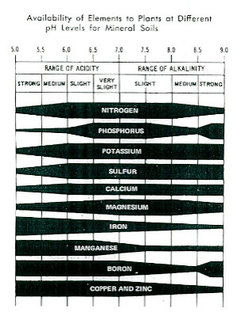
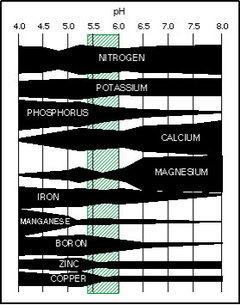
    The suggested pH for citrus in the ground/ mineral soils is 6.0 - 6.5. For container culture using container media, the pH should be somewhere near a full point lower.

    pH chart for mineral soils:

    pH chart for container media:

    This can be clearly seen by noting availability of nutrients at the different pH levels. At an average pH of 5.8 - 6.8, coconut products are outside the ideal pH range for conventional container culture.

    Too, the question about the allelopathic (toxic to other plants) tendencies of coconut products remains, as does coir's distinct tendency to compact when watered from above, and the tendency of coconut products to interfere with iron uptake due to their high level of manganese (antagonistic deficiencies). In view of coconut product's low calcium (Ca) content, using a fertilizer w/o Ca means the grower must supplement Ca, or rely on their irrigation water as the sole of Ca. Since water sources vary significantly in Ca content, a large fraction of water sources would be inadequate in their ability to supply appropriate levels of Ca.

    The main point is, coir and CHCs are not interchangeable with peat and pine bark. This is based on chemistry for both and on the physical properties of coir.

    Al

  • 3 years ago

    Clay has  some good qualities it should be considered as a base soil but  there must be something to balance the  Clay such as  adeep well   but moving the tree can have some unseen effects 


    Howard

  • 3 years ago

    Clay's extremely small particle size is the underlying reason why clay holds too much water and too little air for use in conventional container culture.

    I don't understand what you mean when you reference clay being 'balanced' by a 'deep well'.

    Al

  • 3 years ago

     Tapla(mid Michigan USDAz5bz6a) clay can handle erosion   but it needs some balance

  • 3 years ago

     That is for better  drainage  after the water goes through the sand it must have some place to go

  • 3 years ago
    last modified: 3 years ago

    O Citrus, citrus, wherefore art though 5-1-1?
    Deny thy cultivar and refuse thy soil
    Or if thou wilt not, be but sworn my citrus
    And I’ll no longer be a bonsai.

    Everything you are looking for regarding coconut products, SoCal, Citrus, and Pomegranate can be found in these videos.

    https://youtu.be/yxmSYacK58A

    https://youtu.be/MpJu4krDzM8

    https://www.youtube.com/watch?v=r-lN5wYmB0k

  • 3 years ago
    last modified: 3 years ago

    What light through yonder grow lamp breaks?
    It is an LED, with spectrum as full as the sun...

  • 3 years ago
    last modified: 3 years ago

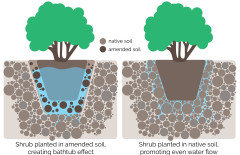
    Since we've transitioned to the words of The Bard of Avon, we might consider that in Henry VI he had Gloucester observing, "Virtue is choked with [by] foul ambition." How does that apply to this thread? In a bid for notoriety or monetary gain, Tana (in her videos) has chosen to offer opinions and instruction that, w/o question, have the potential to detract from the growing experience of others. Her worst mistake was promoting amendment of a planting hole in clay soil with organic soil amendments, which ensures lateral percolation of water into the hole, which creates the bathtub effect and the tendency toward weak/ congested root systems that eventually produce encircling/ girdling roots.

    Bathtub Effect


    Another mistake was not taking the opportunity to bare-root the tree and correct root issues before planting out.

    "The destroyer of weeds, thistles and thorns is a benefactor, whether he soweth grain or not." ~ Robert Ingersoll

    Al

  • 3 years ago

    Too late to bare root a root ball the size she planted. Nice crayons. Does santa know you are posting nonsense on the citrus forum again?

  • 3 years ago
    last modified: 3 years ago

    Well I have to say Tana, is a good looking girl.. She can dig a hole and back fill it with anything she wants at my place.

  • 3 years ago

    I'm pretty sure her name is "Hannah" not Tana

  • 2 years ago

    Al, I've begun preparing some raised beds for fruit trees right now, and want to use your recommended materials/proportions, but have run into one issue: I can't obtain reed/sedge peat (apparently also known as "peat humus') from any store or supplier where I am in Southern California.


    On Amazon some sellers are offering it - but for the absurd price of $56 per cubic foot! Sphagnum peat moss, on the other hand, I can find in abundance, but I know this is usually used in container gardening. Would I also be able to use that in my raised beds instead of sedge peat, or is there another alternative you could recommend?

  • 2 years ago

    I'm assuming the mineral soil fraction of the soil for the RBs is around 80%? You can use sphagnum peat or compost as the organic fraction. I doubt it'll make a difference, but reed/sedge peat is often packaged as Michigan or occasionally Minnesota peat, too.

    Al

    manic_gardener_socal_10a thanked tapla (mid-Michigan, USDA z5b-6a)
  • 2 years ago
    last modified: 2 years ago

    I'm not sure about the mineral soil fraction - how does one determine that? Unfortunately there is only one bulk seller here from whom I can buy top soil to use for the "70% native soil" part of your RB blend. On the phone they could only tell me their topsoil product is 50/50 and consists of: "50% sandy loam/50% compost." I asked them if they could send me a data sheet for it but they don't have it on hand - said they need to get it from their supplier. With any luck they will email me the data sheet tomorrow - then if you have any questions about it, I should be able to give you more info!

  • 2 years ago

    I'm not sure about the mineral soil fraction - how does one determine that? First, I should probably mention we're talking about fractions by volume, not weight. Then, take a SWAG at what a RB that's 80% full of mineral soil looks like, you'll have 20% of available volume left (or whatever ratio you settle on) to fill with your organic fraction.

    When talking about media for RBs, there isn't much critical re the exactitude of the proportions because the earth will act as a giant wick, pulling any excess water out of the RB soil and ensuring an ample volume of air porosity. When making a medium for conventional container culture, ratios/ proportions are more important. Most important is is the threshold proportion which is a way to say there is exactly enough fine material to fill and eliminate all the potentially large air pores between the large soil particles. People who add together an equal measure of potting soil and pine bark generally don't realize all they have done is reduce the volume of the medium actually available for root colonization. Roots are still growing only in the tiny spaces between the fine material because they have diminished o/a air porosity. That isn't a consideration in soils for RBs, again, because the earth is a reliable wick, which is why RBs work well when growing in the earth presents issues with air porosity (clay/silty clay soils).


    If what you're considering buying (the 50/50 mix) is a bagged product, I'd reconsider. I have never found anything that wanted to grow in a bagged product containing topsoil, and to be clear, I'm talking about using it for landscape projects, not for use in containers. Perhaps others have had better results, but personally, I've decided to avoid it entirely. Take a survey here or otherwise try to find out what people think of a bagged product like that (if indeed it IS a bagged product).


    Good luck. Let me know if you have other questions you think I might be able to answer, or there is additional input.

    Al

    manic_gardener_socal_10a thanked tapla (mid-Michigan, USDA z5b-6a)
  • 2 years ago

    This definitely isn't bagged topsoil. Minimum order is around 20 cubic feet, and delivery is in a truck.


    Ironically, though (in light of what you just said) they advised me not to get their bulk topsoil product for raised beds because it is not "prepared soil." Instead they recommended a bagged potting soil product which they sell (much more expensive).


    Very limited options for bulk soil in my area, though, so if I don't get this bulk topsoil, my only other option is to get some kind of bagged product. So I'm praying this one will work with your recipe.


    For whatever reason, it's taking them awhile to get the data sheet for the product - I'm still waiting. If there is any info on the data sheet you think would help you determine whether it is a suitable topsoil for your raised bed blend, just let me know, and I can pass that info along to you once I have it.


  • 2 years ago

     manic_gardener_socal_10 a 


     it might  be time  to find another company to order  your bulk top soil  for your raised beds  if you  intend to have many of them  just take bids on the cheapest one

  • 2 years ago
    last modified: 2 years ago

    Ironically, though (in light of what you just said) they advised me not to get their bulk topsoil product for raised beds because it is not "prepared soil." Instead they recommended a bagged potting soil product which they sell (much more expensive). It's unfortunate they do not understand how water behaves in various media. There are 2 things they do not consider. 1) With the earth acting as a giant wick, all water will be pulled downward from all spaces between soil particles, whether the medium is all or almost all mineral soil or it's some type of potting soil. This means, in the case of mineral soils, all water will be held on the surface of soil particles, at the interface where soil particles contact each other, and in the internal pores of the organic fraction of the medium. Potting media will dry out very quickly, resulting in the need to water frequently. 2) There will be a LOT of annual soil shrinkage due to natural composting and carbon gassing off as CO2 from a media that is nearly all organic. If you scroll up to my first pots, this thread, you'll see I offered cautionary words about soils with a high % of organic material (>50%) being difficult to keep watered and the shrinkage associated with their use in RBs. It's not that they CAN'T be productive, it's the extra work it requires, and to some degree the expense that comes with the necessity of continually adding a fairly large fraction (25-25%?) of OM to to replace what's lost to gassing off ,,,,, and that was a self-critique resulting from the lesson I learned from the soil I have in my OWN beds. Too much OM.

    If there is any info on the data sheet you think would help you determine whether it is a suitable topsoil for your raised bed blend ..... I doubt there will be one. It sounds like it will be a matter of mixing screened topsoil, which can vary considerably in physical properties which depend on the %s of clay/ silt/ sand, with compost that might come from an entity that contracts with a municipality to accept yard waste. A thought: If they have to mix it, why wouldn't you be able to order it with the ratio of soil:OM you prefer?

    Al

    manic_gardener_socal_10a thanked tapla (mid-Michigan, USDA z5b-6a)
  • 2 years ago

    That is exactly what I did when, on occasion, I ordered topsoil for the yard. I would ask them to mix in compost usually about 25% or so. But then I tilled that in with native soil otherwise I would have asked for less compost percentage. First couple of times I had ordered with too much compost. Worked well for a couple of years but the whole things starts shrinking and sinking and learnt my lesson. It is surprising how much it can sink in spite of tamping and compacting when first applied.

    manic_gardener_socal_10a thanked tropicofcancer (6b SW-PA)
  • 2 years ago
    last modified: 2 years ago

    Al, I found another supplier in my area whom I asked about screened top soil. For whatever reason they too tried to sell me a totally different product than screened top soil, telling me first: "Yes we have that, we actually call it an amendment, it has a lot of recycled green waste, worm castings, etc, it's really good for the soil." So I repeated that I just wanted screened top soil, something like sandy loam with nothing else added, did they have that? He seemed confused--apparently this is not a request they get often. He said they did have screened top soil but it had no nutrition so he didn't recommend it. He didn't even have an exact price on it, and after searching couldn't give me one, just a ballpark figure. anyway, long story short, they do have screened top soil and will sell it to me by the yard. They do not have an information sheet on it though; all he could tell me is that it is "recycled" product.

    For the other parts: I was able to find "greenall microbark" at a local nursery, sold in 2 cubic bags, to use for the 15% Bark fines part of the mix. Since I can't obtain the sedge peat, I am considering using either EB stone organic compost or just using recycled potting soil made primarily from sphagnum peat moss - whichever one you think would work better.

    In summary, here is my proposed mix:

    70% screened top soil from above mentioned supplier

    15% Greenall microbark

    15% EB Stone organic compost or recycled potting soil (?)

    What do you think, should this work well or are there any changes you would recommend? I appreciate your guidance through all this. It has been a real journey, a learning experience for sure, and there have been a few more obstacles than I anticipated!