Software
Houzz Logo Print
rossn1

How effective are 'flat' range hoods?

3 years ago
last modified: 3 years ago
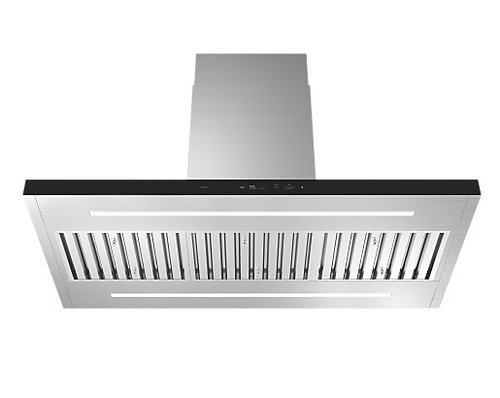
We are looking for a 54" island range hood, and the options are somewhat limited by comparision to wall hoods.


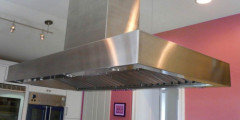
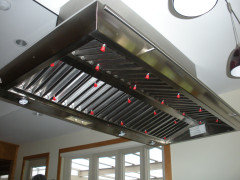
How effective are island range hoods of this 'flat' style?

Example:


Best, Dacor, Zephyr, and a number of other manufacturers use this style, though I can't imagine they are very effective in the periphery... especially on a 54" model.

Comments (33)

  • 3 years ago
    last modified: 3 years ago

    Ideally, one wants to trap (capture) the rising plume components and have them pulled through the baffle slots (and be, thereby, contained). This is aided by some volume below the baffles and definitive "fencing" of the plume as it tries to reflect off of metal areas that are not slots. In commercial hood systems, 'spillage' is defined as the part of the captured plume(s) that gets out of the fenced reservoir volume. I'm not sure that spillage even applies to the flat surface designs because the plumes weren't captured to begin with.

    The example above is likely effective over its slot zone, and perhaps a few inches wider, depending on CFM. It would best be used to overlap a cooking zone smaller than the baffle space area and not one a few inches smaller than the external boundary area, in my opinion.

  • 3 years ago
    last modified: 3 years ago

    A canopy shaped hood captures smoke and grease much better. There are a number of canopy shaped island hoods made. A flat hood is a lot of money spent on a less effective design. You can't fight the laws of physics.

    I still think the best bet is to get the range off the island. Of course, off the island is less expensive and an easier installation. Not just the hood, but your island needs to be large enough and deep enough for the range and for landing space around it - so that adds the cost of island cabinetry, counters, the support needed, and the required aisle space around that large of an island. Also, the idea of cooking while facing your friends sitting at an island is overrated and a product of TV cooking shows. You are looking down at your pots and pans, not looking at your friends. And your friends don't benefit from sitting at the island where smoke and grease are too close. Better to make an island a prep counter where people can hang out, drink wine, maybe help with the salad, and eat the appetizers set out on the island.

  • 3 years ago

    Thanks, all. All that makes sense and fits with what I had gathered, but wanted to make sure I wasn't missing something, given how many manufacturers are designing with this style today. These are mainly eye candy, I suppose :)


    I have looked at some inserts and considered a custom 'thing' coming down from the ceiling, but most likely that won't be the best route. However, I've noticed that basically most of the inserts aren't deeper than say 22-24", as well and often have light bars on each side, similar to above. Maybe those are sufficiently effective if they are recessed a few inches beneath the lip of the enclosure? Are there any island inserts worth checking out?


    With what we've learned, we would love to simplify by moving the range off the island, but most likely there isn't a design that will be be functional, given that framing, windows, siding, plumbing is already in-place. My wife did send the architect a question, but I'm not expecting any miracles at this point.


  • 3 years ago

    I was able to find a used 54" vent-a-hood... like 15 years old. I notice that it has some light bars at the outer edges, maybe 3 to 3-1/2" wide. Even with these, should it capture sufficiently with a 48" range? It is a 54" model... I assume 30" deep, though should verify.


  • 3 years ago

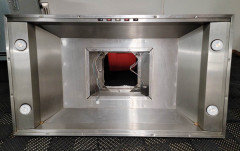
    What is the cfm for that? I would think it would not be high enough for a 48 inch range. I have a 5 year old 48 inch Vent-a-Hood. 1200 cfm. Here is a photo of the inside without the grease trays. Notice it has double magic lungs.


  • 3 years ago

    hi. It's the 1100 CFM model - 4 blowers (think this is 2 lungs)

  • 3 years ago

    With VaH squirrel-cage blowers, the fan curves are somewhat shallow; that is, they are more sensitive to duct and MUA pressure loss reducing their actual CFM relative to some conventional fan configurations. So care in minimizing pressure loss is desirable.

  • 3 years ago

    We ended up ruling out the Vent-a-Hood... they were very particular about mounting at 30" and mentioned issues when folks go higher. So, we did not want to chance that.


    On this topic of flat hoods... there are some that are not 'flat', but semi-flat. Say 6" deep, such as

    Blue Star Manhattan 54 or Modern Aire PSI-16


    Do these hoods (with 6" horizontal section) suffer from the same issue as the skinny and wide hoods, or are they effective?

  • 3 years ago

    I did not see any baffle view images at those links, so I cannot say more than the higher containment area will perhaps improve uniformity of flow over the baffle area. Otherwise, I need to know more to comment.

  • 3 years ago

    Thanks. Supposedly a traditional baffle, but I had the same question as you and when I spoke to Bluestar earlier today, they were going to reach out and send me the cad drawings. I will post up when I get back something meaningful! I agree deeper is always better, but there are some things competing here, including some skylights that will be blocked.

  • 3 years ago

    Have you looked at Modern-aire? They will customize any of their designs. I ordered a hood from them in my previous house. Made in USA.

    http://modernaire.com/hoods/

  • 3 years ago
    last modified: 3 years ago

    Thanks, chipsa. Yes - the PSI-16... still awaiting cost, but suspect that one will be beyond our budget... I believe it is about the same design as blue star.

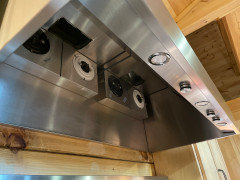
    kaseki - haven't gotten a response from blue star yet, but I believe these are the hood from below. More confidnt on the first than the 2nd, but they look about the same.

    I am thinking it is likely less effective at the edges than other designs, but is it sufficent?... hard to know.


  • 3 years ago
    last modified: 3 years ago

    Residential hoods are always a compromise with ideal (commercial) hood design, driven mainly by lack of height availability and the demand for minimal obtrusiveness. The hood images above show baffles, some tilt, some reservoir volume (minimal) but very little "fencing" around the hood. With the baffle angle, reflections are away from the boundary, so that is a plus.

    It may be visually obvious that if this design were made higher, the baffles could be raised, tilted more, and capture and containment improved (a little at first, more with, say 18 inches of height thickness). However, I think most would find this design approach satisfactory, even if not ideal.

    It will be essential, for hot oil/grease cooking, that the actual air flow meet the standard of at least 90 CFM/sq. foot of hood entry area. As I have remarked many times, the blower rating has to be higher to compensate for pressure losses, including those of the baffles and imperfect MUA. Depending on overlap area, some missed capture of such as steak searing plumes may occur. Cross drafts can be significant, as will be turbulence due to cook and others moving about. These aspects drive a larger hood length x width. If you mount this hood at 36 inches, you will probably want an entry aperture that is about 6-inches beyond the boundary of likely pan edges on the burners. (It is probably safe to count the 1-inch lip as part of the entry aperture, but also count it in calculating CFM required.

  • 3 years ago

    It sounds like you would guess this is a reasonable design. I guess the one thing I am concerned about is less consistent pull at the left and right edge. Best bet may be finding one of these and a wolf in a show room and doing a simple test with a tissue or piece of paper to see if one drops off signifiantly more than the other at the edge. Lots of variables there, but maybe a bit more telling.


    One nice thing about the bluestar hood is that it is 34 inches deep, although there is a light bar at the front and and back which might reduce that a bit. It is disappointing, however, that they are much higher on the cost of their blower at about $2k on the 1400 CFM. Do folks sometimes use for instance) the wolf or broan blower on another hood mfg?

  • 3 years ago

    If the blower is external to the hood, then the only limitation is whether the hood's controls, likely designed for a particular blower or blower type, will work with other candidate blowers. I don't want to get into how to re-engineer the controls. My Wolf (Broan) blower uses an induction motor and can be controlled by a simple diac-triac circuit (which is what was supplied in the hood, or one of the more sophisticated integrated circuits controlling via a less electrically noisy waveform. Some manufacturers use different windings for fixed different speeds, or in principle can use a relatively modern multiphase motor driven by synthetic multiphase waveforms.

  • 3 years ago
    last modified: 3 years ago

    Fair enough - thanks. I believe Viking is also using Broan, but not modernaire. Outside of vent-a-hood and blue star, not sure who else makes residental roof top blowers, but will check. Found out the broan cannot be mounted directly to metal roofing, so now we have to look at a curb.


    I find it very odd that Broan is discontuning the 1200 CFM units, leaving a big gap between their blowers.

  • 3 years ago

    Abbaka (now owned by Bluestar, I think) has/had a 1200 or 1300 size down slope roof blower.

    Discontinuance may be as simple as not being able to obtain the necessary motor. Has Wolf discontinued them also? My 2021 Guide shows that size being available. I suppose it is time to download this year's guide.

    If you need to use a curb, then you can also consider modest CFM sized up-blast commercial blowers, if the much more obvious appearance is not an issue.

  • 3 years ago

    I am dropping in for the first time in approximately a decade.... and *thrilled* to see kaseki here still giving the most excellent-est of advice. They contributed mightily to my kitchen with the best-designed ventilation system that I never had the foggiest idea I so needed! Believe every word!


    kaseki, whoever you are.... thank you so very much! <3 to all of the once and former GardenWeb!

  • 3 years ago

    Thank you, reports singular kaseki.

  • 3 years ago
    last modified: 3 years ago

    Hi All and @kaseki,

    We chatted about hoods and makeup air in the below thread and this thread, and I'm picking up with the discussion again.

    I've been off working other construction elements of the home, but in the meantime, did purchase the hood and range, though need to pick a rooftop blower and finalize the makeup air design.

    Range: Picked up a used 48" thermador PRD48JDSGU/10 with 6 gas burners (112,000 BTU) and griddle (electric).

    Hood: Picked up a used 54" Wolf Island Pro hood PI543418 ( from the same guy... for a steal!). It came with a 1200 CFM internal blower, but will install a roof mounted blower (if anyone needs an internal 1200 CFM wolf blower, let me know).

    The immediate: question is to go with a 1200 CFM roof top blower or a 1500 CFM roof top blower.

    I've verified Broan (and Wolf and Viking and Best) have discontinued their 1200 CFM blower. Why, no one knows... but it is a long term decision. HOWEVER, I could still manage to get one off ebay, etc.

    My vent hood ducting run will look something like this like this (10" rigid duct):

    {Range Hood} -> 2' rise within the duct cover -> 45 elbow -> 1-2' rigid duct -> 45 deg elbow -> 1- 2' rigid duct -> 3' fantech silencer -> 90 deg elbow -> 2' to roof deck -> {roof mounted blower}

    Per the wolf guide, this should give an equivalent duct run length of about 18'.

    Mfg CFM Guidelines:

    Thermador: suggests 1320CFM, based on a generic formula

    Wolf: suggests 1100 CFM on their equivalent range (with infrared griddle), and adds that more air flow for an island can be beneficial, and "High altitudes: Ventilation systems are less effective at altitudes above 5,000' (1524 m). At these altitudes, you should estimate a 20–25% reduction in CFM performance. A higher CFM blower and increasing the duct size is recommended. "

    Now, we are around 5,300' in elevation... I don't fully understand why ventilation airflow has to be higher (it's not combustion), but would assume that at the bottom end of the 'high altitude' range we would be fine with 10-15% adjustment.

    Do you think I'm better off with 1200 or 1500 CFM on the roof mounted blower?

    Downside to 1500 CFM is that it is more air flow, therefore more makeup air and therefore more energy used to temper the air (kind of 'wasted energy)... of course the bigger makeup air unit costs more, as well.


    Kaseki - any idea how low CFM your blower will go, and did you end up with the 1200 or 1500 CFM? I'm not clear if the bottom end CFM for those units is similar or if the 1500 might have a much higher low end. Sometimes you want just a little air flow going.

  • 3 years ago

    My Wolf (Broan) down-roof blower assembly is rated at 1500 CFM. Actual flow (roughly measured) is around 1000 CFM. I can't find my notes right now, but I think the minimum was around 300 CFM. I think I reported it into one of the FAQs here.

    Design minimum is partly a decision on ensuring starting when the power control is rapidly cranked from off to minimum, and an assurance that higher sized particles in low velocity greasy plumes (simmering bacon, say) will still be centrifugally extracted by the baffles.

    Generally, you want to run the hood at higher flow for a few seconds until the damper at the hood opens. The roof damper is part of the motor operation, but I haven't torn into it to see the exact mechanism.


  • 3 years ago

    Thanks, Kaseki.


    Remind me... you are on the 66" hood? Standard elevation?


    I sense the 1200 might be a little shy given island, elevation, and 36" mounting height... but the alternative is upsizing makeup air to match the 1500 blower, and that comes with a higher energy cost for the tempering.

  • 3 years ago

    Yes, 66-inch Pro Island hood, mounted at 34.5 inches above the counter. Entry aperture is about 11 sq. ft., as I recall (without remeasuring it). 350 ft. elevation.

    If the rated CFM is increased to make up for altitude, that just means that one is attempting to get the flow rate in pounds of air per minute higher. It is the air mass flow rate that determines the heat requirement.

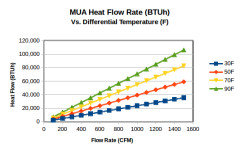
    For example, if a 1500 CFM (in free air) blower is used at a sufficiently high altitude, it might only move 1200 CFM equivalent at standard pressure and temperature (STP). So if that applied to you you could use the 1200 value in my graph below for MUA heat required. (Actually one should correct for pressure losses in the system at reduced pressure, which should be calculated for that altitude. However, the greatest pressure loss is usually the baffles, and you likely won't get that data to work with, nor have I seen from Broan or Wolf any altitude correction values for their fan curves.

    If you calculate a required air flow rate CFM of 90 ft/min times the entry area of your hood in square feet, and then multiply by 2X to cover all contingencies, the result would be the rated blower CFM to aim for.

    Click to enlarge; note values are for STP conditions without correcting for small changes in air mass per cubic foot as it is heated.

    rossn thanked kaseki
  • 3 years ago
    last modified: 3 years ago

    Thanks, Kaseki. Yeah, 2X is a pretty broad factor... that might be a really big hammer (that would spec me at 1620 cfm, and my hood is a fair bit smaller than yours).

    It is unfortunate mfg's don't publish their hood losses, so we can get a realistic idea off the fan curves... but, i do suspect they account for some of this with their overall guidlines for CFM ventilation for a range. I think they tend to 'ideal' CFM, and not actual when, for instance, Wolf says you need 1100 cfm for a range (and some additional reduction for altitude and island).

    Thanks for the charts - those numbers make sense for makeup air BTUs. And, I can certainly understand how that air density would affect that (and combustion). However, do you have clarity around why higher range hood CFMs are suggested by mfg's at higher elevations? In this case, you're still moving the same volume of air... it is just less dense. I'm not sure how that would affect effluent. Perhaps it spreads out more, due to reduced air pressure, and that would drive higher CFM needs?

  • 2 years ago

    @kaseki I seem to recall from a photo of your hood install that you may have incorporated a fire suppression system into it. I have the 54" version of the same hood. Do you have any information you can share about it, and in hindsight, do you think it was a good move or overkill?

  • 2 years ago

    No fire suppression system; stock OEM hood. However, all such hoods depend on the baffles to perform the function of fire blocking such that a cooktop fire doesn't propagate into the duct.

    I have an induction cooktop, so any fire is going to be an inadvertent flambe. Red thingies are not nozzles, but Wolf's favorite color grab knobs.


  • 2 years ago

    Ahh... OK. Color grab knobs? Lol, that's too funny! I think I could only see 1 or 2 in a prior picture, so assumed those were part of a fire suppression system... I thought, wow, Kaskei is serious! I didn't buy mine new, so I didn't know they offered an accessory like that to order. They're metal?

  • 2 years ago

    The baffle assemblies have metal mounts that the red plastic knob caps push onto. The mounts are stepped cylinders attached to the baffle frames by screws from the back. There are 10 baffle assemblies in my hood, so there are 20 knobs.

    Note that my hood was made by Independent before Wolf brought hood production in-house. However, the present images and drawings of the Pro Island hoods look identical. I haven't examined any recent ones to look for differences. In any case, the red caps can be left off for a more sedate look, if a monster hood can be ever be sedate.

  • 2 years ago

    Interesting. I would have thought some protective caps, and if they add the flare you are after, that's great.


    Do you have much knowledge on insulation of the ducted run through an unconditioned portion of the attic? i.e. what r-value, and common approach to handling that (be it a manufactured sleeve or a wrap that is added later?

  • 2 years ago

    The color was too close to typical Wolf knobs for me to assume that they were only for shipping. As I recall, the baffles were fairly well packaged. Also, I think the caps aid baffle assembly removal from the hood.

    I didn't insulate my attic ducting, so I can't help there. I have sound dampening sheets around my hood ducting, however,

  • 2 years ago

    They definitely add some pop.


    I figure I will need to insulate to reduce heat loss (when not operating), as well as to prevent any condensation/drip issue.


    Interesting. Are you saying that you applied a layer of self-adhered sound dampening mat on the entire duct or just some particular spots to add some mass and help with vibration? Did you hear before/after to know if they make much of a difference.

  • 2 years ago
    last modified: 2 years ago

    You should have a damper near the duct/hood interface as well as outdoors where the duct end or blower assembly is. This will keep the air still in the duct and minimize heat loss. Feel free to insulate if you wish.

    I ended up enclosing most of the duct and silencer with sound deadening material. While the type I used was for vertical surfaces, I didn't trust it to stay in place, so each section has circumferential ty-wrap strapping. While the silencer could deal with high frequency blade-tip turbulence noise, there were lower frequency motor vibrations that were induced into the ducting. The difference was noticeable. If the motor/fan is sufficiently balanced before installation, this might not be an issue, so it is worth testing. A factor may be the stiffness of the roof that the blower is mounted on.