Software
Houzz Logo Print
ingrid_vc

Roses For Rather Miserable Locations

Before I had decided to try roses again my solution to populating all that dirt around my house was oleanders. Roses, of course would be infinitely preferable, but there are spots here that are sunbaked and miserably hot all day. I wonder if there are extra-tough roses (which of course still have to be beautiful!) that would survive such conditions. They would of course have water from a drip system.


Jeri, I've been drooling over HMF "Grandmother's Hat", where most of the images seem to be yours. My question is, can this rose be grown in a hot, sunny location where other roses might fail? I've been wanting this rose forever but its large size isn't suitable for the small plots in front of the house. Could it survive and thrive in another location where it wouldn't get afternoon shade?

Comments (27)

  • 3 years ago

    I wonder if you could rig some shade cloth to help your roses during the hottest times, Ingrid. That, and drip and mulch could help your roses live up to their potential. I know you are trying to conserve water too, but sprinkling/hosing them down on occasion could really help too.

  • 3 years ago

    Hi Ingrid, I know it's one whose colour you're not fond of, but Ms Tillier has survived decades of neglect in abandoned gardens here. Are you thinking of getting the newish apricot oleander that stays quite small? It looks pretty. Also, what do you think of Echium candicans? Bees , butterflies and birds are said to love the flowers.

  • 3 years ago

    Trish (do I have that right?) I quite like Monsieur Tillier because no matter what the color the shape of the bloom is beautiful so MT would be a definite possibility, thank you. I also like Echium candicans since I'm very fond of purple flower, and bees, butterflies and birds liking it would be a very welcome quality in the garden. It somehow doesn't look as though it would be super tasty for the ground squirrels!

  • 3 years ago

    Yes, Ingrid - it's Trish. I forget to sign my name. Apparently, deer don't like the echium, so hopefully ground squirrels don't either.

  • 3 years ago

    Hi Ingrid, have you ever tried grafted roses? I believe you ordinarily purchase own-root, but I was wondering if a rose grafted to something with strong aggressive roots would make a difference for you. If you've never tried, it wouldn't hurt to buy one or two and see what happens.

  • 3 years ago

    Trish, that is good news about the Echium, I'll look for it locally. I have just the spot (or spots) for it too. bellegallica, I have three roses that I bought locally which are grafted. Hopefully they'll do well. Sheila, I've ordered Etoile de Lyon and also Rhodologue if it's the same as Triomphe, although I believe they're not the same in your garden. I love all your choices except for Mme. Antoine Mari which for me had an insubstantial and rather shapeless flower. Still, I have plenty of choices to begin with!

  • 3 years ago
    last modified: 3 years ago

    In my garden Triomphe and Rhodologue are different, but I do think Rhodologue is the usual sold under both names. Here, Triomphe from rosepetals is different but maybe too wimpy for my poor condition retaining wall compared to R although the blossoms are lovely. Some of the baby roses sunburned which did not do them any good long term.

  • 3 years ago

    Speaking of cemetery survivors, Octavus Weld (which you call Angel's Camp Tea) was a cemetery survivor here. I love the colour of the blooms in cool weather - not that you get much of that! Trish

  • 3 years ago

    I had Angels Camp Tea a long time ago when I was first starting with the old roses and idiotically did not give them time to show what they could do. I do remember that the blooms didn't wow me, being a bit on the shapeless side, but who knows how it would have matured. That is a mistake I'll never make again. The roses I'm purchasing now will stay put unless I actually hate them (doubtful) or they hate my conditions.

  • 3 years ago

    I am also going to reccomend Monsieur Tillier. It’s almost plant and forget once established. But be sure to give him room. I wrongly thought 2 would be a good idea in my yard, and am now in the process of removing one because it was trying to take over the driveway.


    Another somewhat controversial option is fortuneana. You often see it in old properties where the grafted rose has been cleared and it has regenerated from the rootstock. Only once blooming, but very cute flowers and nice dark foliage. the small leaves make it waterwise too. Another large grower though.

  • 3 years ago

    Billy teabag (one of the Tea Ladies) did describe Octavus Weld as looking like a dishevelled parrot, so you're right about them being shapeless most of the time! I loved the milky pink colour of it in the cooler weather, though.

  • 3 years ago
    last modified: 3 years ago

    Adam, I'm glad you second the Monsieur. A rose I can forget about sounds like a winner for a poor location. Strangely enough I once long ago had R, fortuneana. It was labeled R. banksia and wasn't. However, when you have a ten-month rose blooming season it's difficult to admire a rose that only blooms for a few short weeks. Trish, I kept seeing Billy Teabag on HMF and had no idea it was one of the Tea Rose ladies. "Dishevelled parrot" is a scream, I was laughing out loud!

  • 3 years ago

    Adam, 'Fortunia' can grow here, where there's usually zero rain from the end of April to mid-October, without any summer irrigation at all (something I found out by chance, but there are a bunch of them also unirrigated at old homesteads in the area). Mine grows in what is basically subsoil on a hillside but still blooms for about a month to 6 weeks in early spring and then is a nice-looking mound of leaves for the rest of the year. Growing it without irrigation keeps it less rampant, I think, though I still have to police it to keep it from climbing nearby toyons and ceanothus.


    "Darlow's Enigma" has made a wonderful large shrub on a hillside with terrible soil in my front yard. Bees adore that thing and it has zillions of red hips that birds eat all winter. It blooms spring/summer here, but doesn't bloom in late summer or fall (I definitely don't/can't deadhead it!). For another, I am convinced that you could maybe grow 'Lyda Rose' on a rock and it would still do well. Blooms pretty much constantly from early spring to late fall (in bloom now, in fact) and can be so full of flowers that hardly a leaf can be seen. A large shrub of it had to be cut nearly to the ground last winter for termite tenting and it's already grown back to a well-shaped, full, 5' shrub still continuously in bloom (and it was inside the tent and poisoned!). I've been so impressed with it that I made a couple more plants that I'm trying in some even more difficult areas. Also has showy winter hips -- I do deadhead this one, but leave the last flush for a winter show. Both of these roses never have less than perfect foliage here, no matter what, which is another huge plus, and both have good wafty scents..

  • 3 years ago

    Lyda Rose is lovely and one I'd want to grow for the bees if nothing else, but it sounds like a winner in every way. Darlow's Enigma has even prettier blooms, I think, and makes a gorgeous bush from what I can see on HMF. The jury is still out on whether the ground squirrels will allow me to grow any roses, but I'm accumulating ideas for some beauties just in case!

  • 3 years ago
    last modified: 3 years ago

    I notice that roses with tiny leaves and tiny blooms: Darlow's Enigma, Lyda Rose, Blue Mist do best in light & fluffy & dry and fast draining soil.

    Roses with large leaves: Betty White, Sweet Mademoiselle, Princess Charlene de Monaco with large blooms or Austin zillion petals do best in my heavy & dense and soaking wet clay.

    Darlow's Enigma and Lyda Rose died instantly in my soaking wet clay. Blue Mist was wimpy in soaking wet clay, so I moved it next to a tree .. the soil there is poor and fluffy from tree roots making the soil into dry dust. Blue Mist improves and blooms more in that poor and fast draining soil.

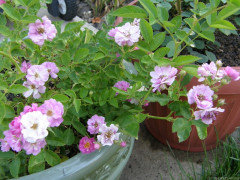
    Below is Blue Mist when it was a pot, it did well since I drilled zillion of holes in the pot for fast drainage, and the potting soil constantly dries out in full sun at 90 F when this pic. was taken:


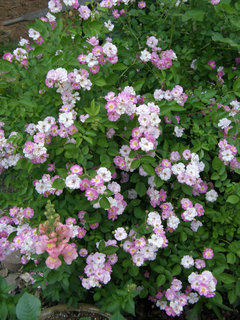
    Below is Blue Mist planted in the ground, blooming well even with tree roots invading it. Extremely prickly and rabbits and squirrels don't dare to come near.


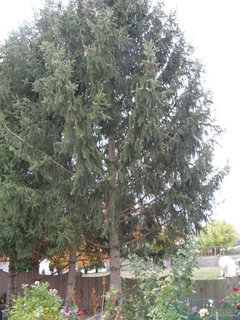
    Below is the hedge of 20+ year old Norway Spruce that are very close to Blue Mist. Workers will chop 2 of the trees closest to my house this Tuesday 11/15/22 since they are invading my roses. Blue Mist is planted very close to that hedge of huge trees. It's the lowest, left most bush, still blooming as of 11/9/22. It will get down to 22 F this Sat.

    Roses that can bloom in extreme cold can take extreme heat. Roses that can survive my zone 5a winter for over a decade like Blue Mist also do well for Pakistan rosarians at 112 F and sandy soil. Below pic. was taken last week and sent to the tree company:


  • 3 years ago

    strawchicago z5, things seem work out differently here in a warmer climate when it comes to soil, as both my 'Lyda Rose' and 'Darlow's Enigma" are growing in dense, clayish, gravelly soils of low natural fertility and organic matter that become rock hard when dry. Of course, there's hardly a hope of any soil being soaking wet for long here, even when there isn't a drought! And, we are on a hillside.

  • 3 years ago

    I can't help but chime in for Darlow's Enigma. This is a great rose for a tough spot. But I grow ii'in pots, so I can't speak to anything regarding soilsoil types.

  • 3 years ago
    last modified: 3 years ago

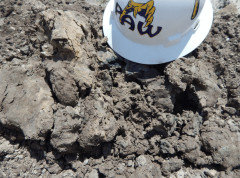
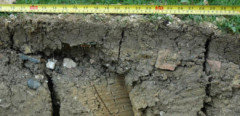
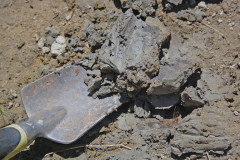
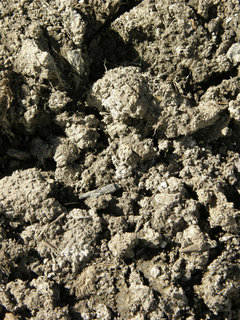
    I lost the pics. of my black gumbo clay that clumps into large chunks the size of grapefruit, and even vinegar could not soften it. Below are some internet pics. that closely resemble my sticky & heavy clay that broke 3 shovels. My clay was tested exceedingly high in magnesium, and it's soaking wet when rained due to poor drainage, but rock-hard when dry:


    Folks here use a pick-ax to dig holes since the clay is like cement blocks. Cluster-root multilfora-rootstock hates my sticky clay:


    Below the black gumbo clay-layer is harder & lighter clay like cement blocks mixed with rocks. That's why I spend 2 hours digging per hole.

    Below link is worth looking for the slide-show of pics. of different soils: loamy, clay, chalky, silty, sandy, and peaty soil:

    SUSTAINABLE GARDEN: “Know Your Soil” – TSKTECH.IN

  • 3 years ago

    Wow @strawchicago z5z5!! That is soso clear with thzthe pictures! What a tough job to do all that digging and soil improvemenimprovement there. Thanks for sharing!

  • 3 years ago

    My soil is basically decomposed granite to which I've added potted soil. I don't expect the roses to leap into growth or bloom production, but the rain we had yesterday will surely help them.


    This morning I hit on the idea of putting pepper leaf fronds on short branches around some of the roses as a possible ground squirrel deterrent. I wonder if anyone else has tried this. I smelled like a pepper tree myself after a while. That is very strong stuff!

  • 3 years ago
    last modified: 3 years ago

    I did the same with strong-smelling basil and mint .. I put them into pots to deter squirrels from pots. Ingrid: I googled "decomposed granite" and found below info.

    " Decomposed granite soils are often sandy in texture, drain too quickly and dry out easily. "

    Roses that do well for Noseometer in his sandy soil & hot and dry New Mexico might do well for decomposed granite. Noseometer mentioned that Abe. Darby does better for him than Evelyn. Same with Brendan in his zone 10b Malibu, CA. Brendan informed me that Abe. Darby is his best bloomer in pots, and Golden Cel. and Jude the Obscure don't bloom much.

    Noseometer mentioned about Desdemona & Bishop Castle as his best performers.

    For heavy clay like mine (rich in minerals), it's a waste of money to use salty chemical fertilizers. Heavy clay retains salt too well. I never have mildew on my roses for 30 years growing 150+ own-root roses, except for this year. We have lots of rain this year.

    1) Certain roses got zapped by winter too short, plus organics don't work well in cold spring, so I had to use chemical fertilizers (MG-shake and feed granules at NPK 12-4-8, plus Osmocote PLUS NPK 15-7-12).

    With chemicals roses have more blooms ALL AT ONCE, rather than one bloom at a time like slow-released organics. NOT worth it.

    2) After spring flush, I ordered bulk Rose Tone from Amazon, waited for months but never receive, so I used available chemicals.

    3) I get mildew FOR THE 1ST time in 30 years, thanks to my heavy clay retain salt from chemical fertilizers too well. These fertilizers have urea and ammonia at salt index from 74 to 104. Before this year, I was 100% organic, using alfalfa or mint tea, biochar, horse manure, or chicken manure in spring.

    Big roses in pots that were fertilized with alfalfa tea plus sulfate of potash (a natural mined mineral with low salt index of 43) .. these don't have mildew.

    Tiny rootings that I sprinkled Osmocote PLUS to force blooming also came down with mildew. Nitrogen at 15 is too high, too salty, and chemical nitrogen fertilizer is too acidic for my high rain climate.

  • 3 years ago

    There is no way i can dig on our property. Apparently, it is ancient ruver bed and the soil is cmpacted fine sediment strewn with rocks and large boulders. So i resort to no dig - as per Mr. Charles Dowding.

  • 3 years ago


    That one is estimated to be 5 tons. The builder contemplated blowing it up but in the end thought the better of it and just left it there - right in front of the main door (which I was told is bad Feng Shui)

  • 3 years ago
    last modified: 3 years ago

    cactusjoe1 Nice rock garden you did. Looks so serene like a Japanese garden. We have beigish dolomitic rocks at 2 feet deep that block drainage.

    There's a spot in my heavy clay that killed 4+ own-root roses, then husband went in with a pickax at 2 feet deep to take out chunks of flat rocks that block drainage. Before this a bucket of water could not drain at 2 feet deep. We get super-heavy rain here that collapsed my brick border.

  • 3 years ago

    I consider most of my roses to be pretty tough...if they're not, they die and are out of here. We get adequate rain sometimes but can have long periods of drought and heat. My soil is light and not very water retentive so I'd say they rough it for months sometimes. I don't have an irrigation system and tend to only water by hand the smaller, newer plants. I often plant a rose with a reputation for great vigor in my dryest, most challenging spots. That way it might curb it's eventual size a bit. So you might try some plants with great vigor. They might have so much inclination to grow that they would deal with your challenges. Many roses you used to have seem like they did well in your spot except for the critters.


    I agree with the poster above that suggested trying a grafted plant . Fortuniana might be a good one. Palatine has wonderful plants grafted on multiflora. Some plants I have own root growing under a crabapple tree where there's a lot of root competition: The Faun, Lyda Rose, Madame Plantier, Mme. Antoine Mari, Ballerina...those ones are doing the best in that situation.

    My Mme. Antoine Mari has really developed some pretty blooms the older the plant gets. I have a James Galway under that tree that is toughing it out and slowly putting on size, also Munstead Wood, Kronprincessin Victoria, Purple Lodge, Tradescant or whatever it is, and Edgar Degas and X-Rated mini. In another bed Madame Berkeley , Chartreuse de Parme, and Rainbow ( tea) do very well even with a lot of root competition and afternoon shade.


    I don't know if cat litter or those polymer water crystals actually do any good in holding water. Clematis experts often suggest growing a shallow rooted plant to shade clematis roots. It seems like it would be a trade off as the shallow rooted plant would still compete for water. But a little shade for the root area can help. I know you used to grow a lot of interesting companion plants. I know you don't like the looks of potted roses, but I do find that if you put a potted plant beside a young rose in the ground the moisture from the pot helps keep the new rose moist. That could work as a temporary help in getting a new rose established.


    Since you have an irrigation system maybe you don't have to worry much.


  • 3 years ago

    straw and erasmus, Bishop's Castle also did extremely well for me, as did both Evelyn and Abraham Darby. We have a large rock formation literally within feet of the side of the house and in one bed my husband hit the underground extension with just a bit of soil above that, and amazingly the roses survived there with help from good potted soil and alfalfa meal. I did have quite a few lovely companion plants and those were the first to go in 2018-19. Losing it all bit by bit........never mind, can't talk about it. But I'm full of hope again, and am lovingly hanging over my small garden of sticks which have sprouted little shoots since the recent rain. It's amazing how everything wants to grow, in spite of all odds, and roses are actually rather amazing in their toughness, especially the older types or even newer ones which have been bred to be tough and resistant to everything. I still will stick primarily with the old varieties and one or two Austins I must have. Well, I did order Lauren, Yves Piaget., International Herald Tribune and Aunt Margy's Rose but at least three I think have old rose parentage also. They'll all be buried in pepper tree foliage and I hope the fumes don't kill them.

Sponsored
Kuhns Contracting, Inc.
Average rating: 5 out of 5 stars26 Reviews
Central Ohio's Trusted Home Remodeler Specializing in Kitchens & Baths