Software
Houzz Logo Print
jdpyn2

Some Cold-Hardy Satsumas and How I Planted One

3 years ago

Apologies for being absent from here so much in the last few years. After the super cold freeze year before last, I have been focusing on other things. The freeze took out some really nice citrus (beautiful calamondin, lots of lemons, and a blood orange that had just given me a bushel of wonderful fruit) but I have some Ponderosa lemons coming back very nicely from the roots (seed-grown), both kumquats survived, and my best Satsuma orange (Owari) came through without flinching. Ok, enough on catching up!


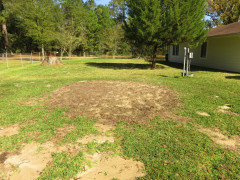
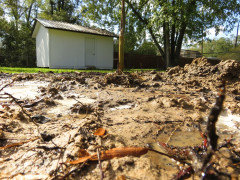
I recently lost a very nice red oak and was lucky enough to have been able to use the trunk as a lever and uprooted the root ball. I hauled out a bunch of gummy clay and brought in several trailer loads of river sand to backfill the hole. I tilled in the sand with the remaining clay to get something that's probably 90-95% sand. There is no doubt this will be like a huge pot of sand in a gummy clay pot but the sand area is plenty big for a large citrus tree's root zone.


Today I visited a local nursery and ran across some cold-hardy citrus, very new to local stores, and produced by a grower right here in my own town, aptly named Orange, Texas.


Here are the three varieties and hopefully some of you in the more northern zones are able to find them.


Bumper Satsuma to 20F


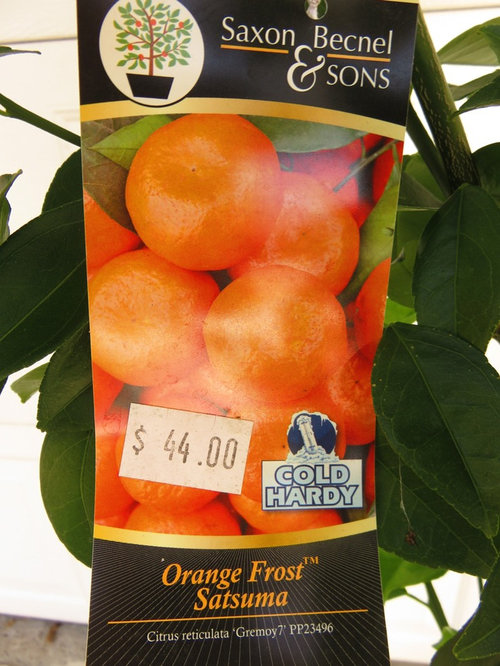
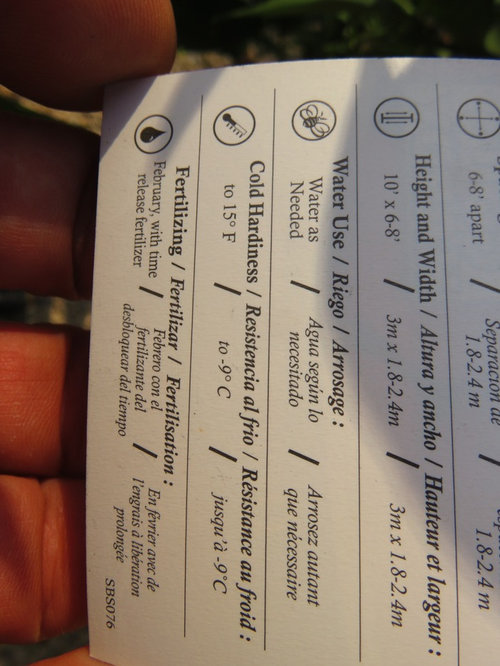
Orange Frost Satsuma to 15F


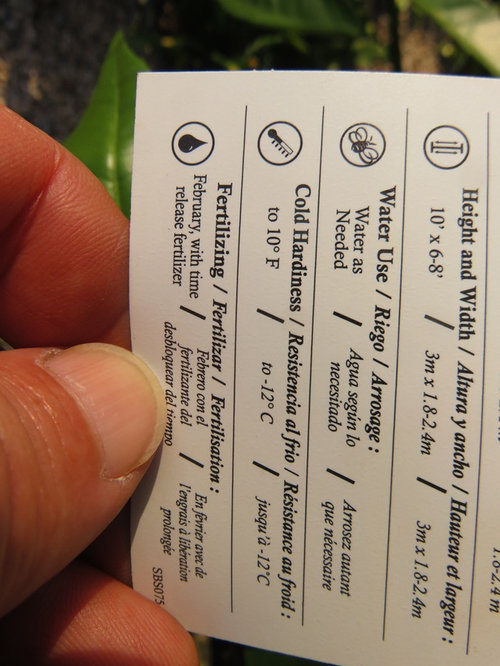
And Arctic Frost Satsuma, to 10F


I think these tolerances are probably for a mature tree so I'm sure we need to protect them during cold nights for a few years.

Comments (19)

  • 3 years ago
    last modified: 3 years ago

    All of the photos should enlarge nicely if you click on them.....not sure why they don't stay enlarged.

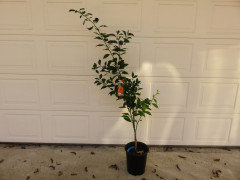
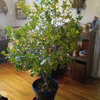
    I decided to pick out one of the Orange Frost variety.

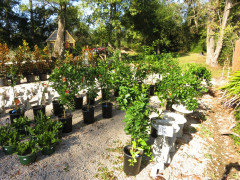
    Here are the trees at the nursery. All very nice ones to choose from so I went for one that had a more upward habit since I want the tree to grow more upward before branching out.


    I'll share my planting method. It may not be completely without error but it's what I have settled on over the years. If you wish to critique or propose improvements, you are certainly welcome to do so! I think we are all here to share and learn.

    I decided to go ahead and plant the tree in-ground now rather than leave it potted during the upcoming winter. I'm in SE Texas so we get mild winters compared to our more northern neighbors. It got down in the teens several nights in a row year before last...unusual for us...but we get a few nights down in the mid to upper 20s most winters.

    My soil is compact clay and on flat topography so it's very poorly drained. The location for this tree is in a higher part of my yard so hopefully this will be a great location just so long as the clay surrounding the sandy part of the hole doesn't retain water too badly.

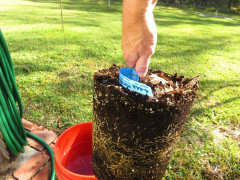
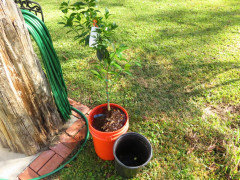
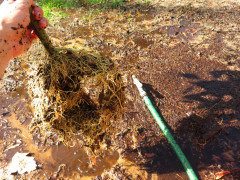
    I have read it's good to soak the new tree for 30-minutes or so to give it a head start on hydration and to help get the potting soil off of the root wad.


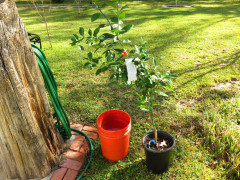
    Here is the location where the oak was and were I have brought in sand to have a looser substrate for the new tree. I brought in enough sand to create a broad mound. Citrus like lots of sun so this open site should be great. It will get a little shade in the evening.


    I don't think it's good to leave the nursery potting media around the roots so I use a gentle spray and some finger work to remove the media...fine and coarse woody material in this case. The smaller roots are very fragile so I used some judgement to decide how much damage I was willing to do in order to remove an appropriate amount of media. I definitely lost some fine roots but I think this will be OK since it's cooler weather now. I also found a fairly major root already growing in a big circle around the pot side. It was small enough to straighten and trap in an outward direction while planting.


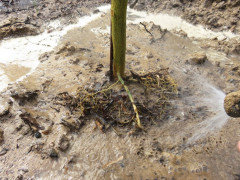
    I used the hose spray nozzle to help backfill the hole, holding the tree high enough so the topmost roots will be a couple of inches above the rest of the mound...photos to illustrate below. Using the spray nozzle to backfill a few inches at a time, ensures the sand backfills into all the voids I have created in removing the nursery potting media from the root ball. I was kind of busy so I didn't get an intermediate photo.


    Hopefully the above two photos show the top inch or two of roots are above the rest of the soil, even in the generally mounded up area. Once I am comfortable with that level....considering that these plantings usually settle for a while....I broadly slope the excess dirt up to just barely over the shallowest roots. I'll probably need to add a little more dirt after the next couple of rains to make sure the shallowest roots aren't exposed more than perhaps just barely being able to see the tops of some of the bigger roots.

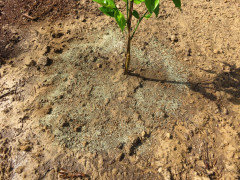
    After smoothing out the soil, I did a light application of an organic fertilizer I like, Microlife Ultimate 8-4-6. It's expensive but I think worth it when you want to add all the micronutrients and some microbes to something like the sandy substrate I used here. The application below may look a little heavy but most of it is well outside of the current root zone.


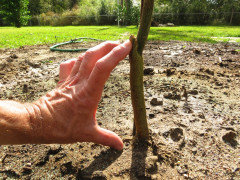
    Closeup showing the graft 4-6" above the soil. The shallowest roots are just barely below my thumb.


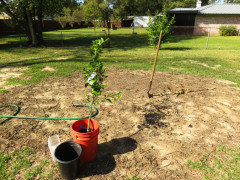
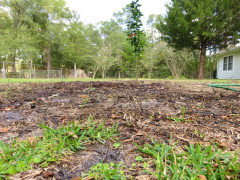
    Another showing the broad mound the tree is planted in. Folks with a drier climate may need to flatten a bit if you need to retain more water.


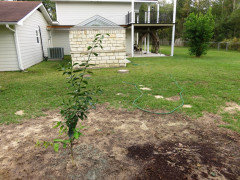
    And finally a general shot of the planted tree. Can't wait to see how it does!


  • 3 years ago
    last modified: 3 years ago

    Bumper, Orange Frost and The Arctic Frost Satsuma is the work of the late Dr. Ying Doon Moy. He was a notable plant breeder with the San Antonio Botanical Garden in Texas for 20 years, where he created 150 new varieties of fruits and flowers. To create the variety called ‘Gremoy 79’ he began with a winter-hardy traditional Chinese tangerine called ‘Changsa’, edible but full of seeds. He pollinated plants of this variety with various satsumas, which have few seeds but are more cold-sensitive. All these varieties are mandarins, selected forms of Citrus reticulata. The seedlings were tested outdoors for seven years before the most cold resistant was found. This was a plant called ‘Gremoy 79’, which has now been released as a Texas Superstar™ plant by Texas A&M University AgriLife Research, with the name Arctic Frost™.

  • 3 years ago

    Thanks for adding those details on the development!

    I have always believed one should put flavor and texture way above some other characters (I seldom buy seedless watermelons) but being able to grow the plant is certainly critical. Hopefully the flavor of this cold-tolerant version will be consistent with the Owari.

  • 3 years ago

    That’s great John! And thanks for the explanation citrus monster lol. John, I hope you get lots of fruit out of those. I posted today about my cold hardy mandarin that has survived here in MD. It was surprisingly good. I finally tasted the fruit this year for the first time. Glad to see you doing so well. :)

    John 9a thanked Laura LaRosa (7b)
  • 3 years ago

    Thanks Laura. I went a checked out your post. I guess there is that concern when we plant cold-tolerant in wondering if edibility or production had to be sacrificed for other traits.


    The weather has been perfect the past couple of weeks for a newly planted tree....not too cold at night and periodic light rains. Hopefully the roots will be setup and ready to put on a foliage growth spurt this spring.


    Funny update on the fig cutting you shared quite a few years back now. I have done some re-rooting/air layering to share with others or to get another plant from a wayward branch. I have one tree out in the yard and it is only doing so-so out there. However, it does know it's winter and dropped all of it's leaves, as has my celeste that I have had for many years. I potted one of the Peter's honey fig branches and it's flourishing in my outdoor shower....well, sort of outdoor since I added a glass roof. The shower is not heated but that fig has no idea winter is upon us and it's fully leaved and has several green figs and one that I'm waiting to get dead ripe. I'm pretty sure they are still suffering from jet lag these many years later :>)

  • 3 years ago

    Good luck with the arctic frost, John. i had one once but gave it away before it fruited. The person i gave it to said the the following yeat it fruited, but the fruit was not that great. The next year it tasted much better, and now the fruit quality is excellent. Wish i still had that tree. i heard at the nursery i purchased it at that there is someone was who had some in ground here in NC.

  • 3 years ago

    Thanks for the info on these Satsuma varieties. I am in zone 8b (N FL). We just moved here from a zone 9a (closer to a 9b these last 5 winters. I am on the lookout for more cold tolerant citrus for our new farm. Hopefully I can find these newer varieties in FL soon. I usually only see Owari or Brown Select.

    I have a bunch of tropical citrus (red fingerlime, buddah's hand, thai lime, etc.) now, that I have potted and overwinter in an outbuilding. I need to start getting citrus that I dont have to baby lol.

  • 3 years ago

     What do sustama varieties go by the name

  • 3 years ago

    Are there any sustama varieties that can handle out side winters in zone 6b

  • 3 years ago

    Arctic Frost is about as cold tolerant as satsuma gets and they're only rated for Zone 8.

  • 3 years ago

     But I live in zone 6b

  • 3 years ago

     But I live in zone 6b

  • 3 years ago

     But I live in zone 6b

  • 3 years ago

     I live in zone 6b 


    Howard

  • 3 years ago

     I live in zone 6b 


    Howard

  • 3 years ago

     I live in zone 6b 


    Howard

  • 3 years ago

     Then why do some  Meyer lemons taste sweeter  than others

  • 3 years ago

    Thanks Laura. I found out about the flavor thing just this year. The flavor really changes with just a little more time on the tree!

Sponsored
Peabody Landscape Group
Average rating: 3.5 out of 5 stars8 Reviews
Columbus' Reliable Landscape Design & Contracting