Software
Houzz Logo Print
snowcountry

Radiant floor heat and foundation

3 years ago

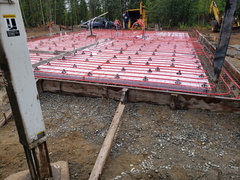
I recently learned that the radiant floor heat should stay away from the foundation 36”, 18” on either side. What happens if the heat practically touches the foundation? Would it compromise the foundation over time? Looking at pictures I took before they poured over the concrete clearly shows, the heat extends all the way to the foundation wall.

Comments (12)

  • 3 years ago
    last modified: 3 years ago

    What's your source for this information? I have radiant heating in the slab on the first floor, and under the sub-floor of the second story. I can't imagine why having the heat closer to the edge than 18" would be an issue. It hasn't been for me, and my house is 20 years old. It seems like you would have a cold perimeter if the tubing was this far back.

    snowcountry thanked kudzu9
  • PRO
    3 years ago

    Whenever I provided in-floor heat in a project, I used rigid insulation under the entire slab and between the slab and the foundation wall, and down the foundation wall. The footings for the foundation wall were below the frost line. My biggest concern was not to heat outside the building's living space.

    snowcountry thanked Mark Bischak, Architect
  • PRO
    3 years ago

    @Mark Bischak,

    I used to live in the frozen north, too, but I have been blessed to spend the majority of my career south of the Mason-Dixson Line. We only need to dig footings to 18" depth below the surface here in coastal VA. Of course, the mild climate obviates the need for in-floor radiant heating.

    snowcountry thanked Charles Ross Homes
  • 3 years ago

    I have never heard of this before. And can not think of a good reason for this. Usually the goal is to have a curtain of heat inside the outside wall.

    The cold climate research center has plans for frost protected shallow foundation slabs.

    snowcountry thanked aklogcabin
  • PRO
    3 years ago

    The goal is to make the people inside the house comfortable. One technique is to reach that goal is to have a curtain of heat inside the outside wall. Another technique is to heat the floor and have it radiate heat up, heating the things it hits like feet. Normally if ones feet are comfortable the rest of them is comfortable too. Radiant heat, either through a floor or radiator or ceiling panel is generally a nice even heat, but some other method would be needed for cooling.

    snowcountry thanked Mark Bischak, Architect
  • PRO
    3 years ago

    @Mark Bischak,

    Actually, radiant cooling is a viable cooling technique, albeit not appropriate for all climate zones. I wouldn't recommend it for a humid climate zone, but it would be a good candidate to consider in a dry climate.

    snowcountry thanked Charles Ross Homes
  • 3 years ago
    last modified: 3 years ago

    How do you do radiant cooling?

    The source is my builder. I have intererior foundation walls for some reason. One of the foundation walls is between the bathroom and the entrance. They left out heating under the entry way. When I protested it, my builder claimed it was for the foundation. That you needed 36” clearance, 18” on either side. In my case, all 36” are on one side, in the entry. I pointed that out and he admitted it was misplaced. It got me thinking if I should worry about the foundation.

  • 3 years ago

    OP:

    “How do you do radiant cooling?”

    Radiant cooling, or hydronic cooling can be done by ‘in-floor’ just as heating is done by feeding the floor or slab with chilled water. It can also be done with chilled beams mounted in ceilings. However, very careful monitoring of room temperature, fluid temperatures, and humidity levels must be monitored and controlled to not exceed the dew point and cause sweating.

    This is usually beyond the scope of residential HVAC companies that only specialize in force air heating & cooling or hydronic heating only installations.

    It can more easily be done residentially with the installation of geothermal Liquid-To-Liquid (Water-To-Water) heat pumps or Air-To-Water heat pumps that are all ‘hydronic’ and supplementing in-floor radiant heated floors or slabs with reversible hydronic fan coil units that can accommodate heating and cooling and have built in provisions to accommodate and draw away moisture (condensate).

    This is where modern cutting edge HVAC is heading towards - particularly with and because of the push towards electrification, decarbonization, banning of natural gas and other hydrocarbon fuel sources, reducing GWP of refrigerants and energy efficiency requirements. Hydronics with heat pumps have the lowest operating cost, highest efficiencies, quietest operation, easiest most effective zoning and some of the greatest comfort and satisfaction levels.

    Is it cheap to install - No!

    Is it ‘economical’? Depends how you look at it and what you value.

    IMPO

    SR

    snowcountry thanked fsq4cw
  • 3 years ago
    last modified: 3 years ago

    Yes in floor heating tubing is placed throughout the floor and provides a nice heat. That's why I just installed it.

    While researching I could not find anything that suggests what you have. And being blessed to live in snow country for a bit I've seen quite a few installations. The plumbing n heating expert with over 4 years doing this is also a best friend. Was nice to have his expertise and his son installed the tubing.

    Balancing the zones is critical. And some will install the heat lines closer together near an outer wall to counter the heat loss near outer walls and windows. The building envelope.

    The manifold centered in the home as much as possible also helps to disturb heat more evenly. I will have different zones for the bedrooms, pantry n such.

    Hope that helps a bit. I certainly know what it's like to heat, pay for heat, after 40 years. A picture of our floor. I also put 4" of pinkboard on the outside of the foundation perimeter. Will put 2" extending out from the foundation next spring. Everything frozen

    My Project · More Info


  • 3 years ago

    snowcountry- I hope these replies have put your concerns to rest. This experience may suggest not giving as much credence to a contractor who gives you baloney when he tries to rationalize any further mistakes.

    snowcountry thanked kudzu9
  • 3 years ago

    " This is where modern cutting edge HVAC is heading towards "

    Baloney. "Modern" cutting edge HVAC isn't heading either toward radiant cooling nor toward ground source heatpumps (intentionally and wrongly referred to by this fellow as "geothermal", a misleading marketing term).


    If you have a steam geyser in your backyard and you have a means to capture the heat, that's geothermal in normal usage.

    snowcountry thanked Elmer J Fudd