Software
Houzz Logo Print
middlepath

Cecile Brünner and ?

3 years ago

Hi everyone.

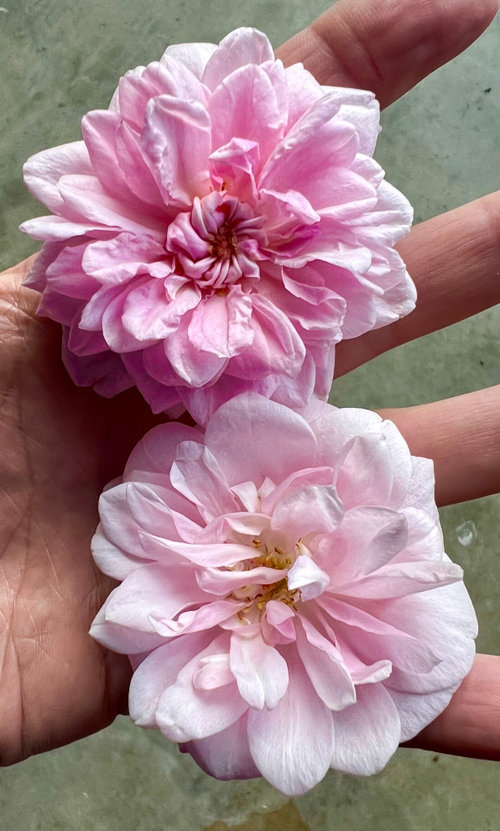
I’m hoping you can help me identify a rose (see pic). The top one is a mystery and was already well established in the yard when I moved in thriteen years ago. The one on the bottom is a Cecile Brünner (shrub) from ARS that arrived two months ago. Are they both Cecile Brünner, the only difference being the mystery rose is a well-establsihed shrub? BTW, the top mystery rose is more fragrant.

Many thanks!


Comments (8)

  • 3 years ago

    Please post pictures (of both roses) of the buds, and the leaves, and the thorns, and any hips if you can find them. Also the entire bush of your old one and your new one. That will make it much easier for folks on here to help you. BTW, I understand that there are at least 3 main Cecile Brunner sports (mutations) which have been identified so far. I think the blooms are the same, but the growth habits are different. One is a bush, one is a larger bush with sprays of flowers sitting above the bush, and one is a house eating climber.


    Jackie

  • 3 years ago

    What Jackie said.

  • 3 years ago

    Jackie is right, and what's more, IME the three are easily confused even by nurseries. I ordered The climbing house-eater CB from Loubert (a very reliable nursery in France), and recieved an enormous specimen, but it turned out that it is NOT the climber. I later on did get the real climber, and there are 2 things that clearly differentiate the plants, even before the climber starts to climb. One of them-I believe it's the huge bush variety-blooms lateish in rose season, whereas the climber starts earlier (a big plus in my eyes) . Also, the flowers of the huge shrub form have particularly long, lacy sepals,whereas the climber 's sepals are less noticeable.

    I tried to get another of the true climber a third time ordering from a third nursery ,and this time got what must surely be the smaller shrub-much less vigorous than the first one. I think it threw in the towel...

  • 3 years ago

    middlepath - I went out and looked at my 2 remaining Cecile Brunners yesterday (we had to have the huge climbing version taken down off our house to make the Fire Dept happy). Both of the remaining ones were here when we moved in 33 years ago. One, I believe, is the regular bush form - it has stayed between 4 and 5 feet tall, without much pruning. From where it was before I took pity on it and moved it (it was growing underneath a hug barberry plant, in deep shade), we think it was probably planted as part of a row of roses along our driveway which my DH's grandfather planted in the 1940s.


    The other one is a clone of a very very old one. That one was HUGE, and part of a row of equally huge old old roses in another part of our garden. As it was dying (we think of old age), it tip rooted a clone of itself at the end of a long cane which had jumped over a low wall into a different part of the garden. That plant has now achieved about 7-8 feet tall, and is still growning. It also has those blooms held at the top of the plant on sprays I mentioned, so I think it and its parent were the what is now called 'Spray Cecile Brunner'. One reason I am hoping you can post a pic of the entire bush of your old one is to see if that might also be SCB.


    Off the top of my head, after looking at my bushes and your photos of blooms, I will offer a WAG that both of your plants ARE Cecile Brunners, but they might not be exactly the same "version". Please do post more pics when you get a chance.


    Jackie

  • 3 years ago

    I have been having so much trouble posting pics lately that I did not try to post any with the above, but tried here, and voila! it worked. I took all of these pics yesterday.


    The above one is a bloom from what I think is our bush of 'Spray Cecile Brunner'. Note the similarity to the first pic on the OP's original post of a bloom on thier established plant.

    .


    This one is a pic of a bloom on our bush version of Cecile Brunner


    The above is a pic of the top of our Spray Cecile Brunner bush - showing the sprays of bloom held away from the bush.


    I have one more slightly related comment, but I will start a new "comment", as I am still paranoid about photos posting if I try too many at once.


    Jackie

  • 3 years ago

    My next comment - this is total speculation, but it is about a long long controversy which existed about the ID of what we now call Spray Cecile Brunner. It was, and is, grown in England, and many many English rose experts insisted for decades that it was a rose hybridized in the US in 1920 called 'Bloomfield Abundance'. Some of them kept insisting that even after the DNA analysis. I remember reading one comment by a person who was in his 60s 0r 70s , saying "my father grew that rose". So, taking that statement as correct, that implies that that the roses were mixed up a long, long time ago. Perhaps the first BA to be shipped from the US to the UK was actually a form of CB! I love these old mysteries - please forgive me for going on & on about it.


    The huge old parent of the tip rooted clone in our garden (I KNOW it was a tip rooted clone, as I noticed it when the old parent rose was dying, and hurried to separate it from its parent, and that worked, and it is still growing in that exact place, as I did not want to risk moving it), which was growing in a row of equally enormous old roses, was thought by my FIL (from whom we bought our house) to have been planted in the early 20th century. A picture of it before it died is in the next comment below (for scale, the cement post in the pic s about 5 feet tall). So, it appears that SCB was in commerce in this country a long time ago, but who knows what name it had then? I don't know if they called it SCB until after the DNA analysis was done - do any of you? Love these mysteries...


    Jackie


  • 3 years ago

    Here is a pic of our very very large, very old SCB which is the parent of our current one:


    Jackie

  • 3 years ago

    Meant to mention - the old what I think is SCB re-bloomed regularly during the Spring, Summer, & Fall, and its tip rooted offspring does also.

    Jackie

0