Software
Houzz Logo Print
sglm

Landscape Design Swimming Pool Area

3 years ago
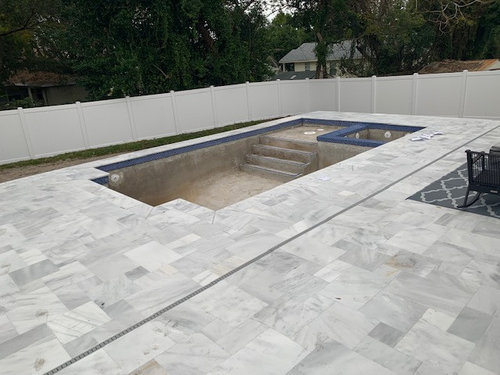
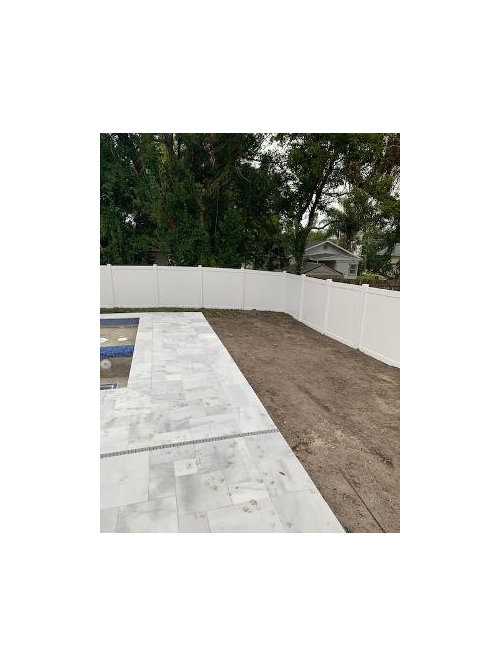
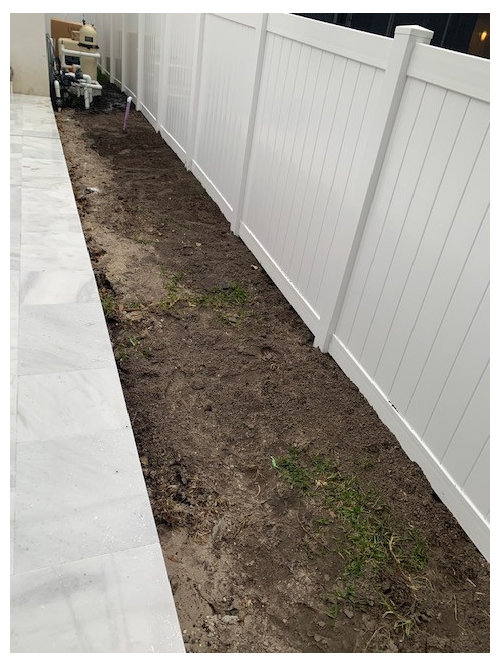
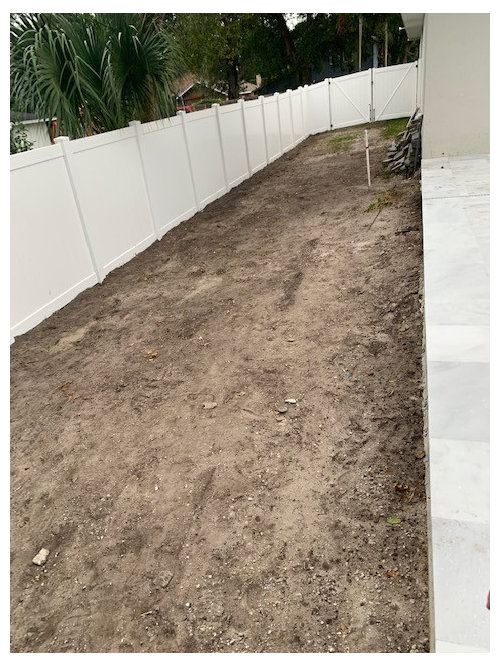
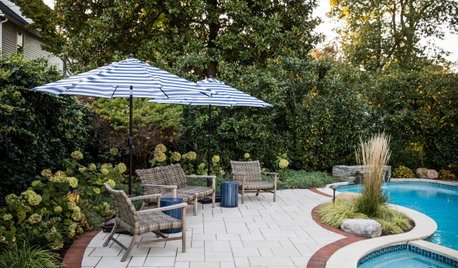
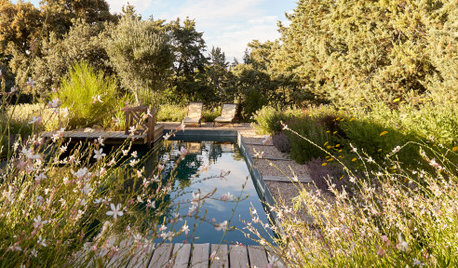
My son is in the process of having a pool installed and it is almost completed. We would like advice on landscaping to border fence and plants for pots in pool area. He prefers modern, low maintenance landscaping. His home is located in Orlando, Florida. Thank you in advance for any suggestions.


Comments (15)

  • PRO
    3 years ago
    last modified: 3 years ago

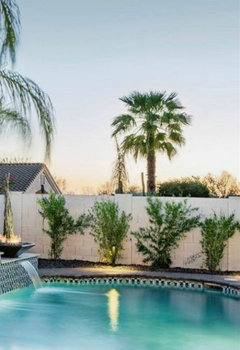
    Usually your best bet is to visit the local garden center to find out what grows well with as much work or not as you are up to. My big issue would be leaves falling into the pool so maybe try for plants that do not drop many leaves . I do not know what groes in FLA other tham palms. There are lots of kinds I undestand but I think so clse to the pool deck you need things that do not have far reaching roots . I woud probably try to find a nice groundcover for that area and do pots around the pool I might do something like this in that space by the fence


    Sheila Lord thanked Patricia Colwell Consulting
  • 3 years ago
    last modified: 3 years ago

    Search the web for "plants near swimming pools" and the like - you will get plenty of hits. With the common shared theme being you don't want anything producing lots of little bits that will blow or fall onto the surface of the water, get sucked into the filtration system. So bigleaf stuff such as the aforementioned palms and others that are already much planted - whether a pool is nearby or not - in warm winter climate areas like his are repeatedly suggested in articles online and elsewhere.

    Regarding upkeep plants in pots = more need for regular attention than growing in the ground. And anytime shadows from the trees behind are not reaching across all that paving around the pool it is going to be blazingly hot there - I was walking in a botanical garden in Orlando during the winter one year and there was a brief sun break that was so witheringly intense I quite soon headed back to the car. (I have spent many hours outdoors in California and Hawaii, yet even in tropically warm and bright Honolulu never encountered sun that felt like this before). Otherwise once the big soil bed areas are completely cleared of weeds cobbles or another rock product of sufficient depth could be used to keep the soil covered after planting. Until then new weeds are going to keep appearing, for as long as the soil surface is left exposed.

    Sheila Lord thanked Embothrium
  • 3 years ago

    I like this site to get a basic understanding of landscaping in FL.

    https://www.south-florida-plant-guide.com/

    Sheila Lord thanked chispa
  • 3 years ago

    Thank you for the information. Very informative website.

  • 3 years ago
    last modified: 3 years ago

    I had a look at the South Florida Plant Guide. This part (below) at least is wrong, consists of information that was being seen to be erroneous during university level controlled experiments starting way back in the 1960s - the author needs to update themselves on modern, scientifically based cultural practices.

    Soil amendments

    Our sandy soil has no real nutrients. Amending the soil gets a plant get off to a good start.

    Just add soil amendments to the hole when you plant. Don't work them in elsewhere - you'll just give weeds a happy home.

    • Organic peat humus or top soil helps the roots retain water long enough to take a drink.
    • Composted cow manure enriches the soil, encouraging the plant to root.

    A combination of cow and peat works for most plants. The formula is 1/3 cow, 1/3 peat (or top soil), and 1/3 dirt, all mixed together in the base of the hole.

    If you use only peat or top soil, use 2/3 peat and 1/3 dirt.

    Do not use potting soil. It's too light and the plant may sink too deeply or fall over later.

    Do not add fertilizer to the hole. This will burn the plant's roots. Only fertilize around the plant 3 weeks or more after planting. See our page on Fertilization for more details.

  • 3 years ago

    I really appreciate your comments! In the past, I've had some new plants that struggled and some that didn't make it. I will definitely do the combination you recommended for my new plants. Thanks again for this valuable information!


  • 3 years ago
    last modified: 3 years ago

    I think medium height trees to hide fence and small enough not to worry about falling leaves, and definitely ambiant lighting, are good choices.


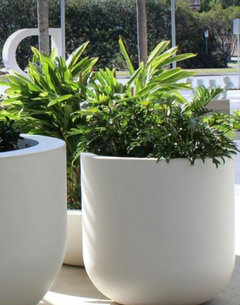
    Regarding potted plants, various sized white clay like planters placed in a grouping would feel modern.


    Sheila Lord thanked Maureen
  • 3 years ago

    Do Pitch Apples grow in that area? I'm SW FL and they grow really well here and make nice evergreen hedges, which you can break up with a few palm trees. The Pitch Apples are pretty "clean" plants and most in my area did pretty well with the hurricane.

    Do not get a Hong Kong Orchid tree. They look really pretty but "shed" like a German Shepherd! There is always debris under them. The ones in my area also didn't fare well in the hurricane.

  • 3 years ago

    I will have to check about the Pitch apple trees. Your suggestions are much appreciated! Thanks.

  • 3 years ago
    last modified: 3 years ago

    sgim if the "valuable information" you are talking about is the last bit I put up it is excerpted from the South Florida site. And is obsolete (no longer considered factually supported) - I put it up to point that aspect out and not to recommend doing what it says.

  • 3 years ago

    The key to a modern low maintenance landscape is by severely limiting the number of plant species used and planting those few plants in large quantity to fill the landscaped space.

    For the Orlando, Fl area an example would be Sabal Palm, the state tree, Pink Muhly grass as the groundcover and a few Waxleaf Ligustrum, Ligustrum japonicum, trained as tree form to screen select sight lines. You could choose three different plant species, but the idea remains the same. Few plant types in large quantity to fill the space.

    The side of the house with the double gate is going to be different than the two sides along the pool because that side of the house is going to need a path or a boat pad. Maintain the simplicity of planting style, but that could be where you add more plant species.

  • 3 years ago

    Thank you Christopher! I'm familiar with Ligustrum varieties; however, I will have to look up Muhly grass. Appreciate your comments.


  • 3 years ago
    last modified: 3 years ago

    According to University of Florida Ligustrum japonicum is likely to be spoiled by nematodes in sandy soils. Also: Predicted to be invasive and not recommended by IFAS Ligustrum japonicum - UF/IFAS Assessment - University of Florida, Institute of Food and Agricultural Sciences (ufl.edu)

    Sheila Lord thanked Embothrium
  • 3 years ago

    Everything in Florida is subject to nematode attack. Perhaps it has gotten even worse over time. Ligustrum japonicum is/was a common as Florida sand landscape plant. Burning Bush is the northern equivalent. Like I said, you can choose different plants. It is the ligustrum's size and form that will be useful to mimic for your modern pool landscaping as a mid-layer plant.

Sponsored
J.Holderby - Renovations
Average rating: 5 out of 5 stars4 Reviews
Franklin County's Leading General Contractors - 2X Best of Houzz!