Software
Houzz Logo Print
buehl

LED Light Temperatures - What to Use in Kitchen & Other Rooms

3 years ago
last modified: 3 years ago
Good morning (or afternoon or evening, depending on where you are)!

We are switching our halogen recessed lights in our Kitchen to LEDs. The LEDs have the following five options:

  • 5000K – Daylight
  • 4000K – Bright White
  • 3500K – Neutral White
  • 3000K – Soft White
  • 2700K – Warm White


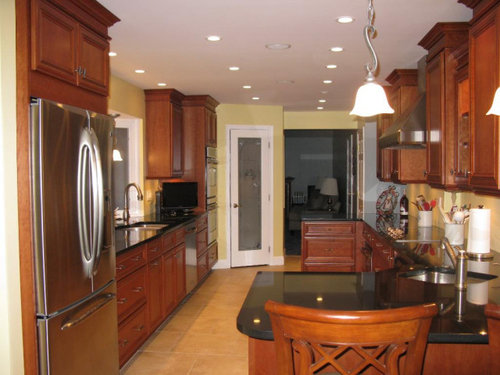
I have heard/read over and over from the Pros & other knowledgeable members that 4000K seems to be the preferred temperature. I've included a picture of my Kitchen (which many long time posters have probably seen many times!)

What would the other temperatures be used for?

We will be replacing most incandescent and halogen bulbs with LED, so what temperature would you recommend for the following rooms?

  • Kitchen - General recessed lights
  • Kitchen - Task lighting under the cabinets
  • Kitchen - Task lighting over primary Prep Zone
  • Kitchen - Pantry
  • Kitchen - Vent-a-Hood lights (3 of them)
  • Bathrooms
  • Bedrooms
  • Family/Living Room
  • Dining Room
  • Garage/Work Room


Pics - taken in 2008 or so (shortly after our Kitchen was completed sans backsplash).

As you can tell, our Kitchen is "Transitional" and the house a typical 90's style.

We may be re-painting as well -- any color suggestions that go along with the lighting question? It's very bright as it is -- both daytime & evening. (Most of the Yorktowne items are gone as part of our décor.)


Note: I will be posting later asking for backsplash help. The one I picked out years ago does not appear to be available any more (Jeffrey Court Pietra Opus II Chapter 9) and it's dated (although I still like it with the addition of the amber glass). [I mention this in case it has any bearing on the LED temperature question.]

Comments (24)

  • 3 years ago

    We purchased several different individual bulbs to try out. I was surprised that I had pretty strong opinions about how kelvins influenced the color of finishes. Personally, 4000K makes me crazy. I found bulbs that were 3200K that I liked but they're not available anymore. The upshot is that I recommended sampling in your space.

    Buehl thanked sheloveslayouts
  • 3 years ago

    When I updated the lighting in my last house, I was unable to find 4000k bulbs at the local hardware or at the big box store, so I tried the Daylight / 5000k. Oh my! My kitchen felt like being in a Walmart. I kept them in for the listing photos since the photog was a professional and said they'd be fine. Afterwards, I put them in the basement, mechanicals room, and garage where they were much better suited.

    Buehl thanked chicagoans
  • 3 years ago

    I should add that these are dimmable, so I can dim them if they're too bright. I did notice the 5000K were really bright as well! It says "daylight" for that temp, but I didn't think it looked like daylight.

  • 3 years ago

    Get sample bulbs and try it out around the room. My UC lights have 3 options and one really makes my backsplash look nasty.

    Buehl thanked Fori
  • 3 years ago

    Brightness is not the same as color temperature. Brightness is measured in lumens, temperature in Kelvins. You can have a dim 5000K bulb, and conversely you can have a very, very bright 3000K bulb.


    I do not like 4000K; I find it too harsh. I can tolerate 3500K but I've got 3000K in the whole house and it's perfect for me.


    I read advice somewhere that I thought was good rule of thumb: If you've got warmer tones or wood cabinetry, you should go with 3000K. If you've got crisp white cabinetry 4000K is better.

    Buehl thanked porkchop_z5b_MI
  • 3 years ago

    I recently switched out my bathroom bulbs to 3500. For me this is just about right. I do not like cool colors but regular soft white bulbs were just too yellow. I an going to try the 3500 bulbs in other parts of my house also.

    Buehl thanked girlnamedgalez8a
  • 3 years ago
    last modified: 3 years ago
    “I have heard/read over and over from the Pros & other knowledgeable members that 4000K seems to be the preferred temperature.”

    As far as I’ve seen on this forum, the only Pro who says that is Patricia Colwell. Though she says it so frequently that maybe it made you think it was being said by multiple people haha. I agree with other comments here that 4000k is too stark white, and that 3500k or 3000k is better overall. The only places I think 4000k would be good is for your two listed task lighting locations and the hood bulbs. You don’t need every bulb to be the same; you can use 3000k or 3500k depending on the room and what you are using it for (e.g. bathroom vs family room).

    Buehl thanked M Miller
  • 3 years ago

    Recessed lights were just installed in our new build. They’re LED and temperature is adjustable. We started at 3000K. Our bathrooms have 18” windows so don’t get a ton of light. The tile and paint were both looking a bit “blah”, so we played around with the LED temperature. What a difference! We ended up at 4000K in the bathrooms with dimmers for the shower/toilet areas. 3500K looks best everywhere else. Anything below 3500K looks a little yellow and above 4000K looks a little blue in our house.

    Based on what we went through, I’d definitely recommend figuring out your lighting temperatures before picking tile and paint!

    Buehl thanked Sofia
  • 3 years ago

    Yeah, mostly the one person on the forums who says 4000K all the time! Much too blue/stark for most people.

    We went with 3500K, high Lumens and high CRI for all our recessed lights (all with dimmers) for the house we built last year.

    Buehl thanked chispa
  • 3 years ago

    3000 or 3500 Kelvin for indoor home use. I've gone with 3500.

    Buehl thanked HU-867564120
  • 3 years ago
    last modified: 3 years ago
    Same as above. 3000 or 3500.

    4000K . . .This color range produces a balanced color tone, not too blue and not too yellow. This creates an environment that can keep employees alert through the day. Spaces that would benefit from this type of light would be commercial spaces, retail spaces, hospital offices and hallways, and office spaces. It could encourage production in a kitchen.

    Buehl thanked dan1888
  • 3 years ago

    We also tried 4000k and found it too stark. Settled on 3500k but 3000k looked good as well. Anything below that turned everything yellow.

    Buehl thanked KT Brown
  • 3 years ago
    last modified: 3 years ago

    Thanks for all the help so far! We've taken your advice and are playing around with them. We're debating b/w 3000K & 3500K. 3500K is the first we're trying, but even that seems stark compared to the halogen and incandescent we're used to. We're going to see if we can get used to it. We'll give a couple of days and then try the 3000K.

    Does anyone know how much blue light there is in the various LEDs? One of my concerns is the blue light since I like to minimize it in the evening. I even have my phone & Kindle on the maximum blue light filter after around 7pm.

  • 3 years ago
    last modified: 3 years ago

    Can't answer how much blue light but we wear blue-blocking glasses in the evening. Just don't go outside and then ask your why spouse the moon is so orange?

    Buehl thanked Linda
  • 3 years ago

    FWIW, I am not a fan of LED light. I got dragged into them kicking and screaming because halogen is being phased out. I find the quality of light from halogen much more pleasing, maybe I'm a person who's extra-sensitive to light, IDK. What is not subjective is the fact that there are issues with LED lights and dimmer compatibility, you'll get buzzing and flickering if they're not compatible. You may still hear faint buzzing even if they are compatible. I have very acute hearing and I can hear buzzing at times. I have LEDs that dim to warm in my kitchen, but most LEDs don't dim to a soft warm glow like halogen, they just dim to a dull, dim white light. None of that BS with halogen. The only thing LEDs have over halogen is you don't have to change the bulb, but I'll trade convenience of not having to change a bulb for better quality of light and no noise from a light fixture any day of the week.

    Buehl thanked porkchop_z5b_MI
  • 3 years ago
    last modified: 3 years ago
    • Living room and bedrooms 2700K
    • Hallways and bathrooms 3000K
    • Kitchen 3500K

    I tested these Philips "warm glow" PAR20 bulbs whose color temperature is reduced as the light is dimmed. I do not recommend these as the color temperature, 2200K when dimmed is too low.

  • 3 years ago
    last modified: 3 years ago

    ^^ I have the Philips warm glow bulbs (PAR30), I quite like them, much more pleasing to me than dimming to a dull flat white light. That said, I dim them for ambience, when I want a little extra light and a warm glow, like being bathed in candlelight from above. They mimic the dim of halogens -- lovely, soft glowing light.


    ETA: Where did the Philips warm glow comment go? I was responding to that...

    Buehl thanked porkchop_z5b_MI
  • 3 years ago

    Thank you everyone! I'm sorry I've been MIA -- I have a lot going on at home & work. (And, on top of everything else, we're remodeling both of our full bathrooms!)


    Honestly, I prefer the halogen & incandescent as well. However, the halogen, in particular, add quite a bit of heat to the Kitchen. While that isn't necessarily a bad thing in the winter, it's an issue in the late spring/summer/fall and when I'm doing my major baking Thanksgiving to Christmas! It was very hot this past Christmas when I was baking. It's also a matter of cost -- LEDs are much cheaper to run than halogen or incandescent -- I like a lot of light when I'm working in the Kitchen but I also like to have a dim light on in the evening when I'm done working for the day as the only way to the Dining Room, Living Room/my WFH office, & Library is through the Kitchen.

    It may be our bulbs, but I've noticed there's not a big difference b/w full light and dimmed light -- at least not like the halogen.


    @ mxk3 z5b_MI: I did some research...

    • The "PAR" designation denotes the light bulb has a parabolic aluminized reflector on its inside, directing light out.
    • Question: What is the difference between a PAR30 and a regular bulb? Answer: Unlike smaller PAR16 and PAR20 bulbs, PAR30 LED bulbs provide a wider beam angle, making them perfect for both spot and flood lighting. PAR30, PAR20, and PAR16 bulbs are great replacements for incandescent bulbs but can easily replace other LED bulbs, such as BR (Bulged Reflector) bulbs.
    • Philips has several options on Amazon that are PAR30, so I don't know which one the commenter was talking about. Since I didn't see the comment, I don't know who said it. Could it have been from another thread about LEDs?
  • 3 years ago
    last modified: 3 years ago

    Buehl: These are the Philips warm glow I (and another poster) are referring to:


    Warm Glow dimming | Philips lighting


    I have PAR30 short-neck floods in my cans; PAR30's also come in spots. The number after PAR refers to the diameter of the bulb. I don't care for BR bulbs, they're shaped differently (kind of a bulging shape). I find they cause too much glare, and they stick out slightly below the edge of the cans.

    Buehl thanked porkchop_z5b_MI
  • 3 years ago

    I don't care for much above 3000 in a residential setting.

    There are two houses nearby that appear to have put 4000 or 5000 in their kitchens and the glow coming out their windows looks like a parking garage. And particularly at night, when these rooms are lit and it's dark outside...aren't we supposed to more attuned to less bright light at certain times of day physiologically? Is it natural to be exposed to daylight lighting temperatures until 11 PM? and then just go right into darkness? I don't know.

    The other thing you have to pay attention too is color rendering index because you can get a bulb of 3000 or 3500 or whatever with good color rendering, or you can get one with lousy color rendering.

    Buehl thanked palimpsest
  • 3 years ago

    "There are two houses nearby that appear to have put 4000 or 5000 in their kitchens and the glow coming out their windows looks like a parking garage. And particularly at night, when these rooms are lit and it's dark outside.. "


    I noticed something similar just last night when I took the dog out -- house across the street had their garage open and a warm light emanating from it (probably 3K), but a big window next to the garage had a harsh bluish-white light coming from inside, maybe the kitchen or family room. When I walk in the evening/at night homes with warmer lighting look so inviting and welcoming while the ones with cooler light temps look...harsh -- like, stay away I'm busy operating on someone right now harsh. I guess it's all subjective, though. Although, I wonder if John Q Public even knows any better -- they just grab a box of bulbs and don't pay any attention, or leave the adjustable LEDs on their original settings because they don't know or just don't care.


    Good point about the daylight light temps into the evening hours and the CRI. CRI definitely makes a difference -- screw in a bulb with a CRI of <90 and a bulb with a CRI of 90 or higher and the difference is apparent.

    Buehl thanked porkchop_z5b_MI
  • 3 years ago

    Ours has a CRI of 90.

  • last year

    4000K all the way. Except table/floor lamps, and exteriors which looks better at 3000K.