Software
Houzz Logo Print

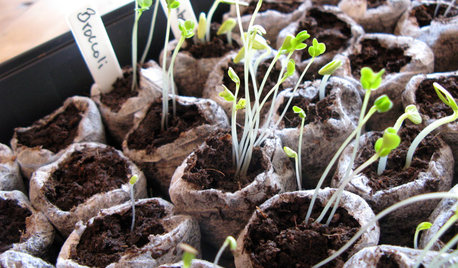
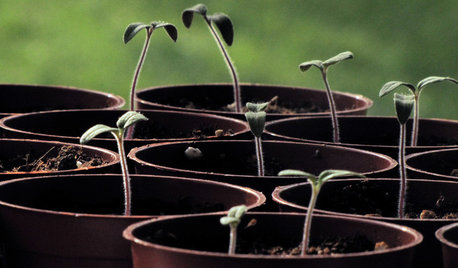
I'm always struck by how germination speeds for different vegetables differ. I have pots where I'm starting peppers, cukes, and squash. Peppers are always very slow. Three weeks after planting they're barely an inch tall. Cukes are faster. They're there after two weeks. Squash? BLAM! They're two inches tall a week after planting. Planning to meet last-frost day outside always requires some care in planting schedule. Mine is third week in February. New gardeners often aren't aware of this.

Comments (13)

  • 3 years ago

    Our last frost date here is becoming more unpredicable every year, sometimes it can be in early April, other times in early May. Last Spring we had a double dose freeze in late April that wiped out the blossoms on all 3 pears trees. My slowest veggie seed germination rate is typically for carrots (~2 weeks), while turnips/radishes/lettuces are the quickest ( ~3 days).

  • 3 years ago
    last modified: 3 years ago

    I always use a heat mat for germinating peppers and tomatoes but not for anything else. With a heat mat set at 80F, most peppers are usually up in 8-10 days and tomatoes in 5-6. Other seeds in the nightshade family benefit from a heat mat but I rarely grow those. I always direct seed cucurbits in early May and they are usually up in 7-10 days with soil temps in the upper 60s.

  • 3 years ago
    last modified: 3 years ago

    Yes, that's a very good point that germination times will always scale with temperature. But the slow ones will always be slow, and the fast ones will always be fast. Under my lights, the "18-hour daytime" temp is 75-80F, and the "6-hour nighttime" temp is about 55-60F. The lights provide all the extra heat. As noted, "last frost date" is kind of unpredictable, but what it really means is the date at which protection is less necessary. I can't direct-seed cucurbits because cutworms are an issue.

  • 3 years ago

    Of course temps are always a major factor, but generally larger/ heavier seeds have more stored energy for quick growth. Small/ lightweight seeds are slower to root and have to collect some solar energy for a few weeks until they take off with growth.


    Not sure what seeds are exceptions for that broad generalization.

  • 3 years ago

    I agree that larger seeds come pre-packaged with energy for quick growth, but as noted here, turnips/radishes/lettuces are fast, and those seeds are quite small. So seed size is not a particularly good discriminator for germination speed.

  • 3 years ago
    last modified: 3 years ago

    Tomatoes don't need heat mats to germinate. But that is dependent on what temperature you keep your house set to. We keep ours at 70° F. At that temperature my tomatoes germinate in 6-7 days in a south facing window.. Growing tomatoes with a heat mat just subjects them to problems with damping off.

    Last year I had to replant my tomato and pepper seedlings in mid April instead of my usual date of mid March. I didn't use the heat mat on the second batch and no lights on either. I never had such good luck with pepper germination. This year I'm going to start my tomatoes in mid March and the peppers in mid April. I start slowly setting out tomatoes in mid May and peppers about June 1. By starting the peppers later I can find days where the outside temperature allows the seedlings to be put outside in the sun maybe even as they're just germinating. on an occasional nice day.

  • 3 years ago
    last modified: 3 years ago

    There are many online assessments of germination time for vegetables. They're just about all somewhat contradictory, though. Here's one that looks more or less reasonable, with estimates for different soil temperatures as well. (In pots indoors, my soil temp is the same as my air temp.) But it shows squash with a rather long germination time at 68F, which has never been my experience. There are several vegetables that actually germinate slower at higher temperatures, and these correspond to my own experience. This is a tricky test to do since, in order to do it right, seeds have to be buried at exactly the same depth and for pointy seeds, in the same orientation as well - ideally sprouting end (pointy end) down.

    http://www.webgrower.com/information/germination-temps.html

  • 3 years ago

    I used to plant seeds pointy-end down, or on edge for flat(er) seeds. Sometimes rapid emergence equals more trouble with "helmets" (clinging seed coats). Believe it or not, unless the soil is packed down, laying the seeds flat is just as effective. I do that now for squash, cukes, limas, and similar seeds. I do the same for beans too (which I often start as transplants here to get seed) laying the beans on their sides, rather than eye-down. Because of the way the stem arches during germination, that actually seems to work better.

  • 3 years ago
    last modified: 3 years ago

    I usually plant pointy-end down, but you're right, planting them flat should be OK. But you're saying that pushing up through more soil better removes the seed coats? Interesting. Planting them upside down (pointy-end up) is just somewhat confusing to the plant. The roots pushing up vertically need to do a 180 and push down.

  • 3 years ago

    If something doesn't germinate for me within a week under the lights, something is wrong; this includes peppers. It's the rare seed that takes longer than a week -- I can't even remember the last thing I grew that took longer than that that actually ended up germinating (like I said, something is wrong if they're not coming up...). It's the growing-on time that varies a lot. Speaking of which, on my list of to-do's is making up the seed starting schedule for this season. Planting out for me is 3rd or 4th week of May, so I don't get anything started any earlier than March unless it needs 16 weeks or so in the house, and even March is too early for most stuff other than flowers that need 12 weeks. Most of my stuff gets started mid-April and onward.

  • 3 years ago
    last modified: 3 years ago

    Yep, it depends on your latitude. Last frost in Saskatoon is in June! You plant starts there in May. Of course, while I can plant out in February, tomatoes, for example, are all done for me in June, because of the heat. My tomato growing season is really no longer than anyone elses. Seeds that normally can benefit from scarification take the longest to germinate, because the outer shell needs to be decomposed. Solanaceae in general - tomatoes, pepper, and okra. But for tomatoes, at least, this is often done when seeds are collected, usually just by fermentation, so by the time you have seeds, they're good to go. Of course, as noted, germination time is usually strongly inversely related to temperature. Peppers might come up in a week if it is warm enough. By that time, turnips will have been up for many days, and you'll still be waiting for okra and maybe swiss chard.

  • 3 years ago
    last modified: 3 years ago

    I just planted some honeydews, pointy-end down, and when they came up, each and every plant has a seed coat still wrapped around the cotyledons. Not clear that was a problem, as when they dry out, they just fall off. But I just plucked them off, and all was well. I do LOTS of cucurbits, so it's interesting to think about.