Software
Houzz Logo Print
alfie521

Rose Cutting Advice

3 years ago
last modified: 3 years ago
Hi,

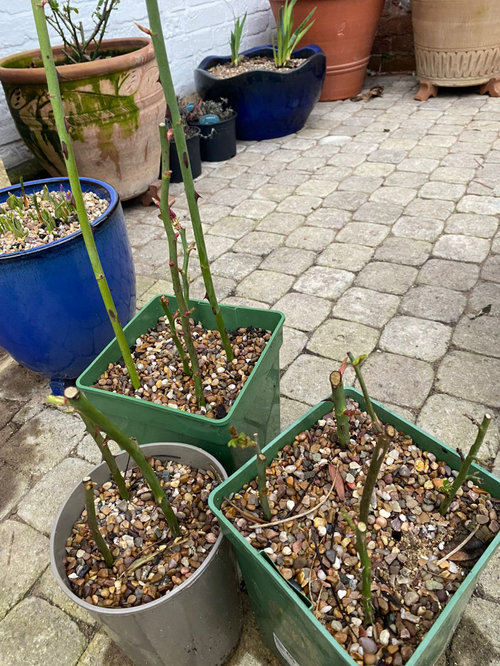
I never have had much luck with cuttings. In the fall I took a load of cuttings and left them in pots of sand in a sheltered spot in the courtyard. Today is the first day I have checked on them in months and every stem at least has some budding with some stems having buds developing into small leaves.


Does this mean every stem has rooted? The sand was quite dry so today I watered all the pots with rain water. What should I do next? Now they are budding do they need transferring or moving into pots with soil rather than sand?


Comments (17)

  • 3 years ago

    I might leave them alone for longer. You could put a few Osmocote Plus pellets on the surface of each pot. Have them in a shaded area in Spring to Summer. Trying to repot too early can kill new rootlings. Some won't make it, likely, but odds improve if you don't disturb them.

    Roots coming out of the bottom of the pots would be a very positive sign.

    Alfie (North London, UK) thanked Sheila z8a Rogue Valley OR
  • 3 years ago

    Oh congratulations !! its so excitign when they root , especially when failure strikes . i agreee with sheila ! or a very lite compost tea

    Alfie (North London, UK) thanked Lilyfinch z9a Murrieta Ca
  • 3 years ago

    They look great! I'm curious what that "sand" is that you used... it looks like tiny pebbles. I'm pretty happy with my rooting methods, but always looking for new possibilities :-D

    After rooting for months, I think you're very close, if not there, for potting them up. Generally, if they look that good after 2 months, you're good... but I have no idea where you are. If you decide to leave them, be very cautious about fertilizing them... super dilute or very few Osmocote pellets, as Sheila said.

    Alfie (North London, UK) thanked susan9santabarbara
  • 3 years ago

    I’ve never been very good with cuttings either but I sure thought those looked successful particularly after so many months.

    I have to admit I was surprised by the lack of enthusiasm in your replies-especially Sheila’s when she said to leave them alone through summer.

    This might be why I’m not good at cuttings-no patience!

    I would have thought they’d be ready to be separated by the end of March, beginning of April no problem.

    Wouldn’t the canes have already started to turn black by now? How long are you supposed to leave them alone? You really wait for roots to come out of the bottom? Wouldn’t each cutting want their own space before then?

    This is so interesting to me, I hope there are lots of responses!

    Alfie (North London, UK) thanked oursteelers 8B PNW
  • 3 years ago
    last modified: 3 years ago

    @susan9santabarbara - I used sharp sand only (no soil at all). I then topped them with horticultural grit (the kind that has been washed thoroughly). I pushed them into the sand then removed them. I then sprinkled rooting hormone in the hole it made then put some on the stem base then put them back in.

    @oursteelers 8B PNW - yes lots of pertient questions you asked. I remember when I did it I read a great thread @strawchicago z5 put together on rooting cuttings with lots of great info but can’t seem to find it again? Can straw or anyone else provide a link to it? Thanks

  • 3 years ago

    Alfie, thanks for the clarification about what the tiny pebbles on top are!

    I agree with @oursteelers 8B PNW that your roses are probably rooted just fine if they've been in there for "months"... I'm assuming 3 months? If they weren't going to make it, they would have turned black by now. I was just being ultra-cautious. I do think that upending rooted cuttings too soon is a big source of failure, but at this point, I'd go for it.

    Alfie (North London, UK) thanked susan9santabarbara
  • 3 years ago

    Until you see roots poking out the drainage holes, don't assume there are roots forming. Winter (dormant) cuttings will often leaf out before making a single root. Be patient - leave them alone until you have proof there are roots present.

    Alfie (North London, UK) thanked User
  • 3 years ago

    I root hardwoods cuttings differently than the OP. Because I have sandy soil, I just stick the cuttings directly into the ground in late fall to mid-spring, and wait until late summer or even next spring to pot them up. High shade/dappled shade works the best. In my climate, in-ground hardwood cuttings with this method take at least six months to get rooted. If the roots are white and very short (less than one inch), there is a high chance that the cutting will turn black after potting up. I think it's because the tiny roots can't absorb much water and rot easily. I'm very bad at controlling water in pots, so I always dig them up after they have at least a few inches of new growth or even bloom. I do have some cuttings that successfully root in pots, but those are in large pots (at least 14 inches deep), which makes me think moisture control is the most important factor for successful rooting. BTW, after potting up, keeping the pot on the dryer side a bit helps the cuttings grow faster. You can always lift the pot to feel the weight and know if they need more water.

    Alfie (North London, UK) thanked Feiy (PNWZ8b/9a)
  • 3 years ago

    Yep, this is definitely why I don’t do cuttings. Almost a year until you can do something with them?!?!

    Too much patience for me! I can wait three years for a plant to shine but I have to at least know it IS a plant and not a dying twig!

    Alfie (North London, UK) thanked oursteelers 8B PNW
  • 3 years ago

    I also saw on another thread BenT used clear cups-that would also help immensely because then you could see the growing roots!

    Alfie (North London, UK) thanked oursteelers 8B PNW
  • 3 years ago
    last modified: 3 years ago

    If you want to speed up the process, you can do softwood or semi-hardwood cutting in late spring/early summer. I do hardwood cutting just because I'm lazy. Usually I forget about them until I see them blooming. I do this for fun so success or failure doesn't really bother me. In fact I have too many successful seedlings. Although most of them are gifted to the neighbors and friends, it's a headache what to do with the others. XD

    Alfie (North London, UK) thanked Feiy (PNWZ8b/9a)
  • 3 years ago

    Thanks to all for such detailed answers. @strawchicago z5 when you say the best medium is at least 1/2 perlite, what would be the other 1/2 for hard wood cuttings? Thanks

  • 3 years ago
    last modified: 3 years ago

    The best medium for INDOOR rooting of hardwood, which I have seen from nursery and my own testing is 1/2 perlite and 1/2 pine fines, plus dolomitic lime (Garden lime with 10% magnesium) to neutralize the acidity of pine fines.

    Pine fines has antifungal properties, same with dolomitic lime.

    Perlite is for fluffiness so wimpy roots (from hardwood cuttings) can push through.

    Pine fines is impossible to find, and very expensive if ordered from Amazon. I wrecked the plastic bowl of husband's $400 Breville food-processor when I tried to make pine-fines (from chunky pine barks). He had to buy a $35 plastic bowl replacement.

    I tried 1/2 perlite and 1/2 vermiculite but that rotted fast, even with softwood cutting.

    Alfie (North London, UK) thanked strawchicago z5
  • 3 years ago

    I called placed that sell mulch and got bags of PB fines for $3 a bag. They woorkerked well, but I did add perlite to some and those seemed to do a bit better in our heavy rain climate.

    Alfie (North London, UK) thanked Vaporvac Z6-OhioRiverValley
  • 3 years ago

    Hi Alfie,


    I used to not have any luck with cuttings either, but I might finally be starting to get the hang of it. Rooted Mamy Blue late last year in a straight commercial bagged seedling and cutting mix (Plagron brand, peat and sand mix). I also just now have managed to root an Evelyn cutting, this time using a homemade blend of sand, a little peat, bark fines and perlite.  


    For the bark fines, Straw is right, they can be expensive and hard to find (even more so on this side of the Atlantic). One option, if you don't need a lot, is to use the repti bark they sell for terrariums. I got a 5 liter bag of JBL brand "Terra Bark" on Amazon, the one with the smallest chip size (2-10mm size, not the chunkier stuff) for about 6€. You can try hunting around for different brands and vendors to get a better deal, or even check at pet stores, just make sure they aren't thick cut, you want the bark fines to be… fine! Repti-bark is way too expensive to use as regular potting soil, but for a few experiments with cuttings, it can be fun to try a small bag.

    Alfie (North London, UK) thanked seasiderooftop
  • 3 years ago

    I can't edit my post above in the silly house app, but I was looking around online and if you want larger quantities this stuff looks amazing. It's composted too, so it won't be as acidic as straight pine bark:

    https://melcourt.co.uk/products/composted-fine-bark/

    Only seems to be available in 50liter size unfortunately, but it looks fantastic.

    Alfie (North London, UK) thanked seasiderooftop