Software
Houzz Logo Print
sumitg

Privacy plants in retaining wall

3 years ago
last modified: 3 years ago
Hi folks

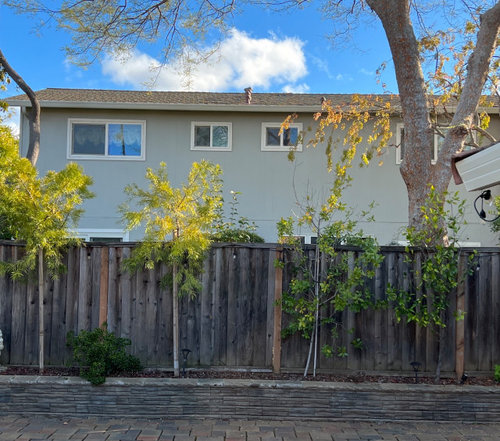
We have a retaining wall against our back fence and would like to plant a tree / shrub / hedge / vine to get some privacy.

Any ideas on what we can do here? We can put a trellis & grow a vine??? any suggestions on something that can get to 14 to 16 feet.


[Edit after some comments]: The 3 plants you see on the right are old plants that are not growing. You can see on the left most side of the image, that plant has grown well.


We are in northern california, south of SF. so moderate weather.

thanks


Comments (37)

  • 3 years ago

    It looks like two of them are fern pines. They will grow in nicely and fill out. Maybe do all fern pines?

    sumitg thanked Stacey
  • 3 years ago

    You already have 4 trees planted that will provide your privacy.....eventually. Where did you intend all these other tree/shrub/hedge/vine elements go? There's not a lot more room in the area shown.

  • 3 years ago

    Thanks Stacey & Gardengal. I should have said -- these plants are not growing well and stuck as they are. The two ferns on the right are about that high for the last 2 years. The one in the middle is slightly yellow and not growing. The one that is leftmost was planted at the same time as the middle one and you can see that has grown well over the last 2 years.

  • 3 years ago


    Given the large shade tree on the other side of the fence it is unlikely that trees on the right will ever grow equally with those on the left.

  • 3 years ago

    "these plants are not growing well and stuck as they are. "


    You (or someone) chose them for this purpose and invested in them and they will serve your needs in time if you can be patient.

    If it was me I'd look to figuring out why they are not doing well and remedy that.


    These trees appear to have been planted in a raised bed? How wide is it exactly?

    Were they planted properly with the root flare showing??

    Are they deep watered regularly when there's not sufficient rain?


    IMO if you'd just double down on the care of your existing trees you'd not need to buy anything.

  • 3 years ago

    is there a bottom to the planter.. or mother earth?? .. its not really deep enough for trees if its enclosed...


    notice the huge old tree on the other side of the fence.. and notice .. the closer your transplants get to the old tree.. the worse they are doing.. that is not surprising..


    first of all.. mature trees are super competitors on stealing water.. ask any hosta grower... most likely the ones closest the to big tee are not getting sufficient water .. and depending on where the sun is.. if the babes are in shade due to the bog old tree.. that might be stunting them a bit ..


    and God help the trees if you are ferting.. cause all you are doing is feeding the old tree.. that is probably growing roots into the holes dug for the new tree..


    increase water ... in hoes that you youngins can get established and fend for themselves...


    tree time is counted in decades.. and it looks like you have made good choices so far.. but that said.. nothing is going to speed up tree time...


    i cant conceptualize a 15 foot trellis..nor a vine that would grow on it.. nor the ladder you wouldn need to properly maintain it ....


    ken

  • 3 years ago

    Thank you. Yes, we did already spend a lot of money in planting these 3 trees which are not doing well. We also suspected the big tree in the other yard as the culprit.


    The planter is about 1 foot wide, and it opens to earth below.


    I took two actions from above:

    - Water deeply-- I will do some extra watering every week to insure they are getting more

    - expose root flare


    what else can I do?


  • 3 years ago
    last modified: 3 years ago

    Planter is much too narrow for trees or shrubs 15 ft. tall. Otherwise, it is impossible for anyone here to zero in on specific involved problems without closer views of the affected plants - none of which are ferns - and full details of what has been done with them up to this point. Also, you will get more screening faster by putting plants and/or built features where you are looking from rather than over near where the unwanted view is.

  • 3 years ago

    Thank you "Embothrium". My neighbor is not very cooperative ... so I have to do the planting....

  • 3 years ago

    Would you consider removing pavers to create a planting pocket in the patio? If a small tree were planted close to your seating area it would create privacy screening much faster. I believe that's what Embo was suggesting.

  • 3 years ago

    its too expensive for us to tear up the whole thing ... I would have made that planter wider if we had known earlier.

    we are also thinking if there are artificial things we can put up - but that seem pretty ahrd for 16 feet

  • 3 years ago

    Okay, how about clumping bamboo in a big pot? A couple of pots of bamboo next to your seating area could help.

  • 3 years ago

    Cecily: Does bamboo stay constrained in pots? I thought they are very aggressive plants?


  • 3 years ago

    There are two kinds of bamboo: running and clumping. Research clumping bamboo, it may work for you.

    sumitg thanked cecily 7A
  • 3 years ago

    Ginkgo trees range in height from 14 feet and width from 5 feet. They are hardy, need little maintenance, and their foliage turns a stunning golden yellow in the fall.


    Next is bamboo, which is fast-growing and hardy. It provides a serene atmosphere for the senses and has an oriental aesthetic. Typically, bamboo reaches 10 feet in pots and 12 to 15 feet in the ground.


    The last is the brightly colored flowering dogwood. It produces white, pink, and red flowers during the changing seasons. A height of 15 feet and canopy width of 15 feet is suitable for medium to large backyards. Ideal for planting in moist, well-drained soil. Before deciding to plant a tree, you need to choose the right size for your backyard, local weather, and soil. Plus, trees take time to grow so they are not a good fit for people who are urgently in need of a privacy solution.

  • 3 years ago

    zoey: the trees you mention will probably not grow in the planter in the retaining wall, right? they all sound like trees that need a lot of space?

  • 3 years ago

    Ginkgo certainly does require much more space than you have in that planter. Even the smaller cultivars.


    You could look at tall obelisks with clematis or honeysuckle to put between the current trees. But really, a 12" bed is very small indeed and usually would only be suitable for annuals or compact perennials.

  • 3 years ago

    Evergreen vines could work…but whether you would be allowed to add lattice that high is questionable….

  • 3 years ago
    last modified: 3 years ago

    I have seen pleached hornbeam growing with a very small footprint....but this would be an intensive project. An uncooperative neighbour, with trees hard grown by the boundary, might also end in uncertain success.Green wall planting has come a long way but requires extensive architecture and tight irrigation set-ups (about which I know nothing).

  • 3 years ago

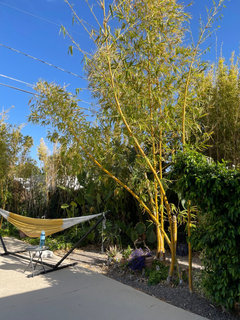
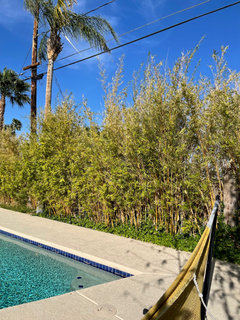
    Our bamboo garden in Palm Springs…2 kinds

  • 3 years ago

    The smaller variety is planted in a spot similar to yours in size…it would spread everywhere if not contained like this…I like the ivy in the ground ..to fill in with a lush ground cover….the larger ones are straining out into the sun…when they need to be thinned they leave dangerous stumps…sharp enough to cut open a leg if you fall on them…they create my favorite spot for hammock time …which is my all time fave in the desert and at home in the mountains

  • 3 years ago

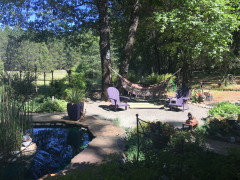
    I have clumping bamboo in a planter behind the hammock….not as tall but lasted many years in that spot…thru snow and rain and hot summers…just need pruning yearly…

  • 3 years ago

    All of these varieties in both locations thriving 15 years and more

  • 3 years ago

    you can try Pacific myrtle. It typically grows as a tall hedge or if pruned, a certain way, it can grow as a tree. But they are fast growing and make great hedges. But I think you would need to decide whether or not you can work with your existing trees. My understanding is that Pacific myrtle is fast growing and hardy. And I think it’s native to your area but not sure. It’s a broadleaf evergreen with beautiful waxy leaves.

  • 3 years ago

    Folks - read the OP's posts! A planter that is surrounded by stone and only one foot wide is not large enough to accommodate any tree or shrub that will get to the desired height, regardless of how deep the root run might be or how carefully they are trained or pruned. They simply will not have enough room to thrive! And that is obvious by the condition of the current trees, which are declining, not growing or filling in.

    Clumping bamboo is a possibility. But will take a lot of work to maintain in a healthy condition in that very restrained location.

  • 3 years ago

    Any kind of bamboo is pretty invasive.. of course… and even in a narrow planter thinning and pruning may become be necessary every year or two… but in the ground it will spread everywhere.. out of control…our clumping variety in the planter…has to be thinned a little every year to keep it green ..the taller bamboo in the above pic is in a bed less than 2 feet wide.. with fencing on one side and the pool on the other….and you can see how tall and thick they have grown

  • 3 years ago

    " Any kind of bamboo is pretty invasive.. of course… "

    That's not true at all!! There is a very distinct difference in growth habits between running bamboo and clumping bamboo that allows the former to become a very aggressive spreader while the latter is NOT! Clumping bamboo is no more invasive than the vast majority of tall growing ornamental grass.....which is precisely what it is. In fact, it is much less of a concern because a) being evergreen, it does not need to be cut back annually; and b) does not self seed like many other OG's do.

    Clumping bamboo is by no means a no-maintenance option....but then no living plant is completely. But invasiveness is not a concern and 'control' of the spread is not a maintenance issue!!

  • 3 years ago

    Let’s just agree to disagree… most of your adamant opinions just don’t apply in my garden….I keep trying to understand why your “ opinions” come across more like attacks🤷🏻‍♀️…instead of helpful advice🤦🏻‍♀️

  • 3 years ago

    I was not offering opinions or advice. I was merely stating fact. And this is easily confirmed by any number of online sources.

  • 3 years ago

    My opinions are confirmed “ in garden” …not …. “ online sources”…i will say again…from my “experience”..all the bamboo types we have….need continuing thinning and pruning …over “20 years” of in-garden experience..with 4 different types of bamboo…in both our California homes…north and south…

  • 3 years ago

    What you seem unable to understand is that this has nothing to do with opinions but everything to do with morphology. The two different types of bamboo have two different morphologies that control how they grow. These do not change. A clumping bamboo cannot/will not change into a running/invasive form. The plant's biology does not allow for that.

    Without an identification of the type of bamboo you are growing, might not your "garden experience" be attributed to yours being running bamboo?

  • 3 years ago

    It could just be wording🤷🏻‍♀️I never said my clumping bamboo was running..AND my running bamboo is in a contained space.. I posted pictures and experiences…why you insist on bombarding me with superior knowledge to correct my “ experiences” is the dilemma…

  • 3 years ago

    I find bamboo appealing like I do mint. In someone else's space. Happy to look at yours, but I won't plant either one in my yard. So many other things do just fine.

  • 3 years ago

    @btydrvn, what you did say was this: "Any kind of bamboo is pretty invasive.. of course… " And as has been clearly explained, that is simply not true!! Clumping bamboo is NOT invasive. Why you keep arguing the point after the issue being explained several times is the dilemma!!

  • 3 years ago

    The Ginkgo trees are 14 feet in height and 5 feet in width. They are hardy, require little maintenance, and their leaves turn an attractive golden color in the fall.

  • 3 years ago

    Unless one selects a very dwarf variety, ginkgoes will grow much larger than 14' tall and 5' wide! 40' x 30' is common with many cultivars and some get even larger. They will not adapt well to a planter that is only 1 foot wide. And they grow very slowly as well.

Sponsored
Peabody Landscape Group
Average rating: 3.5 out of 5 stars8 Reviews
Columbus' Reliable Landscape Design & Contracting