Software
Houzz Logo Print
webuser_145915234

Cannot reach hole to drywall

3 years ago
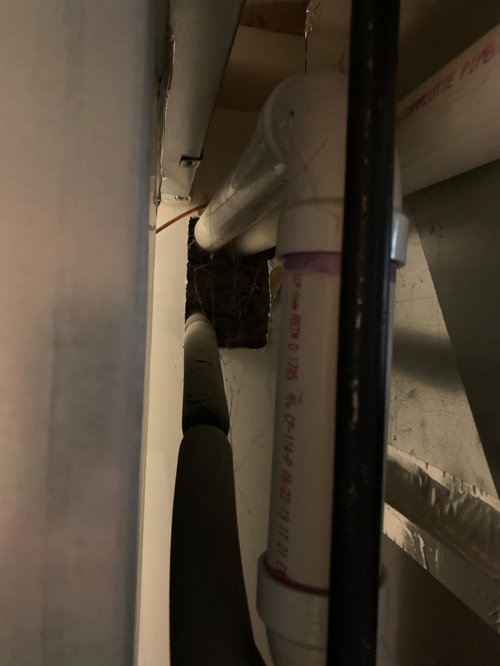
So after my hvac unit was installed years ago, there was a pretty large hole left behind the hvac unit where the pipes exit the house, i am noticing in IL cold, significant cold air is coming through, does anyone have any tips on how to insulate and drywall a hard to reach spot? even from the side there is no way to get tools to that spot, any advice would be greatly appreciated.


Comments (14)

  • 3 years ago

    The oldest time tested and proven method that's so simple your grandmother can do it (probably did once or twice in her life) is rag on a broom handle and stuff it. If after several more years you think of a better method,drive a nail through end of broom handle and fish the rag back out.

    Chris Abplanalp thanked klem1
  • 3 years ago
    last modified: 3 years ago

    @Charles Ross Homes, I was thinking spray foam but I cannot find a long enough hose that can reach that far

  • 3 years ago

    @klem1, I might have to do the rag trick if I really cannot get a long spray foam hose to reach that far

  • 3 years ago

    Hi, A rag Sound pretty good but maybe a pillow would work better.

    Good Luck Woodbutcher

    Chris Abplanalp thanked woodbutcher_ca
  • PRO
    3 years ago

    Buy a Legth of flexible tubing at hd the size of the spray foam tube and make an extension.

    Chris Abplanalp thanked HALLETT & Co.
  • 3 years ago

    Foam has been suggested, re-suggested then suggested again. Will one of you advocates explain procedure for filling hole with foam without filling cavity inside wall first ? I think op will need to know if he finds a long tube for foam can. I like the rag idea for now because it's reversable if a neater solution is found later.

    Chris Abplanalp thanked klem1
  • 3 years ago

    What about strips of the ridged pink foam insulation. Cut it a few inches longer with some adhesive on the edges. Could work 2 inch high and do a couple of strips.

    Chris Abplanalp thanked john3582
  • 3 years ago

    @john3582, so insulation board is an interesting concept, i would have to figure out how to get back in the hole part, @HALLETT & Co., the extension tubing for spray foam might be how i approach this, thank you all for your suggestions, i have much to think about, this community is amazing

  • 3 years ago

    Spray foam and rigid insulation is not allowed to be exposed in that large of an area. Both must have a thermal barrier (e.g. drywall). I thought the issue is you can't reach; so if you can reach, you can insulate and cap it with a piece of drywall. If even contorting doesn't allow your reach, you have to use ingenuity - like putting a piece of drywall on the end of a 2x2, bracing the glued cover over the hole, then removing the 2x2 and braces later (general idea).

  • 3 years ago

    @3onthetree, I cannot reach, that is the issue, using spray form with extension tubing will allow me to put the foam in the hole, i cannot just get a piece of wood and get it back there, so just want to fill the gap, maybe if foam hardens I can drill a few pieces of drywall onto that

  • 3 years ago

    I think maybe you didn't understand - even an extension tube for a spray foam can is flacid, and I don't think you want to spend a buttload on a rigid wand - so getting it back to the hole will need some ingenuity too. Use/make tools to extend your reach (a tool doesn't mean it is a Kobalt product bought at Lowes - it is just a device that helps you to do something) like a 2x2, broom handle, whatever.

  • PRO
    3 years ago

    I could be wrong, but I infer that the mechanical contractor cut an opening in the wall to vent a condensing furnace. I don't think they would have removed cavity insulation through such a small opening. I believe the scope of work is air sealing the area of a 6"+/- x 8" +/- rectangle less the space occupied by the pipes (I'm guessing (2) 2" PVC pipes) and the line set. A code compliance inspector in our area wouldn't cite the small area of exposed foam as a fire hazard. As a further aid to an aspiring DIYer, here's some instructions for accomplishing the task.


    First, assemble the following:


    (1) Homeowner; preferably with a modicum of creativity and a sense of adventure.

    (1) Can (not previously used) spray foam insulation. Open or closed cell--take your pick.

    (1) Duct tape. Not the bargain kind--the good stuff! I recommend ACME brand.

    (1) broom or mop handle; preferable borrowed from a neighbor since it might get spray foam insulation on it.

    (1) piece kitchen twine, string or fishing line. If you don't have any, you can cut the cord off a lamp and use it instead. Just remember to unplug the lamp before cutting the cord.


    Instructions:


    1. Call insurance agent and verify that adequate insurance is in effect.

    2. Call lawyer and verify that last will and testament is up to date.

    3. Using copious amounts of duct tape, affix spray foam can to end of broom or mop handle so can will be upright when handle is extended. Follow a criss-cross pattern completing a couple of passes in a clockwise direction followed by a couple in a counter-clockwise direction.

    4. Tie the string, twine, fishing line or lamp cord to the trigger of the spray foam can being extra careful not to pull on it prematurely and causing the can to discharge (premature foamulation.) Alternatively, duct tape can be used to affix the line to the trigger.

    5. Follow instructions on spray foam can to prepare it for use. If instructions have been obscured by step 3, remove duct tape, read and memorize instructions. Then repeat step 3.

    6. Extend broom or mop handle to place spray foam can in proximity of area to be sealed.

    7. Make sure tube at spray foam can exit is placed inside the cavity to be filled.

    8. Pull string while maintaining strong grip on broom or mop handle to counter any potential effects of spray can recoil. Keeping legs spread slightly apart and "leaning in" to the shot may be helpful.

    9. Continue to pull string until cavity is nearly filled, allowing for expansion of the foam as it cures.

    10. Properly dispose of consumables and return broom handle or mop to neighbor.

    11. Continue to next item on honey-do list.


    Chris Abplanalp thanked Charles Ross Homes
  • 3 years ago

    12. Repair bulging and busted drywall caused by Great Stuff swelling inside wall cavity.