Software
Houzz Logo Print
hobby_libby

Self-watering pots not for certain tropicals?

3 years ago

I recently bought self-watering pots/planters.
I don’t know how moist they stay, but I’m guessing pretty moist.
Are the following plants ok or not ok to plant in them?

Philodendron
Scindapsus
Epipremnum
Aglaonema
Dieffenbachia
Dracaena
Sanseveria
Spathiphyllum
Homalomena
Monstera
Rhaphidophora
Syngonium

Comments (15)

  • 3 years ago

    An issue that comes free of charge with "self watering containers" is the fact that they insure all dissolved solids (salts) from tapwater and fertilizer solutions are retained in the soil and soil solution. This causes 2 problems. 1) The steady increase in the level of dissolved solids in the soil solution makes it more difficult for the plant to take up water and efficiently move it from place to place within the plant. Sooner or later this is usually made manifest in symptoms of necrotic areas of leaf tips and margins. It can become so severe that the flow of water is actually reversed so water flows OUT of cells by way of the same mechanism by which curing salt "pulls" water from the cells of bacon/ ham/ jerky. 2) The build-up of salts can seriously skew the ratio of nutrients in the soil solution, each nutrient to all of the others. There is an optimal ratio of nutrients and when that ratio becomes skewed, too much of nutrient A can cause deficiencies of one or more of the other nutrients. Example: An excess of phosphorous because a grower decided a "bloom booster" type fertilizer was a good idea can cause deficiencies of calcium, potassium, copper, zinc, and (especially) iron.


    It is also very common that, when media comprised of very large fractions of fine ingredients is used, too much water is retained to ensure good root health, so at their very best they are still 'iffy'.


    It's possible they might get higher grades from growers who look at them from the perspective of grower convenience, but when the perspective is from that of what's best for the plant, I'd give them a D+ or possibly a C- in some cases where a very appropriate grow medium is used.


    Al

  • 3 years ago

    Are you planning to use a soil-based media or something semi-hydro like leca or pon?

    Self-watering can be tricky, IMO. The only plants that I truly like in self-watering planters are ferns because in my climate, I can't provide the type of humidity they like so I trade that by giving them consistent soil moisture in a self-watering pot.

    I also do use some self-watering type pots with leca or pon for hoyas and some philodendrons.


    All of the self-watering I have do allow me to flush the plants periodically.


    the one plant on your list that I do not think would appreciate self-watering is sansevieria. They really seem to like a water then full dry cycle before watering again.


  • 3 years ago

    And yet, if so bad for plants, information like what you provided, isn’t readily given in website plant groups & is not easy to find during a general internet search.
    All the while these pots are now becoming popular.
    Especially with Amazon, & China-direct apps offering quite the selection of the deep & shallow water reservoir self-watering type.

    So, making my own chunky aroid mix with charcoal & using rainwater won’t eliminate or ease these insidious plant problems?
  • 3 years ago

    My chunky aroid mix is Fox Farm Ocean Forest, chunky horti charcoal, perlite, & repti bark or orchid bark. I got rid of my leca. I didn’t want to deal with fishing it out of the potting mix & cleaning it.
    I don’t know why I mentioned sans because I know they need to go dry awhile. That was a mistake.

  • 3 years ago

    Self-watering pots are popular because they promote laziness. They're not the best way to culture...well....hardly anything.

  • 3 years ago

    So, making my own chunky aroid mix with charcoal & using rainwater won’t eliminate or ease these insidious plant problems? In order for medium to work well in a SWC, it has to be like Baby Bear's porridge - just right. It can't wick water too well, so the medium is saturated, yet it has to wick water well enough to pull water at least half-way up into the soil column. The most productive media for conventional container culture are not particularly good a wicking because their capillary "pull" needs to be low to limit water retention and increase aeration/drainage.

    Your idea of chunky and mine might be different. A medium doesn't need a lot of big chunks of material, in fact, big chunks are counterproductive. A medium composed of particles from about 1/8" to 3/16" with a very small fraction of fine material is very productive and easy to grow in because it holds almost no water between soil particles. That means that no matter how thoroughly you water the soil, as soon as it's stopped draining the entire soil column is well aerated and free of excess water. It's the water held in the interparticular spaces that is limiting because it displaces air/oxygen essential to normal root function.

    Many growers think that amending poor (water-retentive) potting media with perlite and/or pine bark is effective, but it isn't. Pine bark and perlite, when added to fine particles, DECREASES aeration. You can "see" this in your mind's eye if you imagine a jar full of peat. Add a flake of pine bark or perlite to a full jar of peat causes the peat to overflow from the jar in a volume equal to the volume of the bark or peat particle. The problem is, these particles don't just displace peat, they displace peat and air. It becomes even clearer if you have a jar of peat and start adding marbles. With each marble added, a volume of peat and air equal to the volume of the marble overflows the jar. The marble obviously provides no air porosity, so the air porosity of the medium in the jar decreases.

    It is only when you START with a large volume of coarse material and add only a small fraction of fine material that you can take full advantage of the benefits of high porosity and very sharp drainage. The key is, there cannot be enough fine material in the mix to fill all the spaces between the large particles; otherwise you're simply crowing in the fine material. In a 50/50 mix of marbles and sand, where will the roots be growing? In the sand. Pine bark and peat are pretty much the same as the marbles unless there are a lot of open pores in the medium that aren't full of fines, bringing us back full circle to the idea you need to START with a very large fraction of coarse material (80%+) to take advantage of optimal aeration/drainage.

    You can decrease water retention by adding large particles to fine material, but you cannot increase aeration of a given volume of grow media based on fine materials by adding coarse materials.


    Al

  • 3 years ago

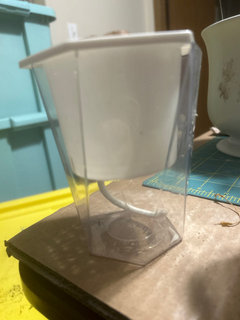
    I have several types of self-watering pots, though. Most have clear bottoms and white potting areas. In the picture is just one example.

  • 3 years ago

    Is that a wick at the bottom?

  • 3 years ago

    Yes

  • 3 years ago

    Dbarron- as for promoting laziness, more like for helping me when I leave MO for PA for a couple weeks. My husband is not a plant person and has killed some of them with kindness (too much water & not dumping the runoff in the cache pot). I figure if he can see how much water they have left, that this will be a good thing.

  • PRO
    3 years ago

    I think if you just use them like regular pots most of the time while you are around, and only use them as vacation pots when you are away you might be OK. Leaving water in them all the time isn't much different than letting them sit flush into a cache pot with water in it. You just have a wick between the pot and the cache instead of direct contact. That can lead to problems. Tapla laid it out well.

    With plants that honestly like to be moist or wet a lot, it can work. If you use them correctly, flush the pots on the regular, keep them clean of alage and such. Because that's another thing you might face with those pots if you leave water in them, alage formation. Especially since it's a clear base that will let in the light.

    I'm not going to say don't use self watering methods. I use ollas and drip jugs. They are wonderful. I use self watering wick pots for my hanging baskets out on the porch. Right handy things. I've used violet pots in the past, those regulate differently because of the nature of the pottery vs an all plastic wick pot. I've been growing out crops of radishes and tiny bok choy in square inch gardening over the winter using pot on dirt method. I'm a lazy gardener, yep, but the plants seem to like it. I am saying understand your plants needs and how to use that kind of wick pot if you plan on using them.


  • 3 years ago

    Yes, I plan on using them when I’m gone. And I believe the only ones I’ll use them for are syngoniums and spathiphyllums.

  • 3 years ago
    last modified: 3 years ago

    I love wicks. I've been dabbling with them over the past couple years and every plant that I've put in a wick situation has grown noticeably more evenly and steadily than similar size specimens in regular watering situations. As far as I can tell, wicks do not create a perched water situation. Over time, roots start to grow along the wick and into the water.


  • 3 years ago

    I think the wick should come though the soil to the soil surface.