Software
Houzz Logo Print
austinkisses2008z8a

Super Thrive- just a share

3 years ago
last modified: 3 years ago

I assume we all use this on bare roots before we plant. I have a couble of small 2 qt roses planted last fall and some newly planted clematis. They are each growing well but I am impatient and always perfer fast rewards. I added superthrive to their weekly, weaky fish diet and omg! I think they grew 2 inches in 2days. I swear they looked empowered the next moring after feed. 1/4 per gal as per bottle instructions.

Comments (32)

  • 3 years ago

    That's great to hear. Honestly I forgot about using Super Thrive but I will absolutely start adding it to my regular feeling. Thanks for the reminder.


  • 3 years ago
    last modified: 3 years ago

    I've used it for years, not just for roses, but for any bare root perennial, and any potted plants that need a boost. But where I've noticed the greatest effect is on my vegetable seedlings. I use a sterile, non-fertilized, coir and peat-based soil mix. So as soon as the seedlings have their first set of true leaves, I have to begin to fertilize them. I use a 1/4 strength mix of Miracle Gro and Super Thrive, and water with it as needed. I have to be careful not to start my seedlings too early, because with this regimen, I usually have transplant-able tomato seedlings in five to six weeks, not the six to eight weeks recommended. Of course I do use artificial lighting, too.

    Super Thrive is a mix of minerals and vitamins (you can SMELL the vitamin B....phew), and a rooting hormone. It's very low in the big three (N-P-K) nutrients, though. Vitamin B is one of the ingredients in other transplant formulas, like Miracle Gro's Quick Start. But there's really nothing else I've tried that's as good as Super Thrive. It also seems pricey, but it goes a LONG way.

    Some people are skeptical of ST, but I've grown the same varieties of veggies for years, both with and without ST, and there's an obvious difference. It may be less than scientific, but I'll stand by my experience. I've always used it in conjunction with a regular N-P-K fertilizer in my potted plants, and it makes a difference there, too, but the greatest effect is on younger plants, it seems. As a bare root soak, I use it on every single rose.

  • 3 years ago

    Remember Messenger? What ever happened with that? Does anyone use that anymore? I thought it worked but was expensive.

  • 3 years ago
    last modified: 3 years ago

    @Sheila z8a Rogue Valley OR The active ingredient in Messenger is still sold under the name Axiom Harpin Protein. I've used Messenger, and it was the price that was the limiting factor, because it *worked*, but with my number of roses it wasn't feasible or cost effective. I haven't bought any Axiom, again because of price, and it seems like it only comes in huge volumes. I know Rosemania sells it, but they're going out of business June 1st. I seem to recall finding it on Amazon, but I'm not sure.

    EDIT: Yup. It's on Amazon, in smaller amounts (read...miniscule) and just as expensive, if not more so, than Messenger, was, lol.

    AXIOM

  • 3 years ago

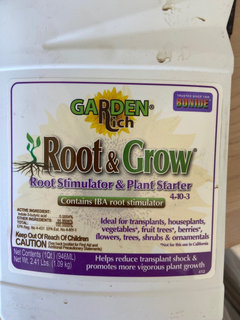
    I’ve used Superthrive for a number of years, especially when transplanting and I feel it’s been very helpful as well. And now I found a bottle of this stuff on my shelf… can’t remember buying it but I suppose it happened on impulse one time and now I don’t really know how to use it, but according to the instructions, it’s also a good transplant helper. Anyone have anything to say about this one?

  • 3 years ago

    Control studies of Superthrive have demonstrated that it has little to no effect on most genera tested. In some genera, it had a negative effect on rooting/propagation. In the few studies where improvement in growth was observed (mostly in Grasses and Orchids), the average increase in plant size (compared to the control plants) was about 20%. That's so close to insignificant as to be meaningless. I'm one of the folks who believe Superthrive is "snake oil": a bit of genius marketing and little else.


    The active ingredients in this product are well known to degrade once in solution (Naphthalene acetic acid, B vitamin) indicating that the shelf life of the product is about one year at most. If stored in a warm location, the shelf life is shorter still. Most of the product on shelves in retail settings is already many months old and in some cases, well beyond a year old. At that point, you are buying expensive smelly water.


    If you found Superthrive improved your results, what were you measuring the results against? How can you be sure the Superthrive was the factor that influenced what you observed? (This is why a control study is meaningful) Anything else is just anecdote.


  • 3 years ago

    Interesting, Paul. My local nursery must believe in it because they always ask if I have enough Superthrive on hand when I buy fruit trees from them and remind me to make sure I use it. But I’m not one to argue against evidence such as you presented.

  • 3 years ago

    @judijunebugarizonazn8 Nurseries are in the business of selling products. Its unrealistic to think that they genuinely believe in the efficacy of every product they sell. Superthrive practically sells itself because of its mythology. You think nurseries are going to take it off the shelves because its of questionable value??

  • 3 years ago

    I've never used Super Thrive and don't intend to use it. I totally agree with Paul. I am curious like Sheila about the originally vaunted Messenger. As far as Superthrive goes, I would want to see two independent studies of its performance, plus a control study, and a well written article by a plant scientist or two, evaluating the results of the studies, independent of those persons running the studies, and published in a respected journal. Whew. I loved your evaluation above of this product, Paul. Diane

  • 3 years ago

    I’m with you Austin and Fig!! I use it for roses bare root pre-soak and planting. We call it GO JUICE!!! I’ve never tried it on my tomato seedlings, though. I’m gonna do that this year. Thanks for the ideas, all of you!

    Rebecca

  • 3 years ago

    Hey Paul apprciate the information but was not trying to promote Superthrive. I bothered to share only because I alway like hearing methods that other found successful.


    I say, this is sounding a bit like -Alfalfa, epson salt, and adding mycorrhizae to soil. Didnt the ARS say newest scientific research showed that alfalfa meal and epson were the biggest of ”snake oil‘s” …maybe our gardening research has gotten political like everything else. Not sure which expert to believe so I will continue to go with the, ”cause no harm” approach/ using whatever points to that direction. 😎

  • 3 years ago

    Didnt intend to push people buttons😱

  • 3 years ago

    Austin, I don’t think anyone feels like you were pushing buttons. This forum is great for batting around ideas and personal experiences and it’s all good! I am happy to hear your perspective as well as Paul’s and everyone else’s thoughts.

  • 3 years ago

    Hey does anyone know anything about the alfalfa and epson??? I know I felt they worked for me. I found that ARS article was interesting and informative, so was confused.

    Kinda felt like a button, guys😍
    but agree this is a wonderful place to share our successes and failures… ta da…

  • 3 years ago

    Austin, I haven't used Super Thrive or epsom salts, but I have used alfalfa tea some years, and it seemed to do a great job. I also read an article not long ago by a woman who said she got far better results from using a product that increased bacteria and fungi in the soil than she ever had from fertilising. But what do I know. And clearly controlled studies are the only true measure. In another lifetime I used to be involved with them, but not on plants.

    Austin thanked titian1 10b Sydney
  • 3 years ago
    last modified: 3 years ago

    The compounds in both Epsom Salts (magnesium sulfate) and Alfalfa have a proven track record (backed by control studies) as being of benefit to horticulture. However, you need to know how much Magnesium your soil already has in it before you go dumping a lot of Epsom salts in it, or you may be creating a toxicity problem.

    As for Alfalfa, the active ingredient is Triacontanol and it is beneficial in tiny amounts: exceeding a recommended dose is likely to have undesirable effects. (Studied in Orchids, it was proven to generate flower deformities when applied in any but the smallest amounts).

    Can you please provide a link to the ARS article in question? Thanks.


    @Austin I did not take your statements as being a promotion of the product, but I felt that whenever it did get discussed, it was worth mentioning that its biggest contribution to horticulture is a placebo effect.

    Austin thanked User
  • 3 years ago

    Paul, When I was briefly involved in a study of an anti-depressant many decades ago, the placebo effect was stated as 90%!

  • 3 years ago
    last modified: 3 years ago

    Take identical growing plants (Argyroxiphium sandwicense) and give fertilizer to half of them. If there are differences between the fertilized treatment and the unfertilized treatment, these differences may be due to the fertilizer as long as there weren't other confounding factors that affected the result. For example, if the fertilizer was spread by a tractor but no tractor was used on the unfertilized treatment, then the effect of the tractor needs to be controlled.

    Scientific control - Wikipedia

  • 3 years ago

    Paul, I read it during the winter of 2021 and remember it being the ARS website. I think it was a current addition to the site but cannot be certain. I might have saved it on my PC and will search my gardening folders. I later mentioned it to another and they had also read it. It was a big surprise to us both as the products were part of our February routine and had been so for years.

    I was disappointed with your superthrive info because I thought I had found a kick for hesitant plants. It is always nice to have another trick in our bag. You obviously aproach your gardening very scientifically whereas I simple relpy on instint, experience, and good luck. Both approaches bring rewards. I do very much appreciate your input. BR

  • 3 years ago

    @Austin I've searched the ARS web site and found several references to the (mis)use of Magnesium sulfate (epsom salt) in which it was stated that adding Magnesium sulfate to your garden without first testing to determine current levels isn't going to help anything, and can in fact create problems.

    I also read that no amount of Magnesium applied to certain varieties will induce "basal breaks", as there are plenty of roses that simpy will not do that; a reluctance to do so is baked in to their genes. I have an established plant of 'Mister Lincoln' that hasnt produced a new basal cane in years, preferring instead to build on its existing architecture, and this is normal.

    On the other hand, I found only references to how beneficial alfalfa (active ingredient: triacontanol) can be for roses - I didn't find anything that suggested it was 100% wives tale junk. Its possible the ARS's search function doesn't show you everything they have.

  • 3 years ago
    last modified: 3 years ago

    Paul, I was speaking "tongue and cheek" with the snake oil reference. . Sorry my Daddy was a scientist and I know how to communicate with you but forgot. The article was a specific reference to the use of Epson and Alfalfa by most gardens and saying that recent research showed them to be ineffective. It did not give exceptions. It also did not go into details of the harmful side effects that you mentioned.

    Everything in life has a downside and a little common sense goes a long way in relation to the application of any product. Maybe they decided the article had some "holes" and deleted it. I have also read all the positive reviews of both products at the ARS site ... thus, my years of applying them to the beds.

    I am doing taxes but when completed I will do a search. You have my curosity sparked.

  • 3 years ago
    last modified: 3 years ago
    Austin thanked Embothrium
  • 3 years ago

    That was informative I use water crystals in my pots - guess I better stop

  • 3 years ago
    last modified: 3 years ago

    I have sandy soil and if I don't use soil amendments , my roses will not grow or bloom . I like to experiment myself and take most rose articles with a grain of salt !

    For instance , I have been reading for years that Epsom Salts will not do anything . But in my soil , I notice that roses green up quickly with it .

  • 3 years ago

    I listen to scientifically tested information and I also listen to anecdotal reports from individuals. It doesn't have to be binary, either/or. Because an individual reports on something that works for them doesn't automatically reveal that it's wrong. It's just when they claim to have discovered a universal truth that it gets problematic and oversteps. It irritates me when people do that but I value hearing their experiences otherwise.


    One thing about scientific studies, it is not unusual for scientists to reverse themselves on scientifically tested " truths". New tests can put the lie to old tests and that's the way it's supposed to work.

  • 3 years ago

    Well said🦋

  • 3 years ago

    “Because an individual reports on something that works for them doesn't automatically reveal that it's wrong. It's just when they claim to have discovered a universal truth that it gets problematic”


    Yep. Reminds me of the time (20 years back) when a lot of people were claiming that Miracid prevented Blackspot when used as a foliar spray on roses. That was debunked fairly quickly and relegated to Jerry Baker territory.

  • 3 years ago
    last modified: 3 years ago

    The key phrase is "works for them" and the basis for such conclusions. Which typically are completely untested. Like amending all planting holes and then concluding the method is valid because the involved roses grew afterward.

  • 3 years ago

    I tried Superthrive in the past, primarily on my orchids (tropical and terrestrial) and saw no tangible results. The more experience I have with gardening and various plants, the less I actually bother with stuff like this - I'm definitely not doing my part in keeping the vitamin/fertilizer/mycorrhizae companies profitable :-)

  • 3 years ago
    last modified: 3 years ago

    The active ingredient in Messenger is Harpin protein. If you search for that, you can find affordable options, if anyone is interested. https://bit.ly/3GlBqET

  • 3 years ago

    Hmmm, well, I amend soil before planting roses because, when I didn't amend it, they all died, and when I did amend it, most of them lived. Solid enough evidence for me. As for the rest, I'm primitive, which isn't necessarily the best way to be, but there it is. I amend the planting hole with organic matter and, recently, sand, water the first year, and then everything is on its own. The roses grow in a tangle of herbaceous and other plants; when I pull weeds or prune, the organic matter gets thrown on the ground around the roses. Around the house, quite a few of the roses, now 10-20 years old, are stupendous. The shade garden is more mixed (n.b. it's not really shady: the roses don't suffer from lack of sun), some roses thriving, some not; down in the big garden, quite a few are struggling. So it's mixed. Patience is important: plants grow slowly when cultivated with a light hand, but they're sturdy, and give them enough years and they can get huge, if their genetics allow hugeness.

    My point is that, in some cases at least, simplicity works fine: the gardener gets the plants started, and they continue on their own, without pushing. I don't speak for vegetables, another kind of gardening. And if I were growing in sand, I would make sure those plants got an awful lot of organic mulch, regularly. The trick, of course, is to know when to intervene, and when to let the garden accelerate on its own. And I sure haven't figured that one out.