Software
Houzz Logo Print
holly_hewatt

NEW PATH OR WALK?

3 years ago

I just talked with my landscaper/mason and told him I want a path that is easy to maintain. He had suggested stone pavers with gravel in between. I started looking for my ideas and thought there should be no space in between the pavers for easier maintenance and walking. I want to age in place in my home and am also thinking about the future. Am I right in thinking all connected is better? He said it would be much more expensive with concrete in between etc. Ugh, I am so confused now. I started doing more research and voila more ideas.

Comments (22)

  • 3 years ago

    How prudent to think about aging in place. It might cost more to have it continuous pavement but is a long term investment. If you can't afford to do it now save up until you can.

  • 3 years ago

    Years ago we had pavers installed for our front walkway. No issues walking on them: nice and flat surface.

  • 3 years ago
    last modified: 3 years ago

    You don't need concrete in between pavers!! Nor gravel. Pavers can be set together as close as you can manage and then the gaps - such as they are (typically called "joints") - filled with sand. Polymeric sand intended for this purpose will form an almost sold compound once wetted/sprayed down after application. This is actually the preferred method for setting a paver walkway or patio and is also far less costly than concrete or mortar.

  • PRO
    3 years ago

    Pavers are beautiful, but if you're looking for something more rustic, decomposed granite is another way to go.

  • 3 years ago

    Stone pavers with gravel in between are a pain to maintain. The gravel will move plus you'll get lots of weeds in the gravel. Nobody sets these in concrete.

    Your landscaper is not the right person for this job.

  • 3 years ago

    Decomposed granite does not have a large availability in many parts of the country so not a viable option in many areas.

  • 3 years ago

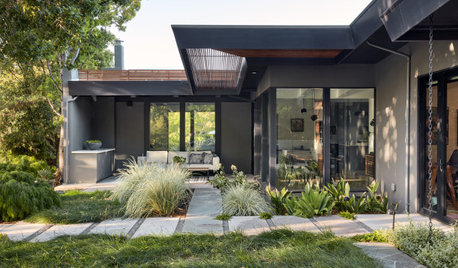
    I’m wondering if your landscaper is thinking about large square pavers separated by wide-ish gravel areas— not the small interlocking paverstones pictured above. Or even bluestone/ flagstone surrounded by gravel. And maybe is thinking of big cement swaths if “ connected”.

    I think it’s easy to miscommunicate if just using words — you really need to review together photos of pathways of several types and pros/cons & cost estimates & what the look like with your home. And some people have experience laying all types or just some.

  • 3 years ago


    This is what he was proposing. Thanks.

  • PRO
    3 years ago

    For sure not that if aging in place is the plan . How the heck wou;ld you even be able to use a walker on that. A lot depends on where you live indidual pavers where I live shift with every winter freeze and thaw cycle se we mostly do all concrete stamped for walkways

  • 3 years ago

    Those are natural stone, usually referred to as flagstone if left as natural edge slabs but they can be cut into uniformly square or rectangular shapes as well.

    Pavers are manmade, usually of concrete, and are typically with smaller dimensions than natural stone. The photos posted by kculbers are concrete pavers.

  • 3 years ago

    I live in Maryland so it's not too cold. I thought less rock would be best but the price for the below is much more expensive. If I could get something like this, it would be great.


    He said this is much more time and is expensive.


  • 3 years ago

    That picture of what he is proposing looks pretty bad. You will have weeds all over the place.

    Do get another landscaper to give you an estimate.

  • 3 years ago

    I have pavers, larger in scale than pictured, no space between them. They are very easy, smooth to walk on, They’ve held up great, no cracks or shifting. And don’t even think about decomposed granite unless you like it tracked into your house, it also blows around when windy. Had mine removed after six months!

  • 3 years ago
    last modified: 3 years ago

    We have a sidewalk like what kculbers shows. It is great for those with limited mobility to walk on. Ours has pavers with special silicone sand between them. The only maintenance is after years one might need to add more sand.

    These were originally with our house that was built in 1963, but a couple of years ago I had a company relay them with a slight upward slope to shorten the step up to our entrance. They added the new type of sand. This whole reworking is great.


    I should add that I live in Illinois, so the walk is subject to freezing and heavy downpours.

  • 3 years ago

    For aging in place, I highly suggest concrete pathways. There are different finishes you can use to change up the look and you'll never have to deal with weeds growing between the cracks. Concrete can be straight or curved, be used for stairs and patios, and can be hosed down. It's not terribly expensive considering its long life and easy maintenance.

  • 3 years ago

    I was going to suggest concrete as well. You can get it stamped to look like stones.

  • 3 years ago
    last modified: 3 years ago

    What you are proposing looks like natural stone cut to fit like puzzle pieces. Yes, it is expensive. It's probably expensive material to begin with, and it needs to be cut to shape on site by someone with the knowledge and the proper tools. It may not be as smooth as you want since it is natural stone.

    I would use manufactured paving stones with special sand in between, or stamped concrete. Less expensive and smoother than natural stone. What he is proposing is very uneven to walk on, and will get weedy quickly.

    Is your path curved or straight?

    You need to talk to someone who does paving like this all the time, not someone who is a landscaper and puts in a path once in awhile.

  • 3 years ago

    For aging in place put in something you can get a wheelchair across. Even if you don’t need a wheelchair full time chances are all of us will use one at times as we age.

    I would never want my dad with Parkinson’s to have to navigate the path full of rocks in your photo. Make everything as flat and steady as possible. My dad tripped over a little rock on his brick path and broke his hip. This was before his diagnoses so we didn’t know. That fall was the first sign.

  • 3 years ago

    Square pavers will be cheaper. Cheaper still, but still nice looking is flagstone made of a composite. You don't want that rock, particularly not for a path you might have to shovel snow off or or, worse yet, snow-blow.

  • 3 years ago

    You don't have to be in a wheelchair to have difficulty navigating an uneven stone path. Diminished vision, balance and reflexes are normal parts of the aging process -- they will happen to all of us if we live long enough. Tripping on an edge or loose gravel can easily lead to a fall. And for seniors, a fall can be life-altering in ways younger people don't experience. It's nothing to fool around with.

  • 3 years ago

    I am guessing that you showed the picture of a natural stone path to your gardener, and that is not within his area of expertise to install, or he doesn't have the stone cutting tools required. So he suggested the stone+rocks example because that's easy for anyone to lay.

    I actually have a seldom-used stone pathway with natural flagstone laid on soil. Originally it had bark chips in between, instead of the loose round rocks that he shows in the photo. It was easy to lay and inexpensive since I had some flagstones. It was fine for 10 years until the larger stones started to sink into the soil, and the bark chips disappeared. Now, weeds grow like crazy in between the stones. And it never was a safe flat walking path - not what you want..

  • 3 years ago

    I’m not saying you can’t work with your current landscape person, but he doesn’t seem to be brainstorming options that are functional and affordable, and may not really want to do some of the possible installations. Hence, I’m afraid that puts a huge responsibility and burden on YOU to figure it out, and even then leaves you open to being told, “We’ll, I did it how you wanted” if it doesn’t turn out right.

    I hope you can find another person who’s more in tune with your needs. Unless you think you can show him some other options and then see if you get a good response— not just a “ yes” but a knowledgeable sounding discussion of pros/ cons/ costs.