Software
Houzz Logo Print
threehourtour

Vent A Hood ARS Search

3 years ago

I'm having a hard time finding all of the parts for a VAH ARS 36" insert. I have found the main piece (KAH34SLD), but the VAH site is confusing about what else I need and where to find it. There is a K250 (ARS) mentioned, and I read through the instruction and parts, but they really aren't helpful.


If anyone has a site or store to order the 'guts' for this it would be appreciated.

Comments (14)

  • 3 years ago

    The 2 part filter part number is ARSLP 12/10 you should be able to get this at the same place you get the liner/insert.

    Superior Newbie thanked regbob
  • 3 years ago

    If you haven't seen it yet, more ARS information may be found in the long thread: https://www.houzz.com/discussions/2347276/vent-a-hood-ductless-ars-range-hood-update#n=181

    Superior Newbie thanked kaseki
  • 3 years ago
    last modified: 3 years ago

    The K250 blower is included with the KAH34SLD hood. The hood is to be connected to a 3-1/4" x 10" rectangular duct for top or horizontal venting. If it's to be connected to a 7" round duct (for top venting only), you need the VP521 transition accessory as shown in the specs.

    The PARS10 and PARS12 filters, mentioned above, are labeled "replacement filters" so one would presume a filter is included with the hood. As these are expensive, I'd check with the mfr.

    Superior Newbie thanked wdccruise
  • 3 years ago

    Their recirculating hoods and liner inserts do not require any duct pipe. The 2 part filter system sits right on top of the hood. Here is the link to the VAH web site for the liner insert. https://ventahood.com/installpdfs/kahsld%20wall%20mount%20liner%20insert%20specifications.pdf You do need access to this filter so the cabinet for the insert needs a removable front panel or working doors on the cabinet and there must also be an opening of 25 square inches to let the air out of the cabinet. I have the CWEAH6 ARS hood in my home. It works great. It is by far the best recirculating hood on the market. If you cannot vent to the outside this is a great option.

    Superior Newbie thanked regbob
  • 3 years ago

    Thank you all. We're about to start building an (almost) passive house, and this is the vent hood that was recommended by our architect.

  • 3 years ago

    "We're about to start building an (almost) passive house"

    A passive house would be very well insulated. Is it a good idea to allow cooking fumes to circulate within the house rather than venting them to the outside?

  • PRO
    2 years ago

    @regbob did you build a cabinet around your ARS? If so, would you open to posting a picture of the 25 sq inch cut outs to vent the air? I can't picture this

  • 2 years ago

    If you want to stay with a wood look, then using louvers such as are seen on [fake] window shutters is one approach. In such a case, instead of a 5 x 5 hole (25 sq. inches), one should provide an area for the louvered section that is about 100 sq. in. (assuming 50% blocked) to keep down the pressure loss from the shutter louver gaps and the fill factor of the louvers.

    If using metal registers, then a 2X area (50 sq. in.) may do as the blades tend to be well under 50% blockage and the pressure loss in the gaps should be less.

  • PRO
    2 years ago

    Thanks @kaseki - what do you think the vendor envisioned when they suggested 5x5? An open rectangle?


    The Ventahood seems like a great option for non-ducted however the (apparently necessary) high noise level may make me run it less than I should.

  • 2 years ago

    If the ARS uses the squirrel-cage blowers of the Magic Lung line -- as I recall they do -- then they would be particularly interested in the owner not causing more back pressure than they planned for.

    I didn't bother to find out the dimensions for these parts to scale to, but a slotted vent is clearly present at the top of the ARS chimney below, and likely there is one on the other side.


    Note that it is not infeasible to put in a standard hood or insert with baffles, duct to an attic, use a silencer, in-line blower, and a stack of filter packs such as the ARS uses, and then return the air to a diffuser or large register in the ceiling some distance from the hood, or at the hood with the air flow directed across the room so that it returns to the cooking zone somewhat reduced in turbulence. Some assembly required. This would provide the quieting desired. One needs an accessible attic, however, or a machinery closet behind the cooktop.

  • PRO
    2 years ago

    @regbob mentioned they have their ARS in a cabinet and also referenced the 5x5 exit for the air. I'm wondering if they have a picture of how they did it.


    I'll be putting this in a high-rise condo with no place vent outside or get into the ceiling (as we just closed it all up and plastered it). My decision will be a best air-quality x noise x design look and there will be trade offs! (It is mostly a vegetarian cooking household but I like to get the best air quality when I can)


  • 2 years ago

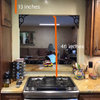
    @Cynthia White art, I did not use the liner for my hood. I went with the CWEAH6 model without the duct cover and put the filter assembly inside the cabinet, I was replacing an OTR. My cabinets do not go up to the ceiling so I just cut some holes in the top of the cabinet with a hole saw for the air to get out of the cabinet.


  • PRO
    2 years ago

    I see, thank you.Mine will touch the ceiling but it sounds like with out the duct cover I can choose a few different places to vent from. Thank you.