Software
Houzz Logo Print
westes

How to Secure a Paver Block Against Street Curb

3 years ago
last modified: 3 years ago
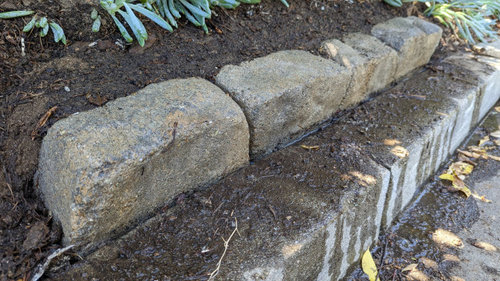
I need to build a retaining wall that is only about 10 inches high right at the street curb. Standard garden edges made of plastic are a non-starter due to lack of height. I also need something that people getting out of cars at the street can step on without damaging the retaining wall. I can probably get by with a hefty stone wall block built to just one level, and not need to invest in building a base for this. The soil on the home side of the wall acts to retain the block. But what do I use to prevent the black from leaning forward toward the street? Does anyone make a miniature t-post that I could sink down 12 inches into the soil at the curb and then have a few inches poking up from the bottom in front of the stone to act as a retaining force and prevent the block from tilting toward the street? What's the best way to solve this problem?

Conditions: I don't want to pay a mason for a real stone wall. I need 10 inches only. I don't want to invest in a multi-block system, which requires time to excavate and build a base for the blocks. I want to just but some hefty stone blocks and with minimal excavation set them in place. If they need to be reset later no big deal. I am doing this for about 50 feet in front of the house.


Comments (16)

  • 3 years ago

    That slope might also be needed for water to drain off your property, and away. Building any type or retaining wall there, might not only be illegal, it just may be a really terrible idea for your property and water drainage too.

    westes Zone 9b California SF Bay thanked cat_ky
  • PRO
    3 years ago

    Any retaining wall can impede water. Impeded water can undermine blocks easier than keep filling till it breeches a 10 inch height.

    If you are having an erosion issue at the hedge line, take some pics from further back so we can see the whole situation.

    westes Zone 9b California SF Bay thanked beesneeds
  • 3 years ago

    Where is the sidewalk in this? The municipality has an easement on the land. It doesn't belong to you to do with what you like. They can come along and tear it all down if it doesn't meet their guidelines. Start there, with your municipality.

    westes Zone 9b California SF Bay thanked User
  • 3 years ago
    last modified: 3 years ago

    As someone above mentioned, it’s likely that the area pictured is owned by the local municipality. Not you. So you are not at liberty to construct anything there.

    (haha I see DeWayne and I were posting at the same time with the same thoughts)

    westes Zone 9b California SF Bay thanked littlebug Zone 5 Missouri
  • 3 years ago

    For water to drain away, it needs to drain from underneath, not pool up to splash over the top. Any kind of barrier there, will keep the water and the moisture on your property. The fact, that parts wash away, says, that is an area, that requires drainage.

    westes Zone 9b California SF Bay thanked cat_ky
  • 3 years ago

    @beesneeds There is one layer of stone blocks. Water being retained behind that wall is if anything a feature, not a risk. What happens when the wall "fails"? I don't see any adverse event that should be protected against there. If you could define the adverse event, it is easily overcome by excavating extra soil behind the block, laying down landscape cloth, and adding a layer of crushed gravel behind and under the block, giving water a path to flow out.

  • 3 years ago

    @User There is no sidewalk. I talked to the city planners today and they said something this small does not come under ordinance. Just keep the neighbors happy was the advice. The cost of "tearing it all down" is less than $100 in materials and less than $200 in labor to install it. We are going to spend more than $300 having this conversation.

  • 3 years ago

    @littlebug Zone 5 Missouri There is no sidewalk and the municipality requires offsets for fences and other structures, but garden edging material falls outside of their formal scope. They don't own the property in question because there is no easement for a sidewalk.

  • 3 years ago

    @cat_ky First, there is an existing toyish wood garden edging system in place now, and water did not make that collapse. It distorted its shape, but the force of water during heavy weeks of winter rain is insufficient in that location to move a fragile wood garden edge.

    Second, I called a civil engineer friend, and he roughed out a calculation that the stone block would need to be around 25 pounds to be able to sustain the force of pooled water behind the stone. The actual weight per stone is about 40 pounds. Note his calculation is way too conservative because the water there does not pool.

    Third, he said I could easily engineer around this concern by digging behind the stone blocks, laying down landscape cloth from the back wall and under the block, then putting in a gravel base under the stone block and backfilling a channel of crushed gravel behind the stone block. That allows water to drain down behind the block and then under the block and out to the street. That's massive over-engineering but would not be hard to do.

  • PRO
    3 years ago

    Sounds like you've gotten your answers for yourself there westes. Luck to you in your project.

    westes Zone 9b California SF Bay thanked beesneeds
  • 3 years ago

    Have you considered a “ living edge”? Sometimes an edging plant like clumping liriope ( not the crazy running kind) planted right at the curb— so would need to trench out some soil, set in smallish transplants & add enough soil back— will be enough to keep soil from washing into the street. If I am understanding the problem.

    westes Zone 9b California SF Bay thanked marmiegard_z7b
  • 3 years ago

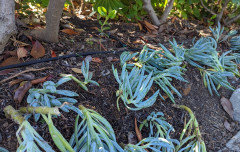
    I have a living hedge. Not sure if you can see it in this photo, but the slope from the base of that hedge to the street is too steep.


  • 3 years ago

    Actually I wrote living EDGE, but I can understand if the slope and soil are such that plant material grown densely at the bottom won’t provide containment.

    westes Zone 9b California SF Bay thanked marmiegard_z7b
  • 3 years ago

    @marmiegard_z7b Thanks for the correction. A living edge is a good idea and I am moving in that direction as well. Some wild grasses mixed in would be both decorative and functional for firming up the soil. Separately from the living edge, I wanted to make the slope for that living edge slightly less steep.

  • 3 years ago

    In keeping with @marmiegard_z7b 's idea regarding a living edge, what would be some good low-water grasses to plant in a small street border area like this. Some color variations would be nice. I may post this as a new question in the grasses section as well.

Sponsored
Kuhns Contracting, Inc.
Average rating: 5 out of 5 stars26 Reviews
Central Ohio's Trusted Home Remodeler Specializing in Kitchens & Baths