Software
Houzz Logo Print
westes

Using Sulfur to Amend Soil Creates Very Non-Uniform pH

2 years ago
last modified: 2 years ago

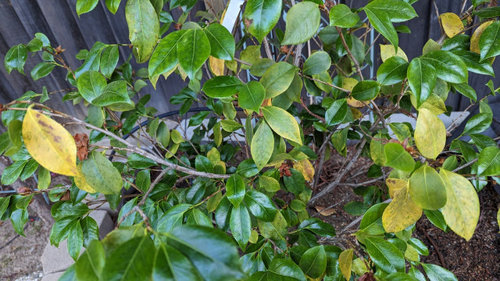
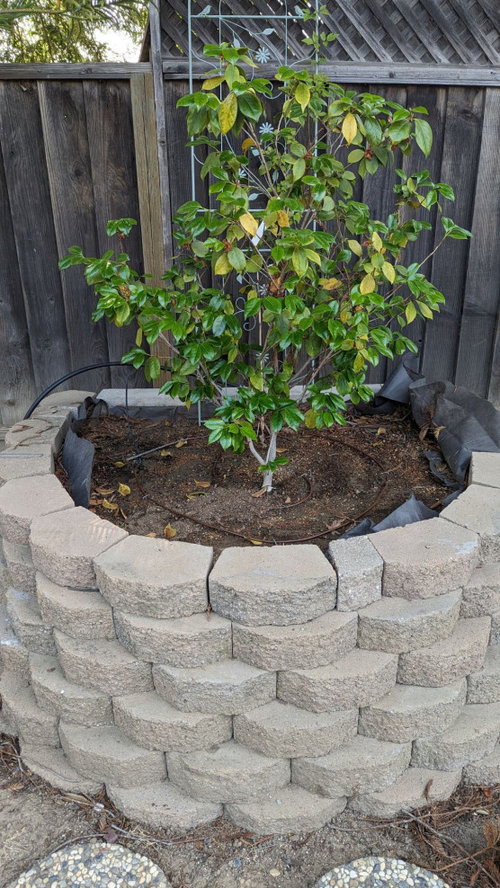
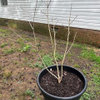
I have a raised bed with a Camellia that I amended with sulfur. I am testing six months later, and I spot-tested the pH in two different locations of the raised bed. One location was pH 5.6 as expected, but the second location was pH 3.5!! My test instrument is sensitive, so these are real numbers, although the pH of 3.5 was near the surface so I might have just picked up a lot of sulfur powder. pH 3.5 is 100 times more acidic than the target pH of 5.5, so I may have a serious problem. The plant has yellow leaves, so it looks like I have induced an iron deficiency.

Questions:

1) What do I do to remediate the iron deficiency?

2) Do I need to invest in remediating the soil pH yet again, or should I just leave it alone and let the pH slowly settle out?


Comments (18)

  • 2 years ago

    @gardengal48 (PNW Z8/9) The soil started at pH over 7. I am simply trying to learn how to use sulfur to bring a soil pH inline to wear a plant grows. I would have been happy with any final pH between 5.5 and 6.5, and I just overshot the mark. It's not an engineering experiment. Cut me some slack.

    I just read that a too-acidic soil actually causes Camellia to get too much iron, so probably you are right it is not iron deficiency. What would you guess is the problem? Insufficient water?

  • 2 years ago

    " What would you guess is the problem? Insufficient water? "

    Maybe. Not really possible to determine from the info provided. Or it just may be the soil is totally out of whack. pH that is too far out of range on both sides of the scale can cause difficulties in accessing soil nutrients. Using a soil that has already been formulated for acid loving plants would have been preferable to going through all these unnecessary machinations.

    And my dear westes, I cut you all kinds of slack :-)) Some of your ideas are so far off the mark I don't even bother to respond. I can think of a couple of regular posters on these forums who seem to have constant issues with their gardens, generally because they overthink everything - you are one. Please, just pick the right plant for the right place and your growing conditions and then let nature take her course. That's how the rest of us garden.

    westes Zone 9b California SF Bay thanked gardengal48 (PNW Z8/9)
  • 2 years ago
    last modified: 2 years ago

    @gardengal48 (PNW Z8/9) "Using a soil that has already been formulated" That is easy to say, but I had five cubic yards of raised beds to fill, and the only vendor in my area who sells a wholesale Rhododendron mix was sold out for months. I am working with what I have available, and rather than encouraging me you look for ways to take cheap shots at me.

    I am not one of the only people to have constant problems with my garden. What I am is the person who wants to understand how things work at a very deep level. I am not afraid of making mistakes, nor am I afraid of exposing my mistakes to others, and I become a better gardener with every mistake made.

    I am going to give some examples of what "overthinking" does. See the next messages here.

  • 2 years ago

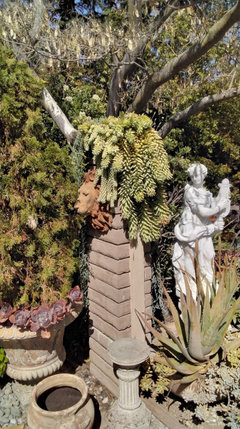
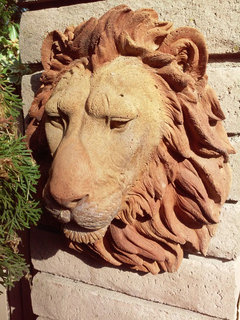
    Example of "overthinking" #1: I found a cast concrete lion's head outside of my area and then researched how to get it acid stained to make it look like a real lion. At every step of this process people complained to me. They complained that it was dumb to order concrete and pay for the shipping costs. They complained that it was not possible to acid-stain an old piece of concrete. Blah blah blah.

    It was incredibly painful to get this thing created. I had to find an ex-employee of Silvestri who could do the acid stain for me on-site, and while it all took some time, now every person who enters the garden comments on how cool this is and asks where they can order one. Well, you can't order one. Creating something beautiful and unique is hard work, and it requires time and pain.

    I have one head on each side of the garden entrance, each with its own distinct personality that complement each other.


  • 2 years ago

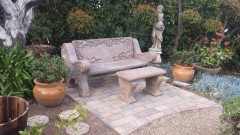
    Example of "overthinking" #2: I won't even go through the list of things that made this patio so difficult to create. The number of mistakes along the way far outnumbers the number of successes. I will just let the result speak for itself.


  • 2 years ago
    last modified: 2 years ago

    Example of "overthinking" #3: while I need to remove many things in this photo and simplify things, the pair of statues I have at the garden entrance were incredibly painful to get in place. I had to learn how to construct a proper base to hold thousands of pounds safely for years. Yes, I had a professional do the installation once I knew enough to know who was really a professional. I had to figure out a way to de-install and transport the statue. I had to build a crane to safely lift 450 pounds of the statue onto its pedestal. I am still figuring out how to remove the horrible and badly done acrylic paint from the aged concrete.

    And for everyone who says "Why don't you just hire a professional to do this?" Try it. Go ahead. I dare you. First off, there are about three designers in the entire Bay Area who do work on classical gardens like this. They are all backlogged for six to 12 months. Even if you could get one, you would be paying $20K to install just one statue and do the design work around that. I don't want to spend $20K. The way I did it I gained valuable skills I can apply to my other projects, and the result speaks for itself.

    When I wanted to transport this statue from its original location, I called 10 different moving companies and every one of them refused the job. The one firm that specialized in art wanted to charge me $10K (!!!) to move these statues. So much for professionals.

    So I will not apologize to you or anyone else for "overthinking", I will continue to overthink, and as a result of my willingness to risk and fail I will continue to accomplish unusual things that have some value in the world.


  • 2 years ago

    Westes, I am so glad that you were pushed to give an explanation of your motives…..I understand you much better now. I applaud you! Your brain simply doesn’t work like most of ours do and heaven knows, we need more people like you around.


    Your plant doesn’t present as one suffering from iron deficiency but frankly, that can be a bit difficult to judge with camellias. Does this raised bed have an open bottom to the native soil, or is it lined throughout? If the latter, that could be a problem, of course. The soil will never be allowed to leach properly. Also, in my experience, all camellias undergo a shedding period where leaves here and there will turn yellow before dropping away from the plant. This doesn’t quite look like that but it is something to consider.


    A pH that is either too high or too low can cause nutrient uptake issue with plants. A strongly acidic soil leaves a plant vulnerable in its needs for all elements except for iron. It can lead to aluminum toxicity. The problem with this situation is that you can’t be certain about the results of your testing, as you have indicated.


    The good news is that sulfur leaches quickly from the soil, it doesn’t adhere to soil or organic particles. My advice is to be patient, water thoroughly when the soil mix dries out, and perhaps find a good soluble fertilizer to spray a spectrum of nutrients on the plant, rather than applying anything more to the soil. If the pH really is out of whack, foliar applications may be required for awhile.


    By the way, how much sun does your plant receive in its present location? The quality and quantity of sunlight makes a difference with these plants.

    westes Zone 9b California SF Bay thanked rhizo_1 (North AL) zone 7
  • 2 years ago

    @rhizo_1 (North AL) zone 7 The bed is lined on the sides and left open on the bottom. I wanted to make sure it could drain. The soil has too much clay loam in the mix and gets rather hard after watering. I wish I had used a more organic mix in the raised bed.

    Since this was my first attempt to use sulfur in a larger bed, and since the soil is too hard and did not mix sulfur well, I do expect that there will be variations in sulfur content in different parts of the soil. I understand your point about Camellias normally going through a shedding period, but in the last six months the plant looks less vibrant than before, so definitely the conditions are not optimal for it.

    Regarding iron and aluminum: I guess we can rule out iron deficiency. Fortunately, I never used aluminum sulfate. But I did use "acid-loving" fertilizers like Espoma Holly Tone, and maybe I should be using a neutral-pH fertilizer here until I get things thriving again? Which soluble fertilizer(s) do you like?

    This plant receives morning sun until about 1pm, at which point it falls under the shade of a Redwood tree right behind the fence where it is positioned.

  • 2 years ago

    Whatever, westes. You're going to do what you want to do regardless of what advice you may receive from those much more experienced than you. And I've provided plenty over the years and not as 'cheap shots' but meaningful, accurate horticultural information with the hopes that you can learn from it and move forward.

    One of the primary tenets of happy, successful gardening is the well-founded adage of "right plant, right place", which you seem intent to disregard. It is hard to imagine a suburban or semi urban garden that wants to be home for both camellias and rhododendrons as well as agaves and other succulents. I can't imagine 2 more disparate plant types, desiring diametrically opposing growing conditions! Have you ever considered planting natives or other common and popular landscape ornamentals that are properly suited for your specific garden conditions? A great deal less work involved and a far greater chance of gardening success. And in your area of CA. the choices are nearly endless.

    Along this same mindset is the need to amend your existing soil endlessly or construct unnecessary random raised beds to accommodate plants that are ill suited to the existing conditions. You are just making things infinitely more complicated and less able to be productive or successful.

    It's one thing to want to understand things "in depth" but not to the exclusion of basic horticultural or 'good' gardening concepts.

    btw, the Bay area is home to a plethora of highly skilled landscape designers able to work in any garden style. Not sure why you have had such a difficult time locating one. Perhaps this too is an issue of overthinking or overworking the qualifications. Maybe try a looser, more relaxed approach?

    westes Zone 9b California SF Bay thanked gardengal48 (PNW Z8/9)
  • 2 years ago

    @gardengal48 (PNW Z8/9) It is not correct that I ignore your advice. I take it all in and do 80% of what you say I should do. In fact, you are one of the most valuable resources on this system, and I pay attention to what you say, always.

    The problem here is that you have built hundreds of raised beds and grown hundreds of Rhododendrons and Azaleas and Camellias. You have probably 30+ years of doing all of that at a professional level, and you can do it in your sleep. I am building my first raised bed and putting my first Camellia in that raised bed, and no one is helping me to do that. I measured the soil pH and it was too high. I corrected it with sulfur as you should. I waited six months as you should. I measured pH and had some obvious issues, which I have disclosed in this thread.

    These are ordinary problems any person doing something for the first time might have. What makes me different than everyone else is that I care enough to do the right thing, and I actually measure the outcome against what is expected. What also makes me different is that I have no fear of revealing my mistakes.

    In that spirit, I have spent years now growing succulents and I want to branch out to vines and climbing roses, and I am experimenting with acid-loving plants in their own raised beds. I totally agree with "right plant, right place". Now how do I do that when I have ZERO EXPERIENCE with vines and climbing roses? Again, you have been doing it commercially for 30 years. OF COURSE I am going to select the wrong vine. That's why I am creating these posts, asking people with experience if this is the right plant for the selected place. It's okay to say no, although the most constructive answer would be to suggest alternatives. I make the best argument I can make, but I fully expect in many cases I am going to need to find a different plant. That's a good outcome and exposing my error up front is much better than discovering my error 10 years from now.

    I grow acid-loving plants together in raised beds dedicated to acid-loving plants. I grow succulents in containers or in-ground plantings suited to succulents. I do not combine those things together in the same raised bed.

  • 2 years ago
    last modified: 2 years ago

    One thing which might be helpful for you is to stop thinking of 'vines' as a category. It is only their appearance and use in gardens which makes them one. Botanically they are varied and do not necessarily have any common features. Your bundling of Clematis and Bignonia into a single group called 'vines' is an example where this concept is problematic.

    westes Zone 9b California SF Bay thanked floral_uk z.8/9 SW UK
  • 2 years ago

    @floral_uk z.8/9 SW UK That is a good point, but in my defense, I am initiating my plant search based on desired function visually / aesthetically, and I don't know enough yet to work from other characteristics. I think it should not be a big deal for me to make a proposal based on wrong plant / wrong place, and simply be corrected. Unfortunately, in social media that is always turned into a big deal.

  • 2 years ago

    It's absolutely correct to search based on function and appearance but when one has found some possible candidates it is important to research each variety and not to extrapolate from one to another based on their growth habit.

    westes Zone 9b California SF Bay thanked floral_uk z.8/9 SW UK
  • 2 years ago
    last modified: 2 years ago

    "I wish I had used a more organic mix in the raised bed."

    Why? remember, everything 'organic' eventually converts to CO2. Faster in a climate with year round rain like mine, and really fast in climates with year round rain and year round high temps like the tropics. I've kept rare bulbs like Brunsvigias in pots for years and years, eventually the soil line is 1/2 as high as it used to be because the composty/peaty part of the mix has broken down. My thinking is a raised bed should most closely approximate the soil conditions where the plants come from in nature.

    westes Zone 9b California SF Bay thanked UpperBayGardener (zone 7)
  • 2 years ago
    last modified: 2 years ago

    @UpperBayGardener (zone 7) Rhododendrons, Azaleas, and Camellias are acid-loving plants whose natural environment is the forest canopy. They live on the constant shedding of organic material from the sheltering trees above them. In the locations where these plants thrive in nature, they typically have sandy loam soil below the organic layers and topsoil, or if there is clay loam then there are a lot of rocks with better drainage than a packed clay loam.

    My soil mix had too much clay loam, which packed hard and made it quite difficult to amend the soil. I could probably rework the soil with 20% added sand and end up with more friable soil.

  • 2 years ago
    last modified: 2 years ago

    Well, many are actually mountain plants, and last I checked, mountains aren't piles of 'organic material'. I'm being a bit sarcastic to illustration a point. Yes you need some organic material in there, but if you, for example, have nothing but a peat based potting mix in there (or, again, anything mostly organic) - expect to someday have to do exactly what you'd have to do with a plant in a 25 gallon pot - repot it. You're essential just 'potting your plants in something that doesn't look like a pot'. Now as I pointed out, YMMV. IIRC Gardengal has said she doesn't have to repot her maples very often in the chilly PNW. Down here in a climate where rainfall has sometimes gone over 70 inches a year...my largest citrus has already lost maybe 1-2 inch of soil height after only 5 years. And geophytes that had been in pots close to 10 years got in a deplorable state of sitting in a pile of mostly old perlite.

    Contrast with fancy rhododendrons like R. macabeanum I saw at Sonoma Horticultural nursery in 2011 and 2016 - now called something else. Polo planted them in a raised beds probably just to reduce the risk of root rot in a low part of his garden. His soil was appropriate for rhodies of course. I saw that the level of soil had somewhat sunk in the raised bed but it was ok because he'd been mulching all those years, and the plants would have grown roots well beyond the raised bed. (I could go find a pic but I barely have time to type this as it is. These were not huge raised beds, just little 3 ft/1 m circles about 2 ft. high - sorta like yours) The raised bed in that case was part of a larger soil 'system'. Seems to me, your are not.

    westes Zone 9b California SF Bay thanked UpperBayGardener (zone 7)
  • 2 years ago
    last modified: 2 years ago

    My soil mix had too much clay loam, which packed hard and made it quite different to amend the soil. I could probably rework the soil with 20% added sand and end up with more friable soil.

    Don't do that. I recently posted about this on another forum but I guess I'd get in trouble for linking to it. I don't know what the various 'potting soil' experts say about this on GW/Houzz, but generally, trying to mix sand with clay is always a bad idea.

    When professional turf managers want to improve clay structure 'mechanically', which is what you're alluding to, they use something like turface. Not sand. You need much much larger particles, not slightly larger particles which is what sand is. If they use sand they are creating a whole new layer of sandy loam atop of a clay soil, and probably installing French drains to deal with the problem of water not moving through the new interface between layers.

    westes Zone 9b California SF Bay thanked UpperBayGardener (zone 7)
Sponsored
The Art of Landscape
Average rating: 5 out of 5 stars10 Reviews
Award winning Landscape Designer in Loudoun County | 2X Best of Houzz