Software
Houzz Logo Print
ahmazoe

Oil based polyurethane off-gassing for 6 months

3 years ago
last modified: 3 years ago
I wanted to follow up for those who are interested in this subject and to also ask a couple of questions.

Original post:

https://www.houzz.com/discussions/6382067/masterline-poly-stinks-after-5-months

In summary, a contractor used oil based polyurethane and it has been off-gassing for the past 6 months (smell and also high VOC shown on air quality meter).

The update:

We decided to redo the floors to fix the problem. The plan is to sand and refinish with a Loba 2K water based poly. A very professional contractor has performed the sanding. But the floors are STILL off-gassing! We can see this on the air quality meter, it is registering high VOC. WTF!!!

(To clarify: the floors have been sanded but not sealed and finished yet)


I’ve been trying to think through what the problem. The stuff has probably gotten into nooks and crannies and in the gaps at the edges of the floors (next to baseboards). But clearly, there is an issue with the oil-based poly (Masterline poly probably). Can oil based polyurethane go bad?

Here is a super interesting thing:

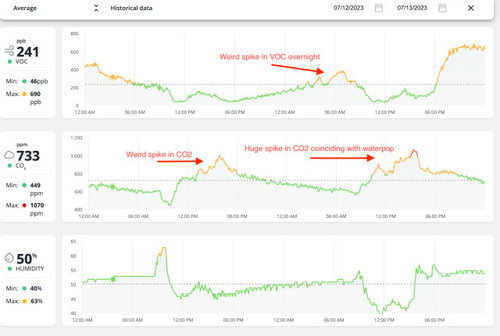
The air quality meter records CO2 levels and there was a very large spike in CO2 coincident with the application of water to the floors (water popping).

From: https://www.l-i.co.uk/blog/blog-archive/the-chemistry-of-polyurethanes

“An important side reaction involves the isocyanate component and water. If moisture is present in the mixture (Figure 4), then the isocyanate will react with this water to form an unstable carbamic acid which then decomposes to form urea and carbon dioxide gas..”

So is it possible the water is reacting with uncured isocyanate to produce CO2 gas? If so, how could this have happened?

Does anyone here know anything about polyurethane chemistry?

Most important question: will finishing with a high quality water based poly (Loba 2K) seal off the harmful chemicals and prevent exposure?

Thanks in advance for any help dealing with this disaster.


Comments (24)

  • 3 years ago

    I'm using an airthings view plus ($300 on Amazon). It seems legit. But really, I got it to get some more objective data on something that I'm already detecting with my nose!

    The VOC level on the meter correlates with the smell. Open the windows and ventilate and the VOC level drops.

  • PRO
    3 years ago

    Your floor is not the first floor to be refinished with the product you are using. If you have questions about the curing of the finish, I suggest you contact the technical support folks at the manufacturer.

    ahmazoe thanked Charles Ross Homes
  • 3 years ago

    That is a great suggestion. I have already contacted Duraseal/Masterline support and they put me in touch with the area rep who was super nice. She may make a site visit but they acknowledged that this is an abnormal situation. I will contact them with an update about the CO2 off-gassing, if that is a clue for the underlying chemistry. BTW the contractor used a 5 gallon bucket of Masterline but I have zero confidence as to what it may have contained or how old it was. In fact, high VOC finishes like Masterline may not be allowed in my county. Thanks for your reply.

  • 3 years ago

    You would be so much less stressed and happier if you just threw the meter away.

  • 3 years ago

    Yeah, but I can't throw my nose away!

  • 3 years ago

    Your flooring and other finishes in the home are not an issue. Your poor quality meter IS. If you are going to rip the home apart, you should at least do it based on sound, science based, empiric, evidence. Not a junk meter or junk science.

    ahmazoe thanked HU-655638150
  • 3 years ago

    I agree with you though I wouldn't characterize the data or meter as junk. I'm going to find an air quality testing company tomorrow to do detailed testing to identify the VOC. Ultimately, that's what is important more than the quantity.. what are the chemicals and how harmful are they. I was asking if anyone is familiar with polyurethane chemistry and may be able to provide insight into the problem given the limited clues we have.

  • 3 years ago

    “So is it possible the water is reacting with uncured isocyanate to produce CO2 gas? If so, how could this have happened?”

    It is unlikely. Well, look at your floors, is there a layer of foam? If not, then… nope.

    It is also unlikely that residual product is creating high VOC levels.

  • 3 years ago

    Your conjectures are not fact or science based is the point. And your meter is not a recognized scientific instrument for what you are conjecturing.


    If you are going to spend 100K chasing your nose, you might start with your nose. Have olfactory testing done. Your ENT will test you. Phantom smells are often a byproduct of Covid exposure, even if you do not have other symptoms.

  • 3 years ago

    No one here can give you answers. Maybe you should consider sending samples to a lab for identification.

    IAQ testing labs will send you the kit, usually media or container and pump. Overnight the sample and they will try to identify the specific VOC.

    Good luck

    ahmazoe thanked bry911
  • 3 years ago

    Thanks so much. That's exactly what I'm plabning to do tomorrow.

  • 3 years ago

    For anyone interested: our working hypothesis is that the oil based polyurethane used was bad (spoiled / improperly stored / too old / expired) and that it didn't cure properly.

  • 3 years ago

    An unopened can of oil based polyurethane should last twelve to twenty years (even though shelf life is usually reported at three). When polyurethane goes bad it stops drying/hardening and so you should realize it almost immediately.

    A good rule for VOC’s is that they all come out. So a product that goes bad isn’t going to release more or less VOC’s, but could release them at a different rate. Generally, we would expect it to be faster, but some catalyst in the product could slow it down.

    If your installer didn’t add anything to it and it dried normally then it seems unlikely that there would be significant levels of VOC offgassing six months later. There just shouldn’t be that much VOC’s to release.

    I would guess something was added to the product or your floors that isn’t playing well with the polyurethane or the polyurethane came bad from the factory.

    ahmazoe thanked bry911
  • 3 years ago

    "our working hypothesis is that the oil based polyurethane used was bad (spoiled / improperly stored / too old / expired) and that it didn't cure properly."

    Highly unlikely, and you're going about testing that theory in an unscientific manner. The best way would be to determine whether the finish was bad is to test an unused portion of the same finish. The second best way would be to scrape off a sample of the dried finish, isolate it and test off-gassing.

    "An unopened can of oil based polyurethane should last twelve to twenty years (even though shelf life is usually reported at three). When polyurethane goes bad it stops drying/hardening and so you should realize it almost immediately."

    Much more credible. Bad poly generally solidifies in the can or doesn't cure properly. FYI, just because you can smell something, that doesn't mean you're smelling a VOC. We use some oil finishes that have ZERO VOCs that still have a smell. I put olive oil in my salad dressing and it has a smell. That doesn't mean I'm smelling VOCs.

    Whether your meter is accurate is debatable, but how you're using it and arriving at conclusions MAY lack scientific rigor. Perhaps you've done measurements EVERY day, ALL day, and are controlling factors that may result in the variations in measurements you are seeing, but have not posted them. I suspect you're not testing constantly and are not controlling other variable that may affect measurements.

    One thing that stands out is the inverse relationship between CO2 and humidity. Could the lower humidity indoors lead to a higher CO2 reading due to the fact that there's LESS water in the air? Why did the humidity measurement show a dip? Why does it show a dip when the floors were reportedly water popped. The water used for popping should evaporate into the air, causing the humidity level to INCREASE.

    Are you living in the space? If so, what are you doing while you're there? Is the space conditioned for temperature? If so, how does the temperature control affect humidity, VOC and CO2 levels under normal living circumstances?

    It's definitely a good idea that you'll be engaging a legitimate test company to determine if you have a problem. Good luck.


  • 3 years ago

    " “Your conjectures are not fact or science based is the point.”

    It kind of seems like they are. The OP didn’t have a problem, floors were refinished and then there was a problem. That certainly seems like a fact, and is pretty much how scientific research is done. When I was actually in research, this is exactly what we did…change one thing and see what happens"

    I agree with the majority of your comments, but in this case you MAY be incorrectly assuming that the OP only changed one thing. The earlier post seems to be gone and may have addressed this, but it's wholly possible that there were multiple things done at the same time (painting, trim, cabinetry, countertops etc.). It's rather unlikely that the poly would have any odor after six month, and the OP seems to be claiming that the VOC issue is still present despite having probably 99+% of the oil poly sanded off. If the OP is still smelling something and the poly is sanded off, it seems unlikely that the minuscule amount left in joints is off-gassing to an extent that it can be smelled and that it register on a VOC meter, which then puts in doubt the assumption that it was due to the oil poly in the first place.

    I have seen instances where flooring or finish were blamed for a VOC issue, where the culprit was something else. It's not too hard to imagine a scenario where the floor is refinished and the smell persists, because it wasn't from the floor in the first place.

  • 3 years ago
    last modified: 3 years ago

    “I agree with the majority of your comments, but in this case you MAY be incorrectly assuming that the OP only changed one thing.”

    I am really not making that assumption and I didn’t mean to infer that. Suppose they made a dozen changes, one of those changes is likely the cause of the problem. That is both a fact and scientific evidence.

    As I have discussed before, my first job after graduation was in coatings development. When something went wrong we often started with the most likely culprit. Sometimes it was not the cause, but usually it was. In fact, if one thing seemed the most likely cause we worked under the assumption that it was the cause until we had exhausted all reasonable possibilities and usually several unreasonable ones.

    I don’t know if the OP is right, in fact, I am still skeptical, but their actions thus far seem reasoned and rational.

    After the Bhopal disaster everyone started working to make isocyanates safer. We started binding them. Basically, many modern coatings come with enough free isocyanates to begin the reaction and harden the coating then the bound isocyanates catalyze to fully harden the coating without releasing the isocyanates into the air.

    So a polyurethane may harden or significantly thicken in the can, both of which would be noticeable at application. It can also just look fine but over time too many isocyanates can have been bound up and the coating never hardens enough to unzip the bound isocyanates. This should look and feel like a regular coating that refuses to harden.

    ahmazoe thanked bry911
  • PRO
    3 years ago

    If, this was a new install. It could be the underlayment paper causing the spike in VOC. Fortified products will off-gas, along with 15 lb roofing paper.


    The old oil base polyurethane is a good theory. Although if, it was old, the product would be lumpy and should never tried to be salvaged.

    ahmazoe thanked G & S Floor Service
  • 3 years ago

    "One thing that stands out is the inverse relationship between CO2 and humidity. Could the lower humidity indoors lead to a higher CO2 reading due to the fact that there's LESS water in the air? Why did the humidity measurement show a dip? Why does it show a dip when the floors were reportedly water popped. The water used for popping should evaporate into the air, causing the humidity level to INCREASE.

    Are you living in the space? If so, what are you doing while you're there? Is the space conditioned for temperature? If so, how does the temperature control affect humidity, VOC and CO2 levels under normal living circumstances?"


    Thanks so much for your reply.

    I agree, the humidity dip is completely anomalous. Like you said, spraying the floors should increase humidity. I know the contractor wanted a stable environment so the house was set to 75 degree and all the windows were closed. The house is largely empty, in fact we haven't been able to move in because of the problem. The space is conditioned for temperature. The humidity is relatively stable at different temperatures, even at elevated temperatures when we have tried to "bake out" the VOCs. One consistent pattern is, VOCs go up with elevated temperature. I had not really paid much attention to CO2 levels until just this week with the water pop. But looking back, CO2 levels have been relatively lower but with spikes coincident with increases in humidity (from opening the windows and airing out) and with especially prominent spikes after the recent sanding.

  • 3 years ago

    I'm eager to learn the results of testing!

  • 3 years ago

    Working on it. I'll definitely post the results.

  • last year

    So I just had my basement floor coated. First an epoxy prime coat, then an epoxy coat to accept the flake, then a polyaspartic grout coat. They polyaspartic coat is sending me, my dog, and my air quality meter into a panic. I had the same strange spike of VOC in the middle of the night! I see your proplem is with polyurathane which the contractor is supposed to be putting on the final coat of today. Now I don't know what to do. I hope this doesn't turn into the same problem you are having!

  • last year

    I'm still eager to learn the results of testing.

  • last year

    James Joseph said, " It Can be brought back by adding mineral spirits to old jellied up polyurethane, i just did this to some oil based satin polyurethane that i had harden on top and jellied in the middle, i just saved myself a trip to the store and 50 bucks , this stuff was really jellied too"


    You can't really bring back polyurethane. It is a reactive coating, once it has reacted the crosslinking can't be released and reestablished. It is like pulling packing tape off a cardboard box. Once the packing tape has adhered, you can pull it back off the box and reapply it, but it loses significant strength.


    It might appear OK and it might apply OK, but it will be missing a significant portion of the strength. It is an obstacle to proper reaction and crosslinking rather than a benefit.