Software
Houzz Logo Print
rkashwood

white in soapstone?

3 years ago
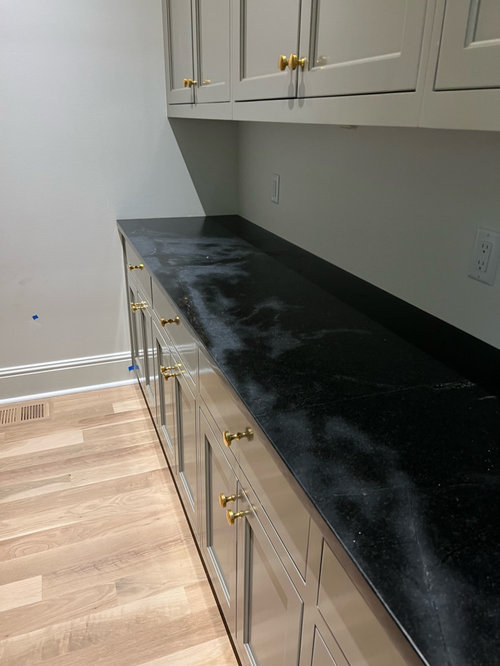
My counter people just installed and oiled. The rest of the areas look great except these splotches? Is this just the stone? Thanks!

Comments (14)

  • 3 years ago

    What did the slab look like before they oiled it? Were the white marks there then? The first one sort of looks to be a vein to me, others I cannot tell.

  • 3 years ago
    last modified: 3 years ago

    Some areas can take the oil more willingly than others, that happens on one section of our soapstone. But, it shouldn’t look white and splotchy. That just doesn’t look right.

    Did you purchase your soapstone from a bonafide soapstone dealer, or from a generic stone yard…whose main business is granite, quartzite, marble, and the fake stuff (quartz)?

  • 3 years ago

    It was purchased from artistic tile and goes through strenuous inspection. Thanks!

  • 3 years ago

    Yeah, well Artistic Tile dabbles in soapstone. They are not true soapstone supplier/fabricator experts. Many of their locations are in territory serviced by M. Teixeira the largest soapstone dealer in the US. Artistic Tile offers just two varieties of soapstone, while they have a multitude of other stones.

    Compare that to M. Teixeira, who at any one time, will have between 10-12 varieties of soapstone….along with expertise to properly sand and fabricate soapstone.

    Anyone near Artistic Tile’s Shrewsbury, MA location, could be serviced by Vermont Soapstone, also soapstone expert fabricators.

    Going through ”inspection” is worthless, if the company doesn’t have the knowledge of how to properly finish soapstone tops. They need to be sanded to a particular grit, for a smooth, silky, matte appearance and feel. And, they should never, ever be sealed.

  • 3 years ago

    Ours does that, and it was supplied and installed by M. Teixeira at one of their largest locations, so I have no reason to believe it isn't genuine soapstone that was properly fabricated. I suspect it just depends on the stone variety. We oiled for the first few years we had it--our stone is now 13 years old--and just had to reapply oil liberally in those areas to get an even color. At this point we only oil it a couple of times a year if that, so most of the time it's a softer gray that has light and dark areas. My oiling "technique" (if one can call it that!) is to copiously apply oil so that it's sitting on the stone, let it sit for an hour or so, and then wipe it down. That seems to let the stone absorb more where it needs to and less where it doesn't, so I'd try more oil first to see if that evens it out.

  • 3 years ago
    last modified: 3 years ago

    The splotchy appearance is typical of newly installed, freshly oiled soapstone. Buff the counters with a clean, dry rag and, if needed, apply more oil and buff again. It will take a while for the counters to stop appearing so blotchy. Some people have had more success with wax or wax/oil mixes. I used an enhancing sealant after trying both oil and wax because I did not want to have to deal with reapplying oil or wax. It took two applications of sealant (after first cleaning of all oil reside) for my counters to stay evenly dark and maintenance free, besides cleaning or course.

    @darbuka I understand that you have experience with soapstone but you have stated (maybe just inferred the first) 2 things that are not entirely accurate:

    1. Even super polished soapstone can evenly absorb oil.

    Here are my counters that were highly polished and evenly darkened with mineral oil:


    2. Sealants can be applied to soapstone.

    Here are the same counters as above after I sanded them and applied an enhancing sealant:


    I have lived with 2 types of soapstone for a total of 15 years and have tried not oiling, oiling, waxing, and sealants and have personally liked the sealant approach the best. My counters in my first house were from Alberene in Virginia and we lived with them sealed for 12 years with absolutely no issues. The new house are harder Brazilian and have been sealed for a little over 6 months, again no issue. I understand that many do not want to use sealants but it is a misconception that they can not be used.

  • 3 years ago
    last modified: 3 years ago

    "Sealants can be applied to soapstone."

    @s m - I understand what you are saying that sealant can be used on soapstone. The issue for me is what happens to the soapstone's appearance when sealant is used. The photo you posted looks like polished black granite. The unique beauty of soapstone has been erased - its softness, depth and gradations of color, everything that makes people love soapstone's appearance is now absent. I would just buy black granite if what you have pictured is the desired look. There are several black granites that have subtle white veining.

  • 3 years ago
    last modified: 3 years ago

    To be clear- the first pic above was overly polished soapstone with ONLY oil applied, no sealant. The second pic is after sanding and applying sealant, since I sanded my soapstone it does not look like granite. In fact, once sanded, the sealant gave it a MORE matte appearance than oil did. It is very tricky to photograph the cosmically dark nature of matte soapstone, no matter what is applied to its surface.


  • 3 years ago

    Sorry, but an ”enhancing” sealer is changing the characteristics of soapstone. Other people have used it, and posted the results here. The counters lose that silky, matte appearance, and the sensuous feel. But, like with @s m, they cared more about eliminating the change in patina; i. e., keeping a uniform look, than keeping the true qualities of soapstone.

    It’s true, the first oilings are splotchy, as different parts of the slab will have a different mineral content metamorphosed in the slabs…making the oil attach to certain parts better than to other sections. However, I’ve never seen white showing in the splotches. And, yes…it will take several days of oiling 2-3x/day during the first week, before the oil adheres evenly, and sticks to the surface without totally evaporating. They should be wiped down to remove excess oil, a few minutes after oiling.

    Many of us have stopped oiling altogether, and just let the soapstone do its thing. Our counters are now 7 1/2 years old. We haven’t oiled in four years. Certain sections of the counters get more patina than others…like, beside the rangetop, at the prep area and sink. Those areas are darker, and the green and white veins really pop.

    About twice a year…or when DH just feels like it, he will strip the patina off, and bring the counters nearly back to their original color. An easy thing to do, with a blue Scotch scrubby sponge, some Bon Ami or Comet, and a bit of water.

  • 3 years ago
    last modified: 3 years ago

    @s m, I never said that polished soapstone couldn’t absorb oil. Soapstone is not supposed to be polished, like other stones. It should have a soft, silky, matte appearance, and a sensuous feel…all things soapstone counters won’t have, if they are polished.

    As for sealing the surface of soapstone, if you’re going to alter or defeat the characteristics of soapstone…you might as well have gotten honed Virginia Mist, or some other black granite with white veining.

  • 3 years ago
    last modified: 3 years ago

    It looks normal for newly installed soapstone. I purchased from M Tex, and my stone behaved the exact same way. No one person here is the single authority on soapstone.

  • 3 years ago

    Darbuka, please realize that I am not trying to argue with you, just share my own experience with soapstone.

    Typical enhancing sealants do not alter the feel of soapstone. My counters did not feel great when they were overly polished but since sanding them they feel silky matte as most people prefer. I have seen posts here where people have theorized that counters were too shiny or not matte enough because of sealant but likely that was actually due to being over polished.

    It is true, I do prefer the evenly dark appearance and have been very happy not to have to continually oil or wax to get it. The stone can still patina, my last counters had a lot of variation in them from use. That is more dependent on the hardness of the variety, my current counters are harder and do not get the dings and little white marks.

    I think it is great that you have had such a good experience with your soapstone and that you want to share that with others. It is not always the case, not all varieties behave exactly the same. Your stone has a lot more movement and veining than many and I think that it helps patina, specifically oils, blend in nicely. My stone has much less veining and is light gray when it is not oiled and every little drop of oil stood out and just did not look good. I have read posts where people were so frustrated with their soapstone that they considered taking it out. For those people, it may help to at least try an enhancing sealant to see if it can help with their issues.


  • 3 years ago

    @s m, that was very nicely put, and I thank you for your thoughts.

    It’s true, we have an exceptionally hard variety, with lots of veining. It’s the one much less veined section that, as you indicated, doesn’t take on mineral oil evenly. Fortunately, it’s a small end section on the right side of the rangetop…at the end run of cabinets. And, even though we stopped oiling years ago, that particular section does naturally patina differently. We give it no thought. But again, it’s just one small section, not a long run of counter…which might bother me if that was the case…I can’t say for sure.

    Perhaps the OP will try the enhancer, and it will satisfy her issue. On the otherhand, what he/she showed us was just the first oiling. It does take several days of persistent oiling, for the mineral oil to fully oxidize, and adhere to the tops of the soapstone.


  • 3 years ago

    Rkashwood, I love your cabinetry and the color you picked! Would you mind telling me about it?