Software
Houzz Logo Print
devin_leejohnson

Cherry Laurel Shrubs Struggling

3 years ago


I purchased 3 large Cherry Laurel shrubs (schipka variety) from a local nursery. They were healthy, bushy and thriving when purchased.

They are planted in a full sun south facing landscaping bed in Zone 6 of Louisville, KY.

Since I planted them, they have always seemed to be struggling. Random leaves in different areas all over the plant continue to turn yellow and drop. The shrubs are starting to look very thin and “sickly” as a result to so much leaf fall. They developed what I believed to be ”shot hole” almost instantly as well. It’s now been 3 months and the leaf fall and overall plant health hasn’t improved.

I feel like I’m doing everything to the best of my ability to help these plants. I water only when the top 2 inches of soil are dry, I water at the base of the plant and I do a slow, deep watering. I’ve often withheld watering these to avoid root rot.

However, I believe this may be a soil issue. I am new to landscaping, so when I discovered a lot of gravel in our landscaping dirt, I did my best to remove all of it before planting the shrubs. I fear that I created a situation where the soil is now compacted. We have heavy clay soil that leans in the alkaline direction, so I attemtped to amend it with gardening soil & compost while planting the shrubs.

Since planting, I’ve tried aerating the area around the rootball with stakes, working gypsum into the soil, composting the plant and I’ve tried letting them dry out a little more before waterings. I’ve also pulled the mulch back about 10 inches from the base so they have more chance to fully dry between waterings. (I have not tried fertilizing because it’s currently above 90 degrees in Kentucky right now every day and I think that would cause more stress to the plant.)

Should I dig these shrubs up and amend the soil more intensely with materials that will help with drainage to avoid potential water logging? Or would digging the plant up during our 90+ degree summer & the potential root damage be worse for them than having soggy soil?

I’m at a loss and don’t know what the best course of action is. Any help or guidance woild be immensely appreciated.

Comments (16)

  • 3 years ago

    Someone like gardengal should be able to guide you.


    I have no experience with laurels. Given that: Sounds to me like you’re doing everything right. Agree with no fertilizer and no transplanting now.

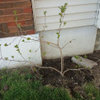
    From the photo, the one shrub looks pretty good, though I realize it may not capture what you see. Does ”shot hole” refer to the foliage?


    She may recommend soil test (or other measures).

  • 3 years ago
    last modified: 3 years ago

    @rifis (zone 6b-7a NJ)Thank you for your feedback. Yes, the shothole isn't super intense, but some of the older leaves developed the holes early on right after planting. I agree that the photo makes it hard to see the issue. I would describe it as, when first planted, these shrubs were dark green, bushy/wide, the leaves were flat and substantially large. Now, the leaves are a light green, and slightly curled, with a drastic leaf fall count on a daily basis. I would say it loses 25-30 leaves a week. They turn bright yellow and fall off on their own, or are very easily removed simply by touching them. I have to do a "leaf sweep" almost every other day to pick the dead leaves up out of the mulch in the landscaping. I fear it won't have any leaves left if this continues. This is the only plant I've had behave this way, so it seems strange to me.

  • 3 years ago

    " We have heavy clay soil that leans in the alkaline direction, so I attemtped to amend it with gardening soil & compost while planting the shrubs. "

    If you amended the planting holes in a clay based soil, that could be the problem. It creates pockets of overly water retentive soil (the amended stuff) surrounded by the slowly draining clay, resulting in what is known as the 'bathtub effect'. This can certainly lead to leaf yellowing and drop and potentially root rots.

    It is rarely ever advised to amend individual planting holes for a variety of reasons, this being only one of them. Laurels are adaptable to a clay soil as long as the planting prep is as follows: dig a wide but quite shallow planting hole and position the shrub so that the top third of the rootball is above grade. Then mound the excavated soil up to the top of the rootball. This is where you can add extra soil or whatever amendments you like. This will allow the plant to extend its roots out into the native soil without sitting in wet, slow draining soil.

    Laurels are not all that fussy about soil pH and will thrive in slightly acidic to neutral to slightly alkaline soil. And while this time of year is not conducive to transplanting, if the above describes the current situation (an amended planting hole in clay), then leaving the shrubs as-is is likely to cause their demise, sooner rather than later.

    I also would not worry too much about the shothole. Schip laurels are rather prone but unless an extremely acute case, it is mostly a cosmetic issue.


  • 3 years ago
    last modified: 3 years ago

    In addition, I would add that gravel in a soil is not necessarily a problem for plants. Cherry Laurel is a tough shrub/small tree which will grow in a wide variety of soils. Unless you have very unusually inhospitable conditions, it shouldn't need any coddling or care other than deep watering after planting in unamended native soil and further watering if you don't get rain. They're widely used in places like road junctions and supermarket carparks here. It is a weed tree in some areas. That's how adaptable and tough they are.

  • 3 years ago
    last modified: 3 years ago

    I don't know if you're new to gardening, but new gardeners tend to fret pretty early on and they tend to try adventuresome, over-reactive cures. I have nothing to add to what gardengal or floral said except to make that observation.

    To be gently frank---you are torturing that plant. You made a bowl by amending the planting hole. Then when the plant became sickly, you forced a multitude of cures down its throat. And you're too fussy with the watering.

    I don't know the plant and I don't know gardening in Kentucky, but if I had that plant in Maine, I would lift it on a cloudy day, replant it in a hole with unamended soil, and I'd use my compost as mulch. I'd shade the plant with my umbrella or a cardboard box if it were hot, and I'd water it daily with a sprinkler.. I wouldn't feed it, alter its pH, or do anything else to it. A sickly plant wants to be left alone. Like I do when I'm sick.

    A plant that's happy and pushing out new roots will show that by its color and leaf health---as you noted. Once it's established and rooting you can think about nutrition, etc.

    Also I just read that in hotter climates, the cherry laurel prefers more shade than in cooler climates. And they like fertile soil, which clay soils are and I read they like acidic soil.

  • 3 years ago

    "I read they like acidic soil. " They may like it but they don't need it. They really couldn'r care less. They grow on limestone round here, self sowing happily and growing into trees if not kept in check.

  • 3 years ago

    @annpat Yes I am new to gardening, I actually said “I am new to landscaping” in my post… I don’t know if you actually read it.

    Your comment is very condescending. It kind of sucks to be eager to learn and looking for help for more experienced people, but to be talked down to like a child. That discourages people from trying new hobbies when people make them feel inferior for not knowing everything. I was simply doing my best with the information I tried to self-teach from gardening websites. I had read that laurels did not like rocky soil, so I tried to provide a new climate.

    There were huge (2 ft. X 2 ft.) concrete block slabs in our landscaping bed from where the builders disposed of their concrete scrap in the landscaping. We had to dig that out bc we were running into it every time we tried to dig a hole for a plant. We ended up having to dig up the entire bed and found old insulation, rusty hunks of metal roofing, a nasty mess. We actually had to purchase a jack hammer to break up some of the concrete slabs. It was not a habitable place for plants. The soil amendment was unavoidable.
    I did not only a mend the holes, I had to amend the entire bed.

    I also have not done anything to the plants thus far except sprinkle some gypsum on top to give them some grit. I’ve not fed them in any capacity. And I’m not being fussy with water whatsoever. I water them deeply about once a week unless it rains, then I leave them alone. I do not understand how that’s “fussy.” That’s what every single website known to man tells me to do and what the nursery owner told me to do when I purchased them.

    I clearly made a mistake trying to take all the rocks out of the soil and created a compact situation. But that’s a rookie mistake and I’m a rookie. That’s why I’m here for advice.

    I appreciated @gardengal advice because she was helpful and kind.

    Anything outside of helpful and kind, I am not interested in. If you’re not here to be helpful & kind, why are you on this website?

  • 3 years ago
    last modified: 3 years ago

    I'm sorry, although I don't think there was anything condescending about my post at all. And I did not "talk down to you like a child".

    I imagine you took offense when I asked if you were new to gardening, which you had not mentioned. You mentioned that you were new to landscaping. They're not the same. In fact, most landscapers are not gardeners at all. I asked because I was trying to mention an observation I've made over the years. Often a new gardener will see a hole in a plant's leaf, and then they apply every piece of advice they find on the internet all at once. Overkill is a common newbie mistake.

    I was trying to be helpful. You said you found gravel in your "landscaping dirt". I didn't understand that you were gardening in concrete debris. I also thought you amended your planting holes with compost---not the entire bed. I thought our conversation would go on longer and I'd mention someday that compost is not stable and will disappear over time---making your new landscaping sink if incorporated into the soil---something that I didn't understand about compost for a long time.

    And "fussy about watering"? You said that you watered deep and long. Sometimes you withhold water. I wasn't being unkind. Most newly planted shrubs like to be watered daily to help establish roots. That's if the water can leave the area. Established plantings get treated differently than the same plant when it's trying to get a foothold.


    I do have an issue with tone, you're right, but my motives were pure. I think if you reread my post without seeing offense where there was none, it might sound different.

  • 3 years ago

    I feel bad that my response discouraged you from continuing to find the source of your problem. Let me try again.


    Overzealous new gardeners is "a thing". I wasn't insulting you. And I genuinely didn't know what you meant by being "new to landscaping". A lot of new gardeners (I'm not talking about you.) see some leaf damage and the next week, they're in a store getting advice on how to rid themselves of whatever pest it is. A more experienced gardener might tell them not to worry about the damage yet. It might be temporary; the outbreak might be small; and natural predators might show up---if they're not poisoned. Also, a primary cause of disease, and a reason pests are sometimes attracted to a plant, is specifically because it has an underlying problem that makes them vunlnerable, and that should be addressed.


    I didn't accuse you of fertilizing your plants, if that's what you thought. You said you hadn't fertilized them because it was too hot. I was merely further advising you as a newbie that a struggling plant does not want fertilization, whether it's hot or not, unless fertility is what it's lacking. When my mother was ill with pneumonia and not eating and barely conscious, I wanted to force-feed her, but I was advised by medical practitioners that that was not in her best interest. Same with an ill plant. Unless of course, its malady is starvation.


    You got some good advice from Garden Gal. I think both of us agree that the plant needs to be lifted and replanted in soil as close to native as possible. You can apply amendments from above. Compost is generally not advised to be applied to a planting hole in a permanent planting. You could incorporate it into an annual bed---your vegetable garden, say.


    I don't think the problem is soil compaction unless you actually sieved the soil. You might think about lifting the plant and looking at the roots. There should be new white roots forming if the plant is taking off as one would expect after being put in the ground and removed from the pots. We do know that amending a planting hole with compost can negatively impact their growth; why not make that your prime suspect? Although, I don't know what happens when an entire perennial bed is amended with compost, etc. Garden Gal can tell you what to expect from that. I know the bed will sink in exact proportion to the amound of compost applied, but I don't know how the bowl effect is impacted.


    Good luck.


  • PRO
    last year

    @DevinJ 6b-KY your plant suffer root rot. i am struglinh as well 2 yrs plant die after i realized this issue. ( dieback), they grow well but in basically sandy soil or mixture not 20% compost. i triying this mix now... raining days + compost soil+ frozzent water in winter season or in container doesn help to prevent root rot. i do remove the plant and check roots are brown... try this mixed i am doing the same here. to see if this get live or recoverd. i will sugges to check before your plant if your root came white from nursery. otherwise you will have dieback issue... remver the day you got the plant what type of soil i was thre in the pot... mostly not dirt or compost at all more chips and fertilizres in capnsulles... so ironically what this plant grow well in any soil no so true they die eventually do this issue root rot... root are merenly thin so quite sensitivy to moisture on soil.

  • last year

    The above is not at all true (what I can make out from the bungled wording). Cherry laurels are like weeds here (borderline invasive) and they CAN grow everywhere - highly enriched, cultivated soils, pure compost, forest duff, clay, rocky and/or sandy soil. As long as the soil drains decently, root rot is very unlikely. In fact, I have never seen a laurel die from root rot.

    Sounds like excessive watering or poor drainage is the issue, not the soil itself.

  • 10 months ago
    last modified: 10 months ago

    Annpat is as far from being a troll as it is possible to be. She's a long time (many years) valued poster on these forums and is a highly experienced gardener. She has a fantastic, quirky sense of humor and if you don't get it that's your loss. Perhaps it would be sensible to wait until you get to know the characters on this site before jumping in with insults in your very first post.

    Now, if you really want help with your cherry laurel issue it would be helpful if you posted pictures, said where you live (location, not zone) and provided information on how you have been treating them up until now. We are all happy to help.

  • 10 months ago

    Yeah, I gotta jump in here for Annpat too. I bit my tongue the first go-around two years ago, but won't this time now that this thread has been resurrected. Annpat is a very knowledgeable, long-time poster with a fantastic sense of humor and a great willingness to help. Everyone could learn a lot from her if they would be more open to actually listening to feedback when they ask a question. She tried a lot harder to assuage some hurt feelings than I would have. I would suggest listening to and learning from her experience.


    :)

    Dee

  • 10 months ago

    Oh, 34737326! I'm quite warm and pleasant feeling from Dee's and flora's defenses, so you're completely forgiven. Welcome.


    Yes, I could probably word things differently---like maybe I shouldn't have said Devin was "torturing" her plant" (even if it was true), I probably could have said something more diplomatic like "Devin, I wonder if your plant might prefer if you would walk away from it for awhile, and cease your possibly overly attentive ministrations that may actually be causing its malaise." All right, yes. I can see that would have sounded better. And I can certainly see why she was offended when I asked if she was "new to gardening", because the typewritten word might not convey warmth and sincerity.


    I'm generally very fond of strangers and feel bad when I've driven one away. And I try not to engage in foolery when conversations around me are academic. My strength is more theory and supposition. so I try to hold back when more scientific types are chatting. Every once in a while, though, someone will say something just too horrible to ignore, and I have a hard time staying mum when that happens.