Software
Houzz Logo Print
rewindtech

How fast do Quaking Aspen actually grow?

I live in Northeast Ohio and I’ve seen aspens growing in the wild here just fine, I just wanna know how fast they have grown for other people in the Midwest.

Comments (15)

  • 3 years ago

    My yard is already a forest lol, that’s the whole point of why I want to plant them😂

  • 3 years ago

    I recently have also seen a whole colony growing in a nature park near my house

  • 3 years ago
    last modified: 3 years ago

    How long is a piece of string? True, they are, like all the willow family, fast growers, but not at the same rate. During their adolescence (between 8-15ish years), they can easily sprout over 120cm a year...and possibly even more in favourable conditions) On average, I would say aroundbetween 2-3 feet a year, over a (not very long) lifetime.

    I am no tree expert but I do have a poplar plantation and made it my business to pay attention to things like growth and health, as well as the aesthetics. I don't think I would choose one for a garden though - they sucker like crazy and are unreliable - tree surgeons often refer to them as 'widowmakers'.

    Also, I am not in the Midwest...not even on the same continent, but like when anglers tell you about the 'massive' fish they just caught...there is a fair bit of hyperbole around the rate of poplar growth (or silver birch and Empress trees for that matter).

    I expect a bunch or tree forum folk will jump in with better estimates of growth in your area.

  • 3 years ago

    I WANT to make a forest out of them and have my own little Aspen colony lol, I hope they do grow decently, and like my forest ha

  • 3 years ago
    last modified: 3 years ago

    And there are many species of the Populus genus. 25-30 species.

    We have several native to our area.

    Populus grandidentata is my favorite. Brilliant yellow to orange Fall color and is more of an upland tree.

  • 3 years ago

    I’m also trying to grow bigtooth Aspen, my friend has a ton in her yard and they look so beautiful in the fall

  • 3 years ago
    last modified: 3 years ago

    Not all of the poplars sucker - hybrids (populus x canadensis) will grow rapidly, but mannerly, while both white and black poplars are lovely trees in their own right.

    I do understand why you would want them - the canopy is high and light, so you can maintain a decent understorey or even grass and wildflowers. I knew hardly anything about poplar (apart from general scoffing about matchwood) but since acquiring a little pocket wood of 6 acres or so, it is a genus I have come to love...especially the white poplars which look amazing in the landscape.

  • 3 years ago

    Generally about a 30-50 year lifespan.

    Tall, single or sparsely placed specimens have a tendency to snap off mid trunk during high winds.

  • 3 years ago

    They grow fast, I've seen some grow nearly 6 feet in a year out in the open, but usually 3 feet is normal in the open, while only a couple feet when competing with other trees. Quickest growth comes when they're small and will do 4 to 5 feet in moist sunny locations and why I need to cut my clearings two or three times a year, to keep the aspen from growing. I can walk the perimeter of my land and could count 100's of aspen but It would I'd be hard to find 10 without problems.

    Snapped tops from the wind is common and kills the growth and they die, but they will have dozens of suckers coming up to take it's place. Walk into those stands of aspens and look at the trees. They aren't pretty close up with lower branches always dying from lack of sun and the trunk around the dead branches turning black and canker looking, not to mention the ugly gulls from pests, and only look to do well in a colony from a distance. You said you have trees, so aspens are no match for oaks, conifers and maples and you end up with a forest of dead aspen sticks. They will grow well with birch and cottonwood (for some reason) but still get a lot of dead aspen sticks,....but don't mind growing with buckthorns I've noticed.


  • 3 years ago
    last modified: 3 years ago

    Bigtooth aspen will sucker, but perhaps not quite as much as quaking aspen. Strangely, when I lived in a part of a national forest of oaks, hickories and maples in VA, there were occasional 100 ft canopy bigtooth aspens. There were no suckers around these canopy trees. I think they would eventually disappear as longer-lived oaks, hickories & maples continued to grow/spread.

  • 3 years ago
    last modified: 3 years ago

    An amazing thing about poplars, if you cut down a mature specimen, for what ever reason (generally they get an internal fungal rot with age), the shallow root system will send up thousands of new shoots over a large area. This new stand of whips be so thick i.e., close together, a rabbit can't hardly walk between them.

    They do 'self-thin' over time and is a sight to see (over several years).

    When I worked in the woods back in the day, a conk or shelf fungi on the trunk of a poplar, was a clear indicator that there would be punky wood inside the trunk. ;-)


    eta: https://apps.extension.umn.edu/garden/diagnose/plant/deciduous/poplar/branchesfungi.html

  • 3 years ago

    I have a small ’grove’ in my backyard. theyre short-lived, sucker, need lots of maintanence, and i absolutely love them. the slightest breeze gets them ’quaking’, the birds are always in and out looking for bugs, the smooth gray bark is attractive, the fall color is amazing, and when i get tired of them i cut a couple down, and when i want more i let a few suckers grow.

    right now my only problem are the spotted lanternflies. Theyre going to move onto the trunks now that theyre bigger, and make a blackened, sticky mess as they squirt out their waste… but theyre on plenty of other trees as well.

    sometime this month i’ll run the mower through them to clean up the ’meadow’ underneath and get rid of the suckers, last last month i went through with the saw to limb them up for more light.

    I’m about z6a now, up from 5, with thin soil and plenty of rocks. Seedlings and transplants take some time to get a root system established, and grow much slower, but suckers can grow several feet each year in a sunny spot.

  • 3 years ago

    i had some bigtooth aspen here at first but cut them down. They were bigger and the smaller quaking aspen seem to ’fit’ better in my relatuvely small yard.

  • 3 years ago
    last modified: 3 years ago

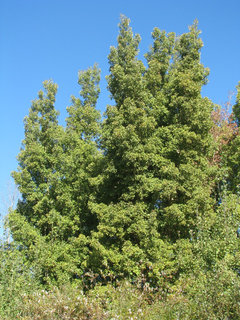
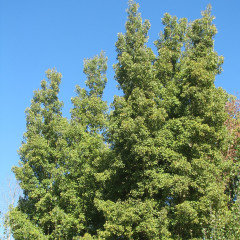
    Trembling aspen is the main species here, I wish I could trade a whole lot of them for a nice mixture of long lived hardwoods! But, with that said, there are some very nice clonal stands and specimens worthy of propagation, such as these billowy columnar beauties I came across, actually I did attempt though failed with propagation, must try again if the stand has not been bulldozed or something that is! In my opinion these have way more texture and interest going for them than the commonly available Swedish aspen.


    Edit, I just dropped message to a local tree propagator on whether they'd wish to attempt to trial this selection, hopefully so, please may the trees remain undisturbed where found! :)

Sponsored
Bella Casa LLC
Average rating: 5 out of 5 stars17 Reviews
The Leading Interior Design Studio in Franklin County