Software
Houzz Logo Print
tvzaaa

Best ground cover for sloping ground between raised beds

2 years ago

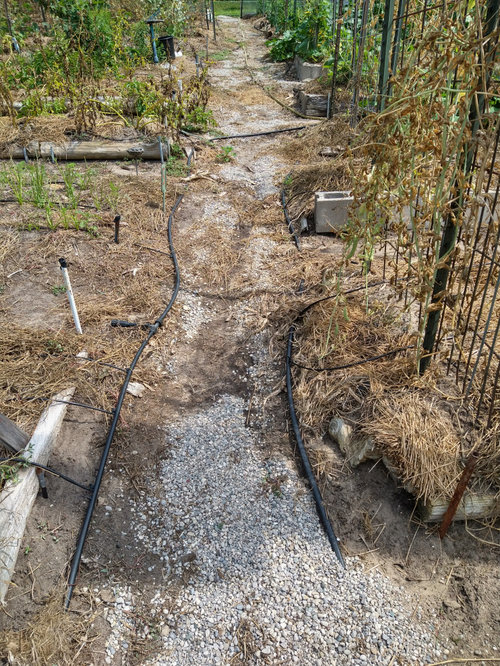
My garden is on sloping ground. I have raised beds that work out well, but the walkways between the beds tend to wash out in heavy rain storms. (They presently are mainly my sandy native soil.) I have tried putting down straw, pea gravel, etc., but they all wash out. I'd rather not use landscape fabric. Does anyone recommend for or against seeding with clover, chamomile, or something else?


Comments (27)

  • 2 years ago
    last modified: 2 years ago

    Does the mulch wash out of the side paths too? I'm picturing this for at least the main path shown..

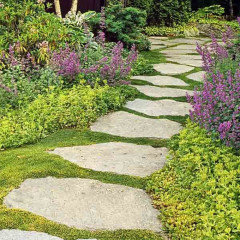
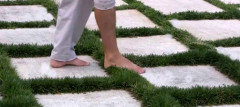
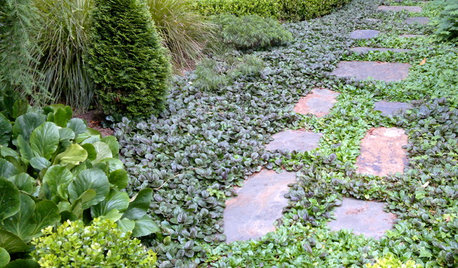
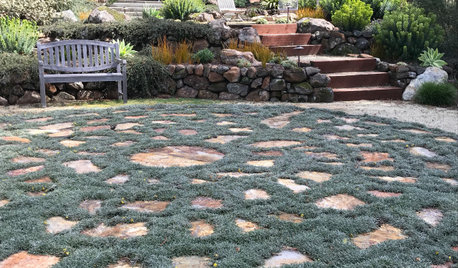
    Stepping stones or squares with your spreading ground cover and clover in between. You local nursery will have what grows in your Zone...NOT a big box store. Creeping thyme, chamomile, sedum, your clover, all good choices. These show lawn in between but the concept is there and the spacing TBD depending on your needs.


  • 2 years ago

    The problem exists in the main path shown, and also 2 others like it that run up & down the hill. The paths running the other way are no problem. The garden is quite large, so it would take a lot of stepping stones. I think I'll start by trying various ground covers in the sloping paths, and see which I like.

  • 2 years ago

    You committed the cardinal sustainability sin of giving water a straight run down hill. You should have staggered the beds so that the path is not straight. I would do a mix of stepping stones and heavier gravel. Pea gravel is too light. Ground covers will not stand up to a deluge.

    Tom VZ thanked ShadyWillowFarm
  • 2 years ago
    last modified: 2 years ago

    I would eliminate the paths that run up and down hill and I would enter the garden from the sides. Or install a series of berms or beams to divert water off the paths to the sides. Or reconfigure the paths. Otherwise it will be a continuing problem with erosion.

    Tom VZ thanked tracefloyd
  • 2 years ago

    ^^^Yes. I just went and looked at the photo again and the beds can be easily reconfigured since there are no permanent walls or other structures. You want the water to meander around the beds rather than go straight downhill.🙂

    Tom VZ thanked ShadyWillowFarm
  • 2 years ago

    I apologize, I could not get a good photo to show the layout. It would actually be very hard to reconfigure the beds, etc., since the whole thing is surrounded by a double fence to keep out my many deer neighbors. I will try a combination of stepping stones and ground cover.

  • 2 years ago
    last modified: 2 years ago

    Don't paint yourself into a corner so to speak. I'm sure there must be a way even within the confines of fencing.

    Not like this:


    Something like this:


    Tom VZ thanked tracefloyd
  • 2 years ago

    Groundcovers, by their nature spread. If you do one, you'll spend a lot of time removing it from your beds, unless you put in a barrier.

    Tom VZ thanked Sigrid
  • 2 years ago

    Thanks Tracefloyd. I agree, your configuration would be better. But my garden is actually about 3 times as big as your sketches, and I have spent 35 years building up the soil in the beds. (My native soil is essentially dune sand. I'm on the edge of what was a bay of Lake Michigan a few thousand years ago.) Also, all of the beds have walls at least on the lower sides to terrace them so they are level. I'm 71 years old, so I don't really want to start over. In my next life I will do it as you say, but for now I'm going to look for a less involved solution...

  • 2 years ago

    Yes, Sigrid, I can imagine that. I do have framing most of the way around my beds, so that might help; but I suspect you're right about the groundcover wanting to spread. That's why I'll just try it out using various species in limited areas, so I can see what (if any) is manageable and effective. Then I can easily remove the ones that don't work well or spread too much.

  • 2 years ago
    last modified: 2 years ago

    Can't you lay down 4x4's across the path to divert water? If the beds are level to grade on the uphill side, let the runoff leach into them. Or will they turn to mud. Hmm.

    Pine needle mulch or straw is cheap and plentiful. At least it used to be lol. Very stubborn to move.

    Wear mud boots. I'm in CA and I wish we had your problem.

    Tom VZ thanked tracefloyd
  • 2 years ago

    Thnx for the thoughts, Tracefloyd. I'm afraid that 4x4's would be kind of an obstacle to my wheelbarrow. Maybe if I half-buried them or just use 2x4s...


    I have used straw and other such materials. They wash away during rainstorms.

  • 2 years ago

    I can't tell the degree of slope, but it looks similar to the ones we had at our old house in the country. We had crushed concrete as the paths and that worked pretty well. The creeping thyme seemed to like that medium and grew surprisingly well. We had more of a problem with gophers than water, but then I live in CA where we don't get much water most of the year, but can get a lot in the winter.

    I seem to remeber that the most sand was on the Michigan side. Are you there? We lived there for awhile, and I don't remember the winters being awful, so the Creeping Thyme might be alright.

    Tom VZ thanked CA Kate z9
  • 2 years ago

    Crushed rock would be a good possibility for holding things, but I have to admit that I love to garden barefoot, but don't think I could handle crushed rock.


    We're in the NW corner of the Lower Peninsula of Michigan, near Sleeping Bear Dunes area. The lake does moderate the temperature so it seldom gets below 0 degrees, so maybe thyme would like it?

  • 2 years ago

    Creeping thyme is fine here. It has a big dieoff about every three years, but that doesn't seem to be related to how bad the winter was. I pull out the dead stuff, and it is back in about a month.

    Tom VZ thanked mad_gallica (z5 Eastern NY)
  • 2 years ago

    I have creeping veronica, like it, and find that it is easy to trim back to within bounds with my garden scissors and tolerates being walked on.. Clover is pretty tough and resilient too, and might well be able to stand up to the waterfall.

    I also was thinking about the way that trail builders in the mountains install cross pieces to divert runoff. If you used 1x1s or 1x2s with just a 3/8" lip above the soil level, perhaps that could have enough effect (except in the heaviest storms) without impeding your wheelbarrow. However, the water would have to have a path across your edging.


  • 2 years ago

    Well, Barefoot Boy, have you tried making a runnel off to the side of the path and directing the water into that?

  • 2 years ago

    No, I wasn't aware of these, floraluk2. However I'd have to put them on all of the three paths that run up & down-hill, so it would be a substantial investment. I'll keep these in mind in case nothing else works! Thnx for the suggestion.


  • 2 years ago
    last modified: 2 years ago
    Tom VZ thanked floraluk2
  • 2 years ago

    Interesting idea, Floraluk2. I wonder if there is a product along this line that is not plastic. I'm afraid that in time it will break down and become incorporated into the soil. I kind of feel like there is enough plastic in our environment. (But I suppose that any more "natural" material would break down quicker and lose its effectiveness.) I'll mull on this in case my more natural ground cover (plants) do not work out...

  • 2 years ago
    last modified: 2 years ago

    There is coir or sisal matting for stabilising sloping areas. And many of the plastic meshes are made from recycled material. Or use heavy duty chicken wire. btw my climate doesn't allow barefoot gardening, but even if it did I wouldn't risk pain, infection or injury by doing it. I don't even wear sandals to garden.

    Tom VZ thanked floral_uk z.8/9 SW UK
  • 2 years ago

    Thanks for the ideas, floral_uk z.8/9 SW UK!


  • 2 years ago

    Many interesting ideas, kevin9408 !

  • 2 years ago

    It shouldn’t be too hard to implement @tracefloyd’s concept especially since you don’t have borders on your beds. Just take some of the soil from the ends of a bed and fill in the bit of pathway in the middle.

    Tom VZ thanked cinny
  • 2 years ago

    Aggregate. #57 stone, had some leftover and tried it. Looks nice and works great. Fabric underneath for weeds. Your paths could channel/focus water, mine do. Maybe put in a "break" to slow it down. Picture a 1/2" lip every few feet going downhill.

    Tom VZ thanked Donald V Zone 6 north Ohio