Software
Houzz Logo Print
olive_carson39

Using Pine Wood for Trim/Baseboard

2 years ago
I am in the process of renovating my home. My carpenter asked whether or not I wanted to use pine wood or primed wood to trim the windows and the baseboard. He explained only that the pinewood would be $3 cheaper per board. Not knowing any better, I agreed to it.

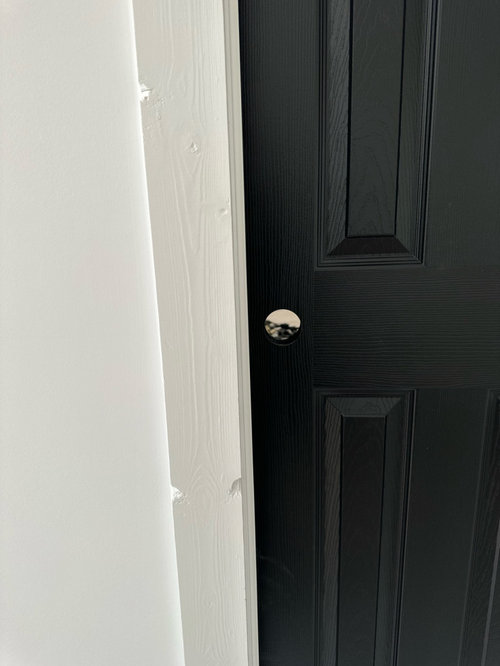
Once the trim was installed, I noticed that there were imperfections throughout the trim, such as gashes and it wasn’t smooth. When I asked about it, I was told that it would be filled. I. I stopped by the house today to take a look, because the painter was wrapping up, and I noticed that all throughout the house there are glaring imperfections. Once I brought it up to the painter, he is saying that he will use wood filler to fix it but I’m questioning why this wasn’t done to begin with and also questioning whether it really will fix the problem.

Has anyone else used Pinewood for trim or baseboards and is wood filler the best option to fix this problem?

Comments (25)

  • 2 years ago

    Years ago we used stain grade pine for window/door trim and baseboards in a custom house. We also had pine doors. DH and I distressed each and every board on a hot and humid 4th of July weekend. Even after we distressed, they did not have the imperfetions yours have.


    Since your goal was to paint, I would have suggested pre-primed or paint grade wood.

  • 2 years ago

    I kind of like the rustic look of it, but depending what style house you have, it might not be the best look for your house.

  • 2 years ago

    House is very modern so the rustic look does not work at all. Lol

  • 2 years ago

    @Allison yes, that’s a big lesson that I’m learning. I needed the primed/paint grade for sure.

  • PRO
    2 years ago

    Wow that’s #2 pine, #1 clear would have been fine. For a modern house with painted trim I would have done a mix of primed mdf and primed finger joint. Yes that wood can be filled and sanded and made to look higher quality but it will be a ton of work. Who will pay for that?

  • 2 years ago

    🤦🏻‍♀️ I don’t know why this was ever used. I’m far from the professional. Carpenter should have known. I’m so distraught right now. The painter said he would fix it, but I’m so worried.

  • 2 years ago
    last modified: 2 years ago

    I don't think this trim will ever be fixed to anyone's satisfaction. Your "carpenter" is not a trim carpenter. He should have shown you pictures of real millwork accompanied with actual samples.

    The labor cost for the time it would take the painter to fix it (even if he could) will far exceed any savings for the cheap pine.

  • 2 years ago

    I've used pine for trim. Your carpenter didn't explain the different grades of pine, and what I see chances are you have grade 3 lumber and so sorry. When appearance is essential I use grade #1 select when it will be stained. Grade 1 is the best when machine stress tested and select is visually pulled from grade #1 when no knots or imperfections are present.

    Grade #2, sometimes referred to as quality has imperfections and tight knots. Grade #2 is what is used to make primed wood but first the imperfections are filled with wood filler at the plant and than primed. I've used bare grade #2 to paint but first filled the imperfections before painting, and the knots are tight and won't fall out.

    Grade #3 and commonly referred to as standard or economy grade has loose or missing knots and used where it can't be viewed or in rustic application. It's also pressure treated and used for privacy fencing, and that is what I see when looking at your trim, painted fence boards.

    There is a Grade #4 but usually ends up in pallets or crates. Some is cut up to remove the knots and then the short pieces joined together end to end to make long boards. Often used in upholstered furniture frames and even primed trim boards.

  • 2 years ago
    last modified: 2 years ago

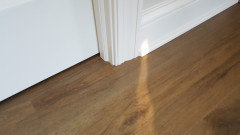
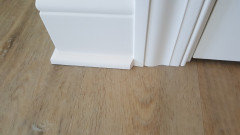
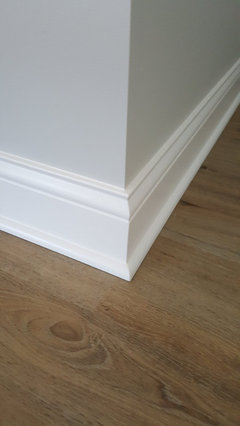
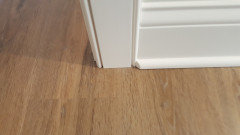
    We used primed poplar throughout most of our house. Our trim style is much more traditional/colonial, but this is the finish quality you should expect:


  • 2 years ago

    I would take it all down and tell them you'd rather spend $3 more per board to get mdf.

    There really isn't going to be a way to get that all smooth, given the deep grain, not to mention the holes/knots.

    As I see it, you have 2 problems:

    1. The trim looks terrible, and you can fix that by having it replaced.

    2. Who has to pay for this mistake. Your contractor does, because it looks awful and was not even within the realm of being a decent substitute for the mdf (or "primed wood"). But you can solve the first problem, and then work on this second problem while they install a nicer looking product.


    Btw, don't rely on a painter to fix that. There's no way that can be more economically done than just installing mdf. imho.

  • 2 years ago

    Can we see the house?

  • 2 years ago
    last modified: 2 years ago

    The problem with mdf trim is in the "description". 1st, never use mdf where it's likely to get wet (bathrooms!).

    Not sure about the lumberyards, but the big box stores are selling some "mdf" that is ok, and some "mdf" that's basically pressed fiberboard. Some of it is so cheap, it's like cardboard! NO amount of paint will protect it from water!

    Millwork quality in general has suffered since Covid!

    Metrie is a brand that makes a quality mdf trim - if there is such a thing! They carry a full line of modern, traditional, etc.

    MDF is great for crown, window casing (unless you get alot of condensation). Otherwise, provided there are no water/moisture issues, it finishes well.

    In the case of water backup or flooding, it won't matter!

  • 2 years ago

    I can't fathom how your carpenter would think it was acceptable to install that trim board with all of those imperfections. Do they all look like that? We used stain grade pine and found that supplier provided over 25% extra material. The trim carpenters went through all the material and sorted them into a use and a discard pile. They got rid of baseboards that had noticeable imperfections or warping. I would put this on your trim carpenter if there is extra cost to fix this.

  • 2 years ago

    Thanks everyone! I really appreciate all the feedback. I told the carpenter that it would need to be replaced.

    @Kevin thanks for breaking down the difference between the grades. That’s good to know for the future. This is going to be such an expensive lesson. I’m surprised that this happened because my carpenter is very experienced and he’s pretty good.

    @Mary, that’s exactly how I envisioned it looking. What I saw yesterday really depressed me. It’s almost every part that’s littered with knots or imperfections.

  • 2 years ago

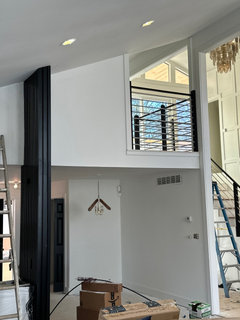
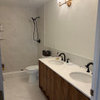
    @Paul, this is the best that I have of the house.

  • 2 years ago

    Thanks so much Charles! Appreciate the comment. I agree with you. I’m not a pro so I feel so foolish not knowing better.

  • 2 years ago

    I would not want that trim. Ask them to remove it and use paint grade trim. I dont like mdf either, and would never be happy with that. Its common to use Pine for trim, but, not utility grade pine. Better to spend the extra money now, to be happy in the future.

  • 2 years ago

    There is nothing inherently wrong about trim being "pine wood". Most all wood trim (common, lumber yard/box store trim) is all pine. The issue here is his choice of #2 common pine and not selecting it better fort he application.

  • PRO
    2 years ago

    MDF is a great choice for paint-grade panels (MDF panels are more stable than wood panels), but I wouldn't recommend MDF for casings or base which are more susceptible to mechanical damage. MDF is both easier to damage and harder to repair than wood.

  • 2 years ago

    @ Liv C - I hate seeing your comment that you feel like a fool not knowing better. You hired a professional to provide you with guidance and ensure that your end result was acceptable. He should have explained not only the cost differential but also why there was such a big cost difference. If you were a professional you would have no need to hire him to do the work or give you advice, he is supposed to be the expert and provide with the necessary information to make an informed decision.


    Not your fault even if your did agree.

  • 2 years ago

    We used stained #1 pine for our time because we wanted the natural wood color. I too, am horrifed that someone thought that was acceptable in ANY home. Ridiculous.

  • 2 years ago

    Thanks so much everyone! 🤗

  • 8 months ago

    @Mary Elizabeth. Could you tell me if your poplar baseboard is 5 1/2" or 4 1/2" and what is its thickness? What is the width of the casing? They are very nice.

    The bottom piece looks like a quarter round.

    Thanks

  • 8 months ago
    last modified: 8 months ago

    @Elizabeth L., The baseboard pictured is 5 1/2" high x 9/16 thick.

    Alexandria Moulding Pro Pack L163E 9/16 in. x 5-1/4 in. x 192 in. Primed Pine Baseboard Moulding (5-Pack − 80 Total Linear Feet) WP163-93192CPK - The Home Depot

    We used a beaded colonial casing (Profile WM445) 3 1/4" wide x 11/16" thick - ordered through a lumber yard, to be able to get 16' lengths.

    All our baseboards are trimmed with actual "shoe" moulding, rather than quarter round. And those are "back beveled" where they meet the casing.

    Our trimwork was installed, nail holes filled, caulked and then primed and painted in place with a HVLP sprayer.