Software
Houzz Logo Print
sam_md

Mountain Laurel - Kalmia latifolia

2 years ago
1.

3.

4.

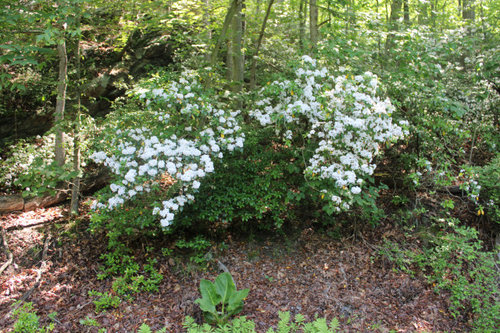
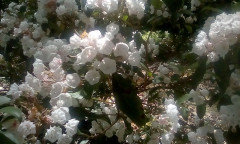
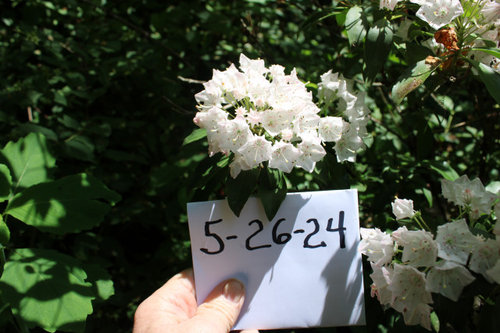
It's time again for the glorious display of Mt laurel. It ranges from Maine to Florida and those of us lucky enough to live in this area see this display every May. It is seen here growing in an Oak/Hickory forest in Maryland. First described in 1642, the only time I see this shrub is in the wild, I never see it in a cultivated setting.

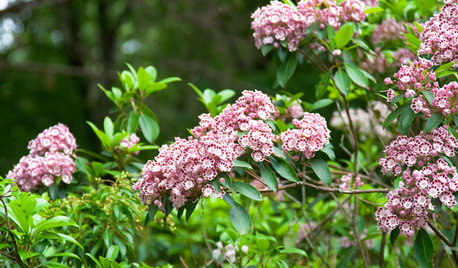
#1 shows white flowers, the buds were pink.

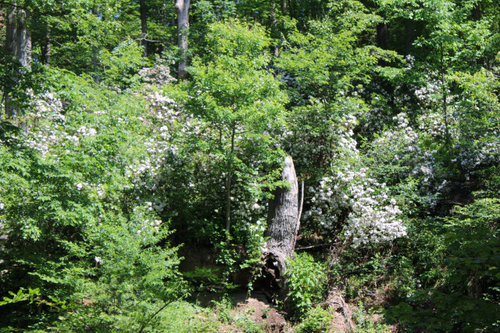
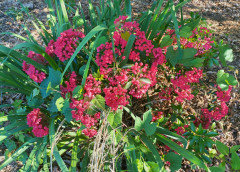
#2 nice specimens in the understory

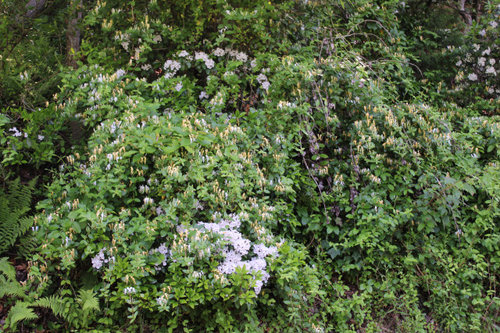
#3 the hated Japanese honeysuckle overwhelming a ML. This is why we despise the asian weeds so much..

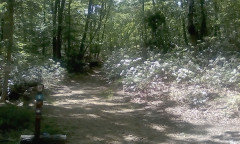
#4. Here I'm trying to show how a large group of ML can grow deep into the understory.

So here's my question, why do we never see this plant in a cultivated setting? We've known about them for four centuries. Are they that fussy to grow? Most queries on this forum are about bitty mailorder plants that were recently purchased. We never see healthy full-sized plants growing in the residental landscape. Someone pleeeeeeease show your pix and prove me wrong.


Comments (27)

  • 2 years ago

    Come to the suburbs of Philadelphia, where they're everywhere! We had an enormous one at our previous house. I'll see if I have any pix, or will try to find some online.

  • 2 years ago

    I love it. It’s just one of many reasons I go East whenever I can.

    Is there an organized effort to combat the uber agressive invasive plants? There isn’t where I live. There are pockets of resistance, but no unified effort. Buckthorn is a nemesis here, but it pales in comparison to the effects of Kudzu and the likes.

  • 2 years ago

    I think deer predation is the main reason.

  • 2 years ago
    last modified: 2 years ago

    I transplanted a number of them from my wooded lot to along my shaded front walkway when living in southwest VA. They all survived the transplant. There's plenty in nearby Rocky Gap Maryland ST park -- prefer dry, sandy soils.


  • 2 years ago
    last modified: 2 years ago

    I used them in designs frequently in the early 90's when I lived/worked on the north shore of Massachusetts. I remember there was a tiny native population in the area, but when I would go south to Rhode Island they were abundant in the woodlands everywhere.

    Fast forward to my days here in the PNW and I again use them in designs and they have done very well. I have 'Keepsake' in my current garden in Oregon. This is only its second year an it is absolutely loaded with flower buds, so many they're bending the branches down! I expect the flowers to open next week. The plant is small but I'll try to post a photo.

    Like gardengal, I'm allergic to pink, so I'll never have a lot of Kalmia, but my clients have really enjoyed them.

  • 2 years ago
    last modified: 2 years ago

    Strangely, although there are quite a few cultivars available here I don't recall ever seeing one growing. Maybe because so few gardeners have acidic soil. I notice a lot of new dwarf cultivars more suited to container growing so perhaps we'll see more.

  • 2 years ago

    The Merritt Parkway in Connecticut (a national scenic byway) used to be full of them but alas the deer decimated them.

  • 2 years ago

    Like artinnature, I've used kalmias often in my designs. They flourish here just as well as any rhodies (and almost ALL other ericaceous plants). In fact, in one recent larger project, an existing kalmia was the only plant - other than a few mature trees - that was retained as part of the new design.

    Maybe we are distracted by the abundance, variety and shear size of our PNW rhododendron population but kalmias do have a presence here. Most larger nurseries carry a good selection and 4 cultivars are included with Great Plant Picks, a regional horticulturists' selection of superior garden plants. And none of them are pink!!

  • 2 years ago

    I used to go to Dolly Sods a lot in my younger days. They grew everywhere the sun shined. Lots of deer there. Maybe the deer ate something better or there were too many for all of them to be eaten.

  • 2 years ago
    last modified: 2 years ago

    "I never see it in a cultivated setting."

    Strange, but now that I think about it, they are very seldom spotted in the Baltimore/DC suburbs. I find myself in agreement with Bookwoman that they are going to be more commonly found in SE PA - and points north, I think they are more often grown in New England. The same is generally true w/ironclad rhodies, of course. If you see them in the DC/Baltimore area anymore, it tends to be in gardens of really old properties. Either people who live in newer tract/McMansion housing don't plant them, or they don't survive if they do.


  • 2 years ago
    last modified: 2 years ago

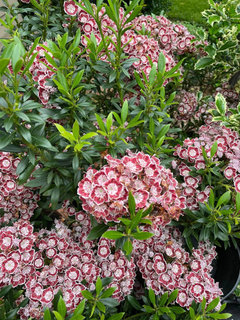
    Here is my 'Forever Red' that is my favorite of the 4 cultivars I grow.


    https://www.brokenarrownursery.com/kalmia-latifolia-forever-red-forever-red-mountain-laurel.html

  • 2 years ago
    last modified: 2 years ago

    Davidrt, your Forever Red has far more flowers than leaves....

  • 2 years ago

    Gorgeous pics! I love Mountain Laurels, they don't love me -- I've tried at multiple houses and I just can't get them to thrive, they peter out over the course of a few years. Sigh...

  • 2 years ago

    Back to sam's original post for a moment, the weed I really see strangling the wild Kalmias in Cecil County is ORIENTAL BITTERSWEET. The stuff is such a menace, don't get me started on how livid it makes me to see property owners - whether private, or the state - let it take over.

  • 2 years ago

    'Minuet', kind of beyond peak bloom.


  • 2 years ago

    Dave in NoVA, thanx for your pix, I consider you to be our BLE expert. I dearly wish you had stepped back and showed us the whole plant. You likely know that Historyland Nursery in your state's Northern Neck has carried a large seletion of MLs for decades. I've been there and seen them. Give us a reason why we never see plants of substance in the cultivated landscape. I mean established plants of 5' or more. Dr Jaynes introduced his selections many years ago, why are they absent in the landscape?

  • 2 years ago

    They are expensive, and difficult to establish.

  • 2 years ago

    @sam_md Nice pic. I'm going up there in a few weeks. Not only will I be treated to the mt laurel, but I think the giant rhodos should be blooming in the wooded areas. I've eaten thousands of blueberries there. Just hope it's not a mudbath.

  • 2 years ago
    last modified: 2 years ago

    More importantly, difficult to propagate! The cultivars have to be either grafted or micro-propagated. Although, nowadays, at the level of industrial horticulture, I don't believe the latter really cost much more money than cutting propagation. It just limits the size of the players involved to large ones like Briggs or Terranova. Back when Rarefind was the storied nursery that it was, Rhododendron cultivars like 'Lumos' were introduced by having Briggs micro-propagate them and send them back to New Jersey. Broken Arrow either has (or had) an in-house micropropagation facility, or were outsourcing it, too.

    Of course, BLEs are a hard sell these days in much of the country, anyhow...which is why Briggs moved away from focusing on Rhododendrons to being more like Terra Nova. The mark up on perennials, and quick time to market, just makes more sense for people who are only into it for the $$$$.

  • 2 years ago
    last modified: 2 years ago

    BTW Floral's comment about Soil pH got me thinking. I've never tried to find a map.

    Turns out, the UK really is a basic b---h BWAHAHA. (I stay young by using the slang of millennials and Gen Z)

    https://www.ceh.ac.uk/sites/default/files/2022-11/soil_pH.pdf

    And, minor correction to my comment...looks like Briggs in fact still carries many shrubs, but have less of a focus on Rhododendrons compared to their early years.

    https://www.briggsnursery.com/plants/briggs-specialties/

  • 2 years ago
    last modified: 2 years ago

    "BLEs are a hard sell these days"

    This is fascinating. My passion for gardening germinated and took root in Z3/4 Minnesota, aka "the land zero BLEs". I simply had to leave so I could grow lots of them!

    I think it was Embothrium (Bboy, Ron Brightman) who once mentioned on this forum that BLEs provide a certain sparkle, a reflective quality, most notably during the dark days of winter, that no other group of ornamental plants can offer (looking at you spirea, arborvitae, juniper & calamagrostis, for example). This observation really stuck with me, as I knew early on that BLEs were somehow magical, beyond being merely evergreen, but I couldn't put words to it.

    I'm writing this on my patio as Camellia sasanqua, Azara microphylla and Elaeagnus Olive Martini sparkle away nearby!

  • 2 years ago

    " BLEs are a hard sell these days "

    They have never been a hard sell for me! After any tree selection, they are the first group of plants I consider when designing client gardens. Fortunately in my area, BLE's of all sorts abound so there is virtually always some sort of BLE available for any gardening situation. Right now they lead my plant shopping list for my new garden - ceanothus, osmanthus, pieris, hebe and possibly eucryphia and azara. Also a crinodendron, maybe a Berberis /mahonia or two. And if I could squeeze one in, an Embothrium as well. The two at my niece's garden just down the street are in full bloom now and stunning!!

  • 2 years ago

    The PNW is an exception, which is why I actually said "BLEs are a hard sell these days in much of the country". It seems around here, many people are cutting down old rhododendrons and hollies. I guess they look too "dark" or something.


  • 2 years ago

    I think the official word is 'overgrown'. Apparently, the concept of pruning is lost on many people. It makes about as much sense to me as waxing your head because you got a bad haircut.

  • 2 years ago
    last modified: 2 years ago

    sam_md , unfortunately this Mountain Laurel is in the same area behind the house where I store all my used pots ... and it's embarrassingly UGLY, UGLY, UGLY. But for some reason, this mountain laurel has thrived here from the get-go. Maybe because it gets part sun and never stays too wet.

    Why are they not planted more? They are pretty exacting of their siting, for one. They tend to grow slowly, so they don't size up in production quickly enough. Probably hard to propagate. But you can see them on undeveloped slopes here naturally. BTW, I didn't see you at the Green Spring sale this year. Really a disappointment. Not many vendors at all.

    davidrt28 (zone 7) , if I had that nice bright pink ML, I think I'd clean up around it! Had to give you a hard time.

  • 2 years ago

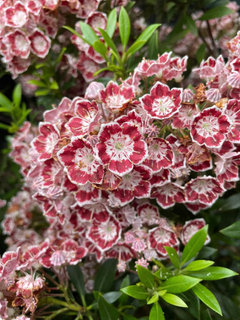
    Here is my Keepsake (still in bud) and my Kizzie. Kizzie is on the right.