Software
Houzz Logo Print
krisztina_markus7

Are the expensive range hood inserts more efficient?

I do not mind paying more for a more efficient rangehood, but how do I recognize one? What should I look for on the spec sheet or in the picture?


When I compare 42X24-inch range hood inserts of different brands with similar CFM, I'm baffled by the extreme differences in pricing. Viking is $3600, Zephyr is $1700, Wolf is $2300, VentAHood is $2600, and Tradewind is $1900. What justifies such a wide range of prices?

Do the expensive ones have better motors and will last longer? Are the filter angles better? Bigger baffle area? Higher quality steel?

Or is it just marketing?

Does this mean that Zephyr will be the least efficient of those I mentioned?

Thank you for any advice you can give me. This is the last appliance I must pick and the most challenging choice. The more I read about it, the less confident I am in my choice. We want to control rising plumes with too many variables.


Comments (7)

  • 2 years ago

    By insert I assume that you are considering a wood or other material hood exterior, and only addressing here the guts. Inserts (also called liners) are hoods without exterior sheet metal except where visible at the bottom.

    Certainly choice of stainless steel can affect price, quality of welding can affect price, quantity of steel will affect price, engineering air flow in baffles and within the hood can affect price, and if an internal blower is part of the package, then motor and fan quality and functionality can affect price. Distributor access and advertising can affect price. Prices can be set on other bases also, such as trying to enforce exclusivity.

    I'm not sure whether all your comparable models are functionally the same. Please put model numbers or links into a message so we can see which are apples and which are pears.

    Also, the requirements on CFM derive from fundamental properties of cooking plumes, so this needs to be established before hunting for candidate hoods/inserts, and the achieved flow rates for various blowers, ducting, and make-up air systems have to be considered.


  • 2 years ago

    Thank you, @kaseki, for commenting. I have read many of your posts and am using one of your calculations. You calculated somewhere that a 42X24 hood needs about 630 CFM, but you recommended a 900-1000 CFM blower for that size because of pressure losses. I was happy to find that info since we are buying that exact size over a 36-inch gas range. I appreciate that you are sharing your expertise on this topic with all of us. Range hoods seem to be the most complex appliance of the kitchen.

    We are also installing an MUA system.

    I priced these models out with an 1100-1200 CFM inline blower, but we may have to use an internal blower, which is a bummer, I know, that is another topic though.

    The models I am looking at and the reason they stood out:

    1)Viking VBCV54238 and an inline blower

    It has a very steep baffle angle, which caught my eye. You explained somewhere how important these deep angles are in commercial kitchens.

    https://www.build.com/product/s1336765?uid=3180457

    2)Zephyr Monsoon II (the cheapest of all)

    https://zephyronline.com/product/monsoon-ii-range-hood-insert/

    3)Wolf Proline (a reputable company, variable speed control)

    https://www.subzero-wolf.com/wolf/range-hood/42-inch-pro-hood-liner-22-inch-depth

    4)Tradewind: It also has variable speed control, like Wolf’s Proline, which I really like.

    https://www.build.com/trade-wind-vsl442-0-22bf/s1623927


  • 2 years ago
    last modified: 2 years ago

    Steep angles over 45-degrees are required by code for commercial (not residential) cooking ventilation. Some angle, however, is desirable to move grease off of the baffles. Whether this matters in a given residence will depend on the rate of greasy cooking, whether the oils and greases rancidify (oxidize) quickly, and whether the lower edge area is designed to capture the grease, as in my Wolf Pro Island hood.

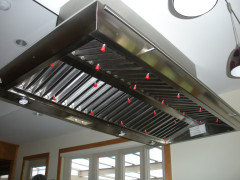
    The Viking may be expensive because it looks like a quasi-commercial "insert" that actually has quite a bit of exposed (and therefore necessarily pretty) stainless steel. Typical commercial hoods are tall with the baffles high up, and the volume below (reservoir) achieving the function of averaging the plume flow over the baffle space. Residential baffle configurations and mounting heights will tend to have the plumes strike only a portion of the baffles.

    The Zephyr baffles have a slight tilt. The exposed portion is more typical of residential inserts. Note that when these inserts are set into wood, the wood at the bottom has to be covered or otherwise meet the requirements of the cooktop installation guide.

    The Wolf looks like a half of my hood. See below (click to enlarge).

    The Tradewind looks a bit chintzy on baffle space; the middle blockage area could cause some capture escape due to reflection.


  • 2 years ago

    Thank you, @kaseki. I was intuitively suspicious about the Tradewinds baffle design. It makes sense that you point out the possibility of reflection caused by the middle part of the baffle.

    Process of elimination: Trade-winds is out.

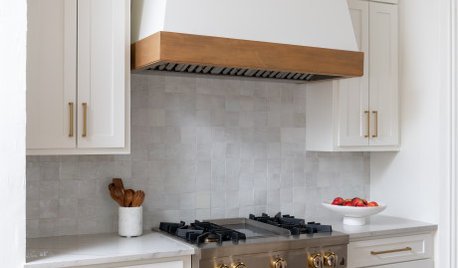
    Can you please clarify what you meant when you wrote: ’’ When these inserts are set into wood, the wood at the bottom has to be covered.’’ I cannot visualize this. Do you have a picture that shows the right way to install these inside a wood custom hood? When I see custom wood hoods, I always see some of the wood exposed on the bottom. (See picture attached)


    You mentioned that your Wolf has a lower edge area designed to capture the grease.

    Does Zephyr have the same feature? I do not know what to look for. From the picture, it seems like Zephyr has a smaller baffle angle than the Wolf’s baffle. Is that concerning?

    In the showrooms in my area, there are only a few liners to display. I have to rely on pictures and the crumbles of information I can find on the manufacturer’s website. Not much. Without the power or information, no wonder VentAHood claims that venting is nothing but magic (lol)


  • 2 years ago

    Heh. It was a showroom introduction to Ventahood in 2008 that pinned my BS meter and led me to become a commenter on hoods after I read enough literature on the subject. At the time, this literature was mainly composed of commercial hood measurements reported in papers by the California Air Resources Board. But the topic is well summarized in the initial dozen or so pages of:

    https://www.tagengineering.ca/wp-content/uploads/2015/02/KVSApplDesign_catalog.pdf

    Wood can be safely exposed facing the "flames" if high enough over the cooktop. This is determined by the cooktop manufacturer in concert with UL. For induction cooking, only unintended flambés would pose a hazard, but good practice would be to accommodate any cooking surface that would fit. What can be done is adding a stainless steel trim piece to the exposed wood at the bottom.

    If you go to your Zephyr Monsoon link and click on the second image, you will see that the apparent extension of the wood hood covering is actually painted metal. That is another approach. If the hood base height is 36-inches above the cooktop, that may be enough for having facing wood. Check your cooktop installation guide. But note you have to protect the wood against cleaning processes.

    It looks like the Zephyr baffles have connection to their panel in such a way that grease could drain into the support structure, but I don't have that type of information. Maybe they answer their phones to field questions like SZ/Wolf does. Please keep in mind that in commercial settings, a day's worth of grease may be equivalent to months in a residential setting, so intermittent cleaning may be sufficient even if the collection points are not themselves removable trays. My Wolf was manufactured by Independent in 2007 or 2008, and I can't say for certain whether this year's Wolf hoods have the same details. But Wolf can.

  • 2 years ago

    Thank you again, @kaseki. We will install it at 36 inches high but I will check the installation guide to make sure we do not need the protective metal piece. This is the first time I heard of this, but when I looked at the picture you mentioned, I saw what you were talking about. The rangehood on the picture appears to be set at a lower height. When the oil splashes, it could cause sparks of fires, so I can only imagine what an accidental big splash could cause.


    I sear meat and fry food on high heat 4-6 times a week for dinner but we are a family of four, so it is done pretty quickly.

    I will have another meeting with my installer next week to see if we could include a silencer with an external or inline blower. I have learned about those options on this website.

    I will make my final

    decision after I talked to him and I will update this thread. It might help others with their decision-making process.