Software
Houzz Logo Print
jeneric_travelers

Erosion mitigation for mulched backyard

2 years ago
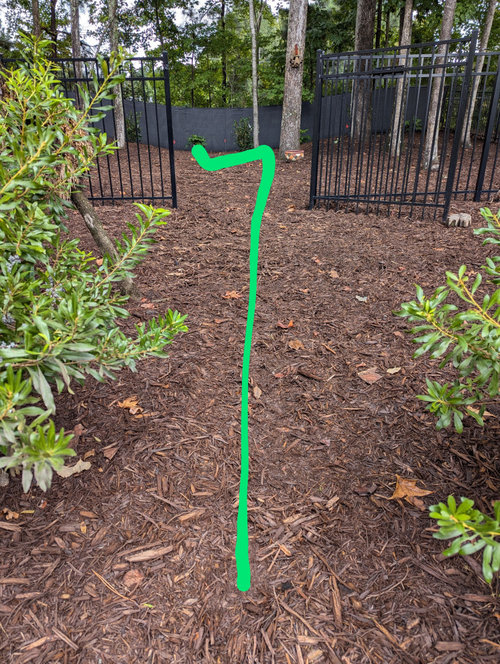
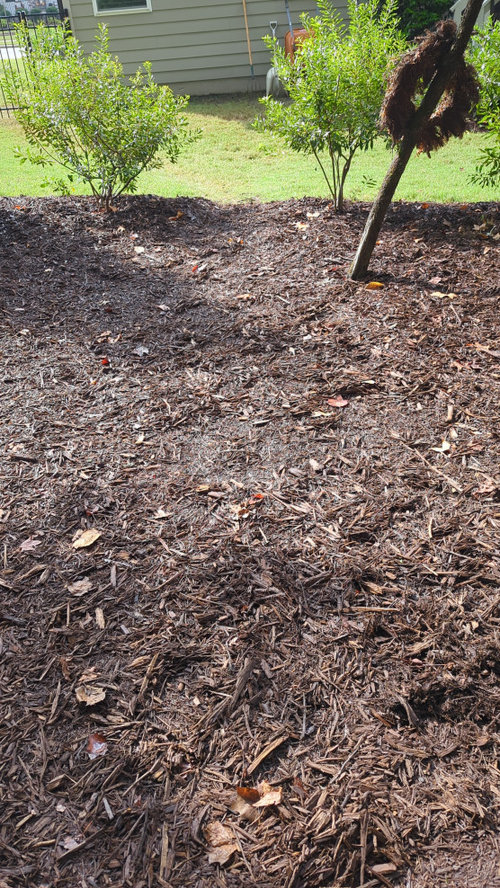
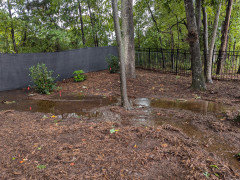
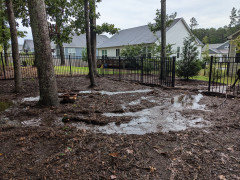
We have this awesome backyard in which the rear area is mulched (it was re-mulched this week). But there's an erosion path that happens after a large rain. When the previous tropical storm went through and left an alluvial plain of mulch well into the grass area.
It starts in the back where there's a low area, but it's well drained. It comes around to the right of the tree (as you see it), and then straight down the center to the gate to where the garden bed ends.
Does anyone have suggestions to slow down the water path in this area so that it's not just rushing the mulch straight out? We're considering a terrace concept for the walkway out of the gate towards the grass. The steps will have to be low because we have dachshunds that need to tear up and down them.

Comments (19)

  • 2 years ago

    Could a rain garden work in the lowest part of the backyard to keep some of that water from moving about? As I said, it tends to drain pretty quickly after a typical storm but after tropical storms it's standing and draining water for a few days.


    We don't want a pond like environment or standing water with dogs and we don't want plants that provide mire shelt options to snakes.

  • 2 years ago

    @floral I think that could be a good idea for this particular area. I wouldn't want to plant plant everywhere as we need to be careful of creating a hospitable environment for snakes.

  • 2 years ago

    If water is ponding near your home then you need a drain of some sort to direct it out to the street.

  • 2 years ago

    @cecily It's not ponding near our home. When it does drain from the backyard to the yard, it's generally absorbed by the grass. The challenge is keeping it from moving from the rear back taking mulch with it.


    I'm thinking cast iron plants It's tall rather than wide, self-propagating, loves shade, and wouldnty create too much of a shelter for snakes.

  • PRO
    2 years ago

    Yes you need a groundcover to tie this all together. We had a similar problem at one of our houses where massive roof runoff cut a swale in the front that was always just dirt. We planted asiatic jasmine but used bricks to create little dams that slowed the water, in time these bricks held soil and allowed the jasmine to take hold. Now it’s just a distant memory in a sea of jasmine. In your case buried logs perpendicular to the water flow to create shallow terraces would be dog friendly and effective.

  • 2 years ago

    Roll out some erosion control blanket on the path, the coconut fiber ones last several years. They come in four foot width also.


    Jen K (7b, 8a) thanked tracefloyd
  • PRO
    2 years ago

    You need to do multiple things. You have effectively made a rain sluice there. It may not be ponding into your home, but if the slope continues that way, the water that sinks into your lawn will go that way too. Right now you have no anchoring or retention as well as a bowl with a straight running line to your house.

    Most intense would be to dig up and set in a drainage from the bowl to somewhere else. Not always an option, and I can't tell if you can do that or not from your pics. You could set in logs as retention barriers at the bowl. Plant in the bowl behind the retention barriers. Choose plants that have deeper roots and mass roots. Deeper roots help anchor and mass roots help deter snakes from burrowing.

    Use erosion control mats or consider harder scaping in your path. It's hard to tell from the pics if steps could be done or not.

  • 2 years ago

    Great ideas everyone. Thank you for giving me ones to work with.


    @HALLETT Great idea! "buried logs perpendicular to the water flow to create shallow terraces would be dog friendly and effective." We were thinking of the terrace for the walkway to the gate, but you're right, we need it from the back to the front.

    - asiatic jasmine? I have to revise the cast iron because there are moments of intense sun that will burn them. The asiatic jasmine might be a good option for one spot that more shade than sun, but we'd have to change to something different getting closer to the gate.


    The most rear fence (covered in black privacy netting) has the lowest spot (kind of easy to see from the photo), so it can be much like a pond which we anticipate with Helene on its way and saw with Debby. So when the water level is at a certain height, it contributes to the flow coming down from the nearby spots along the rear ridge.


    @tracefloyd - so we'd put the erosion blanket under the existing mulch? We recently put down another layer as the previous one, from last year, had broken down as we walk the path multiple times/day. We placed jute as an underlayment between the ground and first layer of mulch but that has a tighter weave than the erosion blanket. Probably why it's not as useful.


    @beesneeds - thank you for this idea. "You could set in logs as retention barriers at the bowl. Plant in the bowl behind the retention barriers. Choose plants that have deeper roots and mass roots. Deeper roots help anchor and mass roots help deter snakes from burrowing."


    I'm going to research plants to create multiple rain gardens as many of you have suggested.

  • 2 years ago

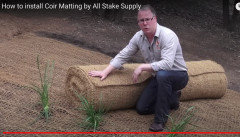
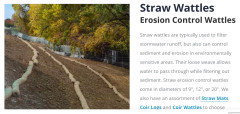
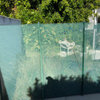
    It's a netting called Coir matting and is staked on top of mulch for wind, water. I've seen on freeway slopes, construction sites etc. They also have hay tubes you lay across the slope...don't know if those are Doxie friendly.

    I found a video and took a screen shot.


  • 2 years ago

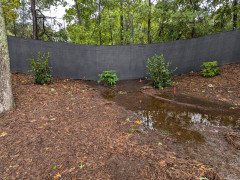
    Post Helene - Raleigh NC. I've staked areas for plantings. The challenge begins behind the fence with a low spot in the adjacent plot. We planted the fatsia and camelias last week. The water is absorbing but it's 100% shade back there. I told my husband we were smug for our own good, but removing the original underbrush was the only way for us to enjoy the plot. And since we didn't know the topography we didn't realize the effects and to start erosion mitigation earlier. It wasn't until Debby, a few weeks ago, that we had the most movement and now we need to fix this.


  • 2 years ago

    Wow!

    Asiatic jasmine does well in zones 7-8 and makes a dense groundcover over time & is usually available relatively inexpensively in 4” pots

  • 2 years ago

    Oops, got sent too soon.

    It is aggressive in spreading, which is good for a groundcover intended to cover a large area. Just don’t want to have it as bordering other different plantings ( except larger things like trees or some types of shrubs), because it’ll intermingle & take over. So can be good where there’s a natural barrier such as curb, sidewalk, or aa area that doesn’t matter, or a perimeter that can be patrolled diligently.

  • 2 years ago
    last modified: 2 years ago

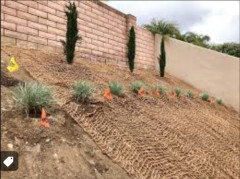
    It looks like a natural low spot for water to drain from outside your fence. The plants were catching the sediment and mulch...apparently the lawn has been absorbing the water fine.

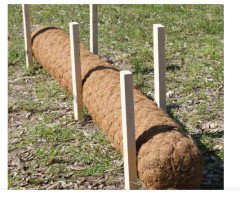
    Get straw wattles and lay every few feet across the streambed and secure with wooden stakes.

    Any big box hardware store or landscape supply company carries them.

    I would try at least a 6" layer of pine needles between the wattles. Something to catch the silt. Enough to be spongy when wet but not muddy.

    You might eventually have to build a 'dry' creekbed of rock to direct water in downpours.


    Make sure they are biodegradeable...no plastic netting. These stakes are before hammering in.

  • PRO
    2 years ago

    Goodness, that is a lot of water in there. What's on the other side of the fence? Is it more of the bowl, or upslope? If it's more of the bowl. it might be possible to fill in your side of the bowl enough to sort of berm back to the other side of the fence. If it's more upslope, then you still want to do retentions and plantings on your side.

    From the newer pics, it looks like your fence has a solid footing? As in it has a solid lip there. That is helping direct the water to channel out the doorway down the hill. Also, it looks like the water flow has more than one direction than the doorway. Some creative depressions could give you two channels to either side if you punch a hole under the fence lip for the water to flow through. That could help mitigate the path problem a bit if the water has three outlets instead of one.

  • 2 years ago

    Is it possible to build a berm or add a swale (with rain garden plants on the edges) that runs parallel to the back fence to divert the water?

  • 2 years ago
    last modified: 2 years ago

    That is far worse than I imagined. I thought you were just dealing with the mulch getting shifted but that is actual flooding and soil erosion. A lesson learned about living with a landscape for a while before wading in with radical changes. Good luck.

  • 2 years ago

    We've had one strong storm since this happened. Great for water, nerves for runoff. We have a deck off the porch and that's pretty much a mud pit. We're installing a permiable deck in Nov with 2ft x 10in high planters along the foundation side and then 4 ft x 10 in planters along the deck and other foundation side. The backyard faces north and this time of year the sun is in short supply to dry things out.


    floral_uk z.8/9 SW UK - I know right!? However there was so much underbrush we wouldn't have seen this flow as that would have mitigated. And we didn't have these severe storms. such that the 'earth' moved, until this year or 3 years later. We tell people to live with their house before painting it, we lived with the original brambles and underbrush for 8 months and no signs. Good thing the area absorbs water quickly.


    Design Fan, tracefloyd - the berms, or wattles, are what my husband is thinking to do. There is a chainlink fence, of the land owners, behind our black fence. We'll tuck it between fences which will soften the blow. It'll be interested to see what happens 'when' the lot is sold and built on. We might also terrance the walkway a bit.


    beesneeds - I don't know what it looks like on the other side of the fence. I've been researching rain gardens; our extension had a good power point on it, albeit more detailed than what we need to consider. Taking pictures reminds me where the current flow is. A landscaper who's helped us with other projects suggested rocks, but that's not great for the dogs and/or snakes, also doesn't do much for collecting, filtering and cleaning the water back to system. The best thing I seem to find is carex or grasses: muhley, oats, rush and wiregrass. I'm wondering if we plant those in the areas I've marked as likely to flood or flow, then border with rocks to keep the mulched areas around it from eroding.


  • 2 years ago

    Now we learn it is affecting the deck and yard....and you're starting construction?

    I looked at your photos again and where you marked is a definite low spot on the fence line. This will continue to be a problem. is there any way to dig a trench around the lawn and out to the street?

    I would not start any construction until a grading/draining expert can come out to look and come up with a solution, if any is needed. If the ground absorbs water quickly, then your deck should not be a mud pit, so something is amiss.