Software
Houzz Logo Print
roxanna_gw

Dealing with potted amaryllis for winter indoors

last year

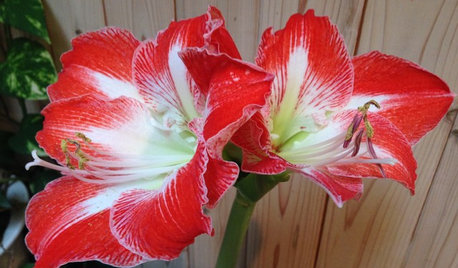
I have a dozen pots of gorgeous amaryllis which live outside on my deck for the summer and have been happy to do so for many years. Some are enormous, and the bloom cycle throughout the winter (whenever they decide to do that) is amazing and pleases me greatly. Now that autumn has arrived, it is time to consider bringing them indoors to be put under plant lights on my shelving unit.


Question: normally I would allow the long leaves to die back naturally. This year I am wondering if I could cut off those still-green leaves when I transfer them inside. Okay to do? Or not??


It would be easier to have them leafless (space considerations), but would that make them less able to stay vigorous and healthy? I do not want to lose them, so I hesitate...


Advice greatly appreciated! =)

Comments (14)

  • last year

    I’ve always understood its important to let the leaves die before removing, among bulbed plants. I always toss my ”used” bulbs into my garden where they bloom spectacurally, usually in the spring.

    I do let the leaves die; do they have something to do with keeping the plant alive and well for next year’s bloom?

    roxanna thanked sjerin
  • last year

    sjerin - I usually do leave the leaves until they naturally go thru the process, but tossing amaryllis bulbs out into my gardens is not recommended for our New England winters, lol! As long as the leaves are green, they do supply nutrients and keep these bulbs vigorous for the future. I have had some of my amaryllis bulbs for many years -- they even have made babies many times.

    I suppose my original idea here is futile. So be it! Drat...

  • last year

    Ideally, after a summer spent outdoors, you bring the plants in and store them somewhere cool (50-55F) and dark and allow the leaves to die back naturally. Do not water during this period. Leave them in this environment for about 6-8 weeks and then bring back into warmth and light. Once you see signs of new growth (might be leaves or might be flower stalk), water thoroughly. Bulb should rebloom in midwinter. The earlier you start this process, the earlier it will bloom.

    roxanna thanked gardengal48 (PNW Z8/9)
  • last year

    They want dark, not plant lights in the off season.

    roxanna thanked callirhoe123
  • last year

    I don't think it is essential to be kept in the dark during their dry winter dormancy (my eldest has a couple in the garden all year round under a waterproof cloche)...but they really don't need supplemental lighting to normal winter daylight, Watering is usually the trigger to break dormancy in spring. I would be inclined to keep the leafage for at least 8 weeks after blooming finishes, then cut the scapes and leaves and allow to dry out naturally. However, I have an abysmal record with hanging onto various amaryllids or hippeastrums - my offspring all seem to do much better.

    roxanna thanked HU-618169007
  • last year

    garden gal is correct.


    bring them in where it is cool, dark and dry ... don't water. when you see them go on sale this fall at the big box stores [mid to late nov/early dec] ... pull them out under lights.

    roxanna thanked bragu_DSM 5
  • last year

    I have several decades old pots of amaryllis, some that originally came from my mom & some are their ”offspring.” I usually put them in the basement & stop watering in September. But i left them out longer this year & plan to do that tomorrow, Oct 2. I would not recommend cutting off their leaves, but let them die back of their own accord & keep them in the dark. I think the nutrients in the leaves go down into the bulbs..

    i bring mine outdoors in May & start watering. They bloom profusely.


    roxanna thanked bee0hio
  • last year
    last modified: last year

    I honestly don't think dark is essential...they are not photosynthesising once the leaves have died back...but keeping them cool and dry is the absolute requirement to maintain dormancy. All my geophytes live outside anyway, with appropriate rain protection (or in the cold greenhouse)...but they are never kept in darkness. They flower in summer because I cba doing forcing for Xmas.

    roxanna thanked HU-618169007
  • last year

    Actually, most sources DO indicate a required period of darkness that facilitates dormancy and the reblooming on a relatively predictable schedule. You can omit this of course but it does make reblooming a hit or miss proposition regarding the timing.

    The dormancy/darkness period is also necessary to encourage the foliage to die back if it has not already done so.

    roxanna thanked gardengal48 (PNW Z8/9)
  • last year
    last modified: last year

    Thanks, everyone, for your advice. I am elderly and not able to lug all these pots to my basement, so I will follow the advice to keep them in the dark with the leaves still attached. I will put them on my plant shelves in the dining room (which is right off the deck) and cover the shelf with panels of oilcloth to provide the darkness. They should be happy! This is basically what I have done for years, minus the light-proofing, and they always manage to bloom (whenever they wish, as I don't force them to bloom at any specific time -- have had bloom from December thru March, usually).

    Looking forward to the beauty! I adore the clean form of amaryllis flowers!! =)

  • last year

    Us too @roxanna ie probably 12 in pots accumulated over the years. I am not sure why but I was negligent in moving them outdoors come the good weather..in fact most of them have been in the cold cellar for weeks now. We shall see what happens.

    roxanna thanked rouge21_gw (CDN Z5b/6a)
  • last year

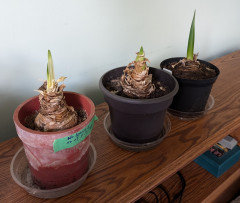
    Here are 3 of them that had sprouted in the cold cellar.


    roxanna thanked rouge21_gw (CDN Z5b/6a)
  • last year
    last modified: last year

    So why are you bothering with light-proofing now, roxanna? I get it - these are not plants which could be expected to grow happily without intervention (for those of you in cold climates, for sure) but I am baffled at the insistence on EXTRA darkness when the bulbs are already under the soil. Bulbs which really do need a degree of dark often develop dropper roots to pull the bulbs deeper into the soil level (like many narcissi and certain tulips do) and which amaryllids do not...which says to me that darkness is not an absolute requirement...unless you are forcing them to bloom at a time of your choosing (usually Xmas).

    roxanna thanked HU-618169007
Sponsored
Mary Shipley Interiors
Average rating: 4.8 out of 5 stars34 Reviews
Columbus OH Premier Interior Designer 10x Best of Houzz