Software
Houzz Logo Print
williamnjzone6b

Is this a terrible idea?

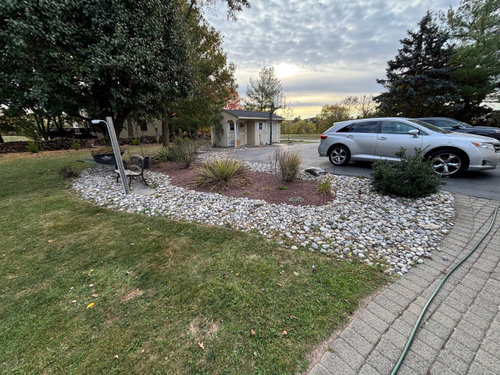
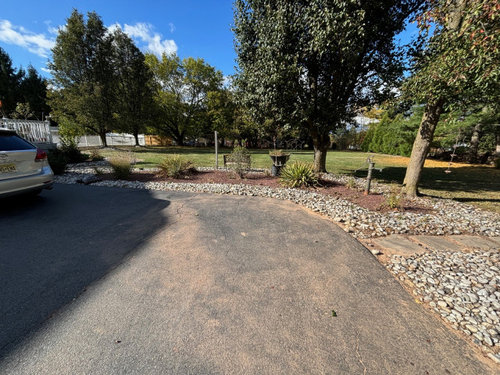
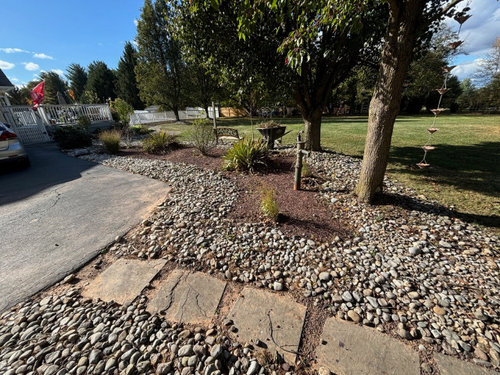
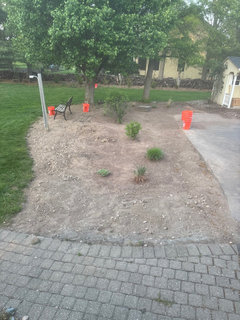
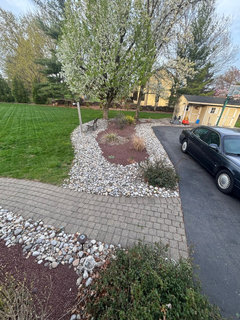
This is a large bed at the top of the driveway thats lost an ash tree and some burning bushes these last several years. The bed is maybe 650 square feet with two pear trees as the only staples of it that I’d probably keep. My idea is to remove all the rocks and convert to mulch for the look, ease of planting, and use of groundcovers. My thoughts are on the end near where you see the car to have a sizeable tree but not the kind with large overhanging branches that would crush a car or house but more like a European hornbeam and then between that tree and the two pears do a bunch of morning light miscanthus with everything else groundcover so it doesn’t require a lot of future mulch. I know this idea isn’t that imaginary but when you’re not that creative I find it safer to just be orderly and simple. Would be cool to make it the premier mixed bed of my yard but googling mixed landscaping beds always seems to bring very full new beds and not clear what it’ll look like 10 years down the line. I’m open to any and all ideas though. This area is full sun by the way.

I’ve done this rock to mulch conversion twice before, most recently on a 250 square foot area and while it’s not a fun job at least this area is directly connected to the driveway where I’d rake it onto. I’ve had people come from Facebook to take what I pile up but it can be more of a logistical problem with this much more stone.

Overall, is it worth all this? Stone just feels so lifeless and I’m picturing this much greener oasis that greets people as they pull up, adds privacy to the backyard from the street, and maybe my nephews zig zagging and hiding between the shrubs or grasses as they play. Possibly even where it’s widest, on the yard side, creating a seating area. Maybe someone’s been there before on an idea like this and can correct me if I’m thinking about this wrong. Thanks

Comments (20)

  • last year

    Floral UK- glad to hear the getting rid of rocks has some support here. The landscaping fabric under this is likely this heavy duty black tarp that was put in decades ago, I’ll dig until it’s much more dirt than stone and then maybe get a few yards of top soil (which will be simple because they can dump it right in the bed) and then figure I’ll lay down some construction paper before the mulch. I meant to say Frans Fontaine Euro hornbeam as I thought this was a kind that grows a lot of narrow vertical branches and doesn’t get too wide. I’m not necessarily set on that tree it’s just that I want a tree that has some presence, doesn’t grow at a snails pace, doesn’t drop tons of stuff, and that’s individual limbs aren’t that likely to total a car. I have some multi stem green Japanese maples in the yard that I think are good fits for what I mean, not sure their growth rate though.

  • last year

    I wouldn’t call it your idea horrible at all.

    A Horrible Idea is to cover the ground with landscape fabric/tarp and pour rocks on top of it.

  • last year

    Have you considered removing the pears and replacing them with hornbeams? Your pears look to be an age when they may begin breaking in storms.

  • last year

    Littlebug- thanks, I’ve warned my brother about stone. People think you put the tarp down and then the stone and you just have this picture perfect landscape forever. Weeds grow, it gets messy, plants die and you have to move all the rock to dig the new hole, it doesn’t go well with perennials or annuals, the rock gets past the fabric and goes inches into the ground making digging harder, putting in fence posts is impossible, worse on bare feet, less inviting to walk through, doesn’t break down into compost like mulch, and weeds are harder to approach. Another thing I’ve thought is that this river stone feels outdated, I’ve no data on it but I feel like river stone beds are becoming less fashionable. Wood mulch will probably be timeless

  • last year

    Cecily- funny you mention it, normally I do my own tree cutting but I had a crew prune the one larger fatter pear and it was a mistake. If I was going to pay that much money for a prune I should have just cut it down, it was a large quite pretty tree though and wasn’t on my mind to cut it down totally yet. So basically now I’m not so sure, I know theyre prone to splitting but if pruned are they safer due to reduced load? Or is it just a factor of age?

  • last year
    last modified: last year

    Definitely go for it! And post photos when you finish!


    ETA: You could build a cobblestone-type path with the stones after you remove them!

  • last year

    But what is the construction paper under the mulch for? Typically mulch is useful directly on soil. If , hopefully, the paper breaks down over time, what have you gained?
    Other than that, kudos to removing rock mulch.

  • last year

    Cyn427- i have these 24”x24” slate stone pads I’d like to do a double row stepping stone path with for the lawnmower and walking, maybe with an arbor if it seems feasible. DIY cobblestone sounds interesting though, I’ll probably find myself YouTubing that at least.

  • last year

    Marmiegard- the construction paper is for temporary weed smothering, I figure it’s like cardboard but breaks down quicker because it’s much thinner and it’s way easier to lay it down. It’s not something I’d do on a reapply but just for the initial step so ideally im not inundated with weeds out the gate. Ultimately I’ll want a ground cover to help outcompete the weeds, liriope does well for me but I don’t want to overuse it and make the landscape more boring. Not sure yet, trying out creeping raspberry in a bed that I’m excited about, not for walking on though.

  • PRO
  • last year

    Marmigard, paper or cardboard or old bills are just another mulch layer and break down in a season. I use paper or old natural fiber clothing under my mulches. If I see a weed popping through my compost mulch, I'll toss some paper on top and cover it with more compost. I'm very adverse to weeding, for some reason, so for at least 30 years, I covered my entire 50' x 100' vegetable garden with six layers of newspaper, weighed down with some seaweed and covered with a hay mulch. It was very labor intensive in the spring, but I never had to lift a finger all the rest of the year except to harvest. And the best thing about a paper mulch is how attractive it it to worms.

  • last year

    Cellery- if you’re a real person, that’s pretty cool seeing a part of yard looking so fancy. There’s a walkway on the left of this picture so the middle path wouldn’t quite work, plus I don’t think I have diy hardscaping in me just yet. Is there a free app or something you could recommend so I could play around with this? I’m assuming not

  • last year

    Annpatt- 5000 square feet of six layers of newspaper is quite something, hopefully not a windy day. Possibly cost prohibitive but maybe check out rolls of construction paper from home depot, think I used 3’ by 100’ rolls. Maybe you can find elsewhere in bulk for a good price for several years worth and with a wider diameter than 3’. Could make it a 20 min job

  • last year
    last modified: last year

    I no longer cover large areas. I did it religiously for 25 years on vegetable beds. I think a hay mulch is gorgeous to look at on a vegetable bed.; I prefer compost mulch on flower beds. I was once given a roll of flawed newspaper paper from a local newspaper office where I used to go to get unsold newspaper bundles. It took me at least a week to lay down the mulch every spring, but the garden was so pretty and so moist and so incredibly weed-free. I now do perennial mulching---mulching my gardens as mulch materials become available. My vegetable garden is very small now and I only grow a few crops.

    Funny you say that about wind because my first experience using a newspaper mulch in 1977, I covered the newspaper with hay and off to work I went. I drove home that afternoon and spotted a piece of newspaper rolling along the roadside. The closer I got to my home, the more there was---in the ditches, blowing across people's front yards, stuck to their siding, I had to take a walk of shame around the neighborhood gathering up my newspaper. That was a small garden, and was when I realized I needed to put weight on the newspaper at least until we'd had a few rainfalls. Getting the seaweed---hundreds of pounds---was much more laborious than putting down the newspaper and hay. The absolute best mulch in the world is that trio. Worms love to work the soil under damp newspaper. The seaweed captures rain water in its pockets and releases it on dry days. The hay is so farm-y looking and soft and dry to kneel on.

  • last year

    Ann pat- I did a walk of shame some years ago after the wind blew all the fliers (with my name on them) that I’d put on mailboxes in several large neighborhoods (including at an ex girlfriend’s house).

    In a long stretch where I used rolls of paper it was also windy and I’d wet the paper as I put it down which was helpful but made it much easier to tear the paper allowing the grass to start popping through. Next time I’ll wait for a non windy day.

  • last year

    Update, many tons removed, couple more to go. Much of the bed didn’t have tarp beneath it which probably helped keep it neater but resulted in several tons of stone going underground which I’m still digging up.

  • last year

    I noticed there’s very little proof of concept online of doing a project like this by hand so I’ll talk a little bit about my process. I first posted a picture of the area on fb marketplace with detailed description of how I will fill 20 or so buckets with stone and any taker will get them for free if they seem reliable enough to bring them back and take a ready to go load of another 20 buckets. Must live close, have a truck etc. this got some hits but not many, my next post had a picture of 20 buckets filled with rocks and this got over a hundred messages. I couldn’t keep up. It got chaotic and I did the bucket thing successfully for a bit but then some people offered dropping off trailers or bringing a trailer and helping with labor, or just a pickup with labor. Currently I took down my post and giving them all to one nice guy who helped with an electrical problem. He was doing great with the labor but since he helped me with the electrical problem I try to just have the buckets filled for him when he shows up. He takes 30 buckets worth in his own bins, it’s about 1800 pounds. He introduced me to the cultivator tool on a pole, not the hand one. This was a big development, it’s the best tool for the job. It works on a fully filled rock bed or when you’re digging in the dirt for them and everything in between. You scratch the area up with that tool, and rake out with a metal rake then use shovel basically. This applies for larger river stone, gravel is really quite easy to move and no one needs my advice on that.

    To try to be concise:
    -make good post on fb marketplace, offer it for free, charging money is stupid for various reasons
    -try to find takers who will also do labor and want a lot of stone, you don’t want to deal with a dozen people. Offer them use of your tools, water, gloves etc. you want them to stick with it (it’s hard work)

    • use the garden cultivator tool, it’s 4 hooked prongs attached to a pole. It’s the best initial tool in the process before using the rake to pull the loosened rocks into a pile and ultimately shoveling them.
      -don’t do all this work to not dig out a good amount of riverstone buried in the dirt, I want to be able to put a shovel in the dirt and not hit a rock every single time. Once the mulch is applied and you plant new stuff it’ll never make sense to go back and get the rocks out.
    • if you’re not in a rush or eager, a really easy way to do it is just dedicate a whole summer to it, fill up however many buckets a day that you think will get you done by fall. Offer them up once you have a full truck load
  • last year

    Good work!! I ihave lots of rocks in my gardens (a Mainer) and other than root crop rows, they don't cause much heartache.

  • last year

    I’m sure if I were less lazy I could have done much more while keeping the rocks but I just grew to hate them. Still have many beds of rock that I’m likely to never replace. This one, though, will make it so basically every bed that’s not against the house will be mulch, so at least there’s some consistency too