Software
Houzz Logo Print

Comments (23)

  • PRO
    last year

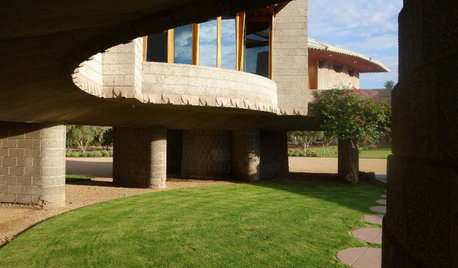
    What an interesting look back at how homes have evolved over the decades. It's a shame those concrete blocks seem to be showing so much white-powder efflorescence.

  • last year

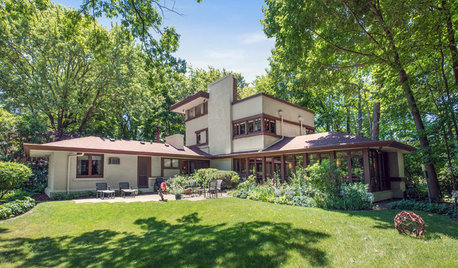
    https://www.zillow.com/homedetails/11185-Hawthorne-Dr-Galesburg-MI-49053/91718481_zpid/?


    I am not sold on the apparent floorplan in this one (?) Lotsa narrow hallway real estate for a relatively small house.

  • last year

    Wow what a neat home - love the ceiling in that front room - (the concrete block fireplace less so..)

  • last year

    Worst era in architectural in history. This is when the unadorned box became okay to build (and on the cheap). And today we have ugly strip malls, factories, government offices, etc. to show for it.

  • PRO
    last year

    I must say I'm underwhelmed by FLW, and this house is just weird. The exterior is not attractive, and the interior materials don't work together at all. The colors are very odd too. $2.3 million? No thanks.

  • PRO
    last year
    last modified: last year

    I love the seperation of sleeping areas and living areas , this house for me is not a huge inspiration of FLW it is poorly proportioned and overdone .with certain elements . The fact is though I think to own this would be a much better investment than some of the mcmansions that sell for a lot more

  • last year

    I think some of the Usonian designs are not his best because some of them are a little small to carry some of the broad, sweeping horizontals he incorporated in his more custom houses, and he did tend to beat to death some of his thematic details, which tended to work in his larger houses but could come off a bit overwrought in his smaller, later ones.

    I am not sure why a house of this size needs the amount of banquette he has. (See the Kalil house for banquette overload, too. And the banquette in Weisblat has a really shallow seat and a 90 degree back. So I don't think they would be particularly comfortable. Really, for as innovative as his designs were in 1910, he was still a 19th c. trained architect, and his younger modernist colleagues in the middle of the 20th c. didn't really consider him a modernist architect. When they reintroduced some of his furniture in the 1980s or 1990s, they noted that they did have to alter some of the dining chair designs because the originals were just too uncomfortable because they were too tall and upright in the back.

    I think the last couple parts of what's going on or "wrong" is with many modern houses they just don't take patina or natural aging very well. They just look beat up. There is a c. 1820 house around the corner from me that a man lived in for decades as a stabilized ruin. He made it weather tight so leaks and such didn't penetrate, but there were areas that hadn't been painted inside after about 1900. Lots of deteriorated surfaces, but it was still beautiful. A veneer plywood flush door comparison looks terrible with a couple scratches on it.

    And, I don't think people know exactly what to do with interiors of a house like this. Most regular furniture looks terrible in these houses, it looks extraneous.


    I think if we were looking at this house in mint condition with minimal furniture pretty much all designed by Wright, and some carefully curated objects, which is really how he wanted his clients to live--he wanted to control everything--it would probably make for a much better visual experience. But I think this is one reason why his houses do not fly off the market. It's a commitment to live in one.

  • PRO
    last year

    To compare this house with a McMansion is a false equivalency. Rather than purchase this house, I would want to buy one that is classic in style, well-proportioned and well-built with quality materials.

    Like these:


    Concord New Farmhouse · More Info


    Lobachsville · More Info


    Summer School (Cape Cod, MA) · More Info


    Red Cape · More Info


  • last year

    The Esherick House is an example of an architectural masterpiece, but as a 1-BR, perfectly-designed-for-the-client house, with kitchen cabinets by Wharton Esherick in it, it lingered on the market because living in an artwork can be restrictive. It could not really be modified to suit in the slightest way without ruining the integrity. (The current owners restored the kitchen but turned the laundry/utility room into a kitchen area they could also cook in, with a DW and such).

    But it lingered on the market because of it's inflexibility as a house for most people.

  • last year

    Much of the woodwork is stunning, but the house looks like an above-ground bomb shelter.

  • last year

    I am going to add "Visit new owners and ask for a copy of the floorplan" of my parents home to my to do list for 2025.


    I know it was designed by a FLW appentice and based on the Utilitarian designs of FLW.


    I love to see the homes designed by FLW. I like some better than others, but I do appreciate his talent.


    Sometimes I think about what was in style when they were built and love seeing it when it was preserved. At the same time I think about the home I grew up in and the changes my mom made to the home over the years. There wasn't a lot of change, but she added wall to wall carpet, changed the color of the formica countertops in the kitchen, and painted to two kids rooms (only rooms that were not fully paneled). Funny, I can't remember not having wall to wall carpet, but also have memories of roller skating up and down the hallway and out into the kitchen/family room and my mom having this monster polishing machine that she used on the spreckled brown floors. Thinking it was most likely terrazzo given the date of the build (We moved into the hoouse in 1963, when I was 2 years old.) I do remember olive green carpets, then a light sage green and finally a light beige.


    They lived in the home for the remainder of their lives (40 years).


    I not only love the aesthetic of the home I grew up in, but the house functioned like a well oiled machine. Every need was met or exceeded. Placement of every outlet / light switch and accomidation to my dad and one sister being left handed and the rest of us right handed, was thought of.


    The raised area in the middle of the house was raised just enough to put in clerestory windows which made the centrally located kitchen light and bright while not taking any wall space for windows - allowing for upper cabinets on both walls of the galley kitchen.


    We did have a 40' gallery between the living space and my parents bedroom with 2 bedrooms (one for the 3 girls, one for the three boys) on either side of the hallway.


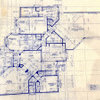
    The room at the far left below is my parents bedroom. The boy's bedroom is the jutted out corner window near the patio. The area between the two where the redwood and clerestory windows are was the portion of hallway between the boys room and my parents room. Girls room on the other side of the hallway.


    That hallway had closets all along the side with the clerestory windows, but they were hidden. The whole hallway was ribbon stripe mahogany paneling and the closet doors were the same material, slab doors that you pushed on to open, no hardware. Looked like a wall, but was really storage space. One closet had some special climate control thing and was used to store my mom's fur coats.


    This picture taken in our dining room shows the doorway to the gallery .


    I grew up with the bedrooms being very separate from the living space and is something I value in a home, but maybe because it is what I grew up with.


  • last year

    I did go to our city to see if they had a copy of the plans only to find out that there wasn't a city planning department until 1975. Houses built before that were not regulated. You bought the land and built what you wanted.

  • last year

    I don't like this one, though I do like some other FLW homes. This one has kinda an institutional feel to it -- parts of it look pretty much like the library from my elementary school...others like the beat-up old basement hallways in the hospital I used to work at. Pass.

  • last year

    Not a FLW fan at all. (This showcases the many reasons why.) It was such a drag when I lived in Chicago and out of town visitors wanted to tour FLW Oak Park homes.


    My grandparents knew Mr. Kauffman, who owned Fallingwater, and my mom hung out and swam there as a kid. I love thinking about her going down those living room stairs and into the water. But that is the extent of my affection for FLW. Fallingwater has no structural integrity and has had to be rebuilt several times. Not such a great architect after all.

  • last year
    last modified: last year

    I don't mind the esthetic of a lot of his houses, I just think they would be hard to live in, and this is not one of his great ones.

    Actually the underpinning of Fallingwater is fine, it was never really a design issue. There were two errors in the construction mostly related to the main cantilevered terrace. One is that the buttresses for the cantilever should have been extended under the main terrace just a little bit more, and the second, more major error is that the concrete was not pre-stressed adequately because they didn't really understand how to do it in 1936. The cantilevers should have been built on an upward angle trajectory above the horizontal so that it would "stretch" or sag into a horizontal position which would then put tension on the concrete which would be stronger, if I am understanding it correctly, and instead, it was build completely level so it relaxed into a downward sloping position, which continued to happen over time as well.

    And the ground around it is a little dynamic, so while the core is firmly anchored the perimeter bits are not as rigid leading to some issues in the past with opening and closing the corner windows, and glass cracking where it is let into the masonry and so forth. And all his houses were very leaky because the membranes to keep water out in something built like this didn't even exist. So it's not really a structural integrity issue so much, much of his work is stronger than it strictly needs to be. The Lily Pad columns in the Johnson Wax building are capable of bearing much more weight than they need to for their purpose. He frequently had to prove this with testing prior to building. Johnson Wax also leaked like a sieve. But his hotel in Tokyo survived an earthquake that leveled a lot of things around it.


    That said, none of these things necessarily make his houses very livable. The senior Kauffmans were not totally in love with Fallingwater. Edgar Jr. liked it more than they did but left it to the PA Conservancy because he knew as it aged he would never be able to afford to maintain it. It requires an incredible amount of maintenance.

  • last year

    Engineers warned him that his structure was flawed and if built as designed wouldn't survive the stress. FLW's ego was always too damn big. My dad is an engineer and I think I saw steam blowing out of his ears in furry when we visited Fallingwater together. Is something really a masterpiece if you cannot, in your day and age, figure out a way to successfully construct it?

  • last year

    Well engineers told him it would collapse immediately as soon as they took the cribs out from under the terrace and here it is 89 years later, hanging over running water, an element that can destroy anything. They also said the the lily pad columns in Johnson Wax would not hold up the building and required that a test column be built and withstand a 12 ton dead weight applied to the top.

    It cracked at a weight of Sixty tons placed on it and then collapsed when the cribs helping to balance the lily pad were completely removed.

    So Wright was an egomaniac, a control freak, and all round terrible person, but "under engineered" his projects are not. Flawed, leaky, and so forth yes. But I disagree that the engineering was bad.

  • last year

    Jennifer Hogan -- your parent's house looks similar but a lot nicer. Thank you for sharing how your family lived in it!

  • last year

    I am a fan of FLW, but not this house. I can appreciate the concept, but wouldn’t want to live in it myself. It doesn’t have the same energy to me as others I’ve seen.

  • last year

    IMO FLW was a scupltor whose medium was buildings. His residential work certainly isn't livable by 21st century standards, and as others have pointed out, this is not one of the better examples either. I think even when built FLW was more concerned about the artistry than the functionality. As a man he would have a different idea of what functionality meant than a woman too since it's doubtful he ever prepared a meal in a kitchen. Men of that time didn't step foot into the kitchen. The kitchen in the home for sale looks awkward.


    I agree with what Diana shows as the best type of house. Building something that still looks appealing 100 years later is a feat. For me, the best house is flexible. You want different things at different life stages, and what is deemed "necessary" changes over the years. Our last house had stone cladding (built in 1945 - so the real, thick stone) on two sides. The back was siding. There were about ten of the original design in my area and they had all been added onto off the back in slightly different ways over the years which helped to bring them into the 21st century. In retrospect, it was clever of the original builder to not put stone on all sides, although it's possible that he was just trying to save money. A lot of Levittown homes have been expanded over the years as well as they were meant to be flexible starter homes. In the last 4-5 years there have been countless bedrooms, dining rooms and living rooms turned into home offices. It's even better if you don't have to add on to get the function you need.

  • last year

    I think the house is great. I love FLW houses. Sure, he was a jerk, but he did interesting stuff and made a big mark on architecture. And he always paid careful attention to the site, which is something you don't see in many houses.


    We went to Taliesin East. It was a rambling structure with all sorts of cool details. FLW was short and he thought ceilings didn't need to be much taller than 6 feet. In the living room, there was a little cupola bringing in light (although there were tons of windows). When we went on a tour, my husband and son, both 6'3" stood under the cupola and the ceiling of the rest of the room was at about eye level.

  • last year

    I am thinking about my career and how I got my start in computer science. I had a brother in law who had a job at IBM working with the new PCs.


    I needed a job and in one of the interviews I was asked if I knew how to use an IBM PC. I said yes and crossed my fingers that I could learn fast. I had used the old Wang word processors and had seen an IBM PC.


    Looking back, that first IBM PC with the green screen, having to know your dos commands to open each program and storing your work on floppy disks was a clunky bear of a machine.

    Connecting to the internet to do research through the accustic modem was pretty clunky too. Things like finding legal presidents could take days of searching compared to moments with today's technology.


    It was these innovators who could imagine the possibilities that got us started on the personal technology journey.


    When I read through posts on Houzz where people are designing their home one of the guaranteed resposes is that the home needs to be designed in relationship with the site.


    That was a core concept of FLW - Organic Architecture - architectural designs should be derived from their surroundings, integrating with the landscape.


    He also introduced the concept of open floorplans combining multiple rooms into a continuous space and minimizing interior walls.


    He believed natural daylight was essential to our wellbeing and built homes with huge expanses of windows, used light tubes and skylights to fill the home with natural daylight.


    Aren't those primary desires of most homeowners today. Light and bright and open.


    In my mind, Wright's influence on the future of architecture and the way we live in our homes is part of the reason why Wright was recognized in 1991 by the American Institute of Architects as "the greatest American architect of all time."

  • last year

    @Kitchenwitch111 - My parents home was built 15 years after the one currently for sale and didn't have an addition built on, which is one of the things that I think makes this home more awkward. (The leg with the greenhouse was an addition).


    I think additions onto existing structures that work well have to be one of the greatest architecural challenges.


    I am grateful for the work that FLW did, for without his vision my parent's home would have never been built. It was the 2nd generation of MCM homes.