Software
Houzz Logo Print
annekreel

Which of these range hood inserts should I choose? A comparison.

9 months ago
last modified: 8 months ago

Ok, so we need to install a range hood over our 36" induction cooktop. Here are some questions I have. Some are about aesthetics and some are about the mechanics:

  1. I know the recommendation is to add 3" to each side of the cooktop and install a 42" hood over a 36" cooktop. However, we don't cook that much and when we do, we don't cook many greasy foods (except for the occasional pound of bacon). Aesthetically, would a 36" insert range hood with a box built to maybe 39" work? Will it make that much of a difference in its ability to remove smoke? We have been cooking without a range hood for about five years. I'd say we set off the smoke alarm a max on ten times (because apparently my son doesn't know how to open a window).
  2. Makeup air: I know we need a makeup air system if the CFM is over 400. It ain't too easy to find a 42" range hood with 400 or less CFM. Due to issues behind our wall, we are limited to units with a 7" round vent max or a rectangular one if the answer to question #3 is yes.
  3. Can a range hood that utilizes a 3.25"x10" rectangular duct be turned 90" to exit the house vertically rather than horizontally?
  4. Can range hoods with higher than 400 CFMs be reprogrammed before installation to not go over the 400 CFM limit?

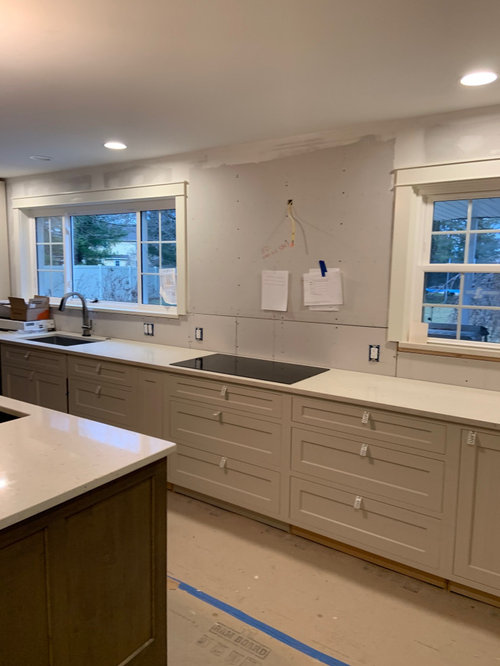
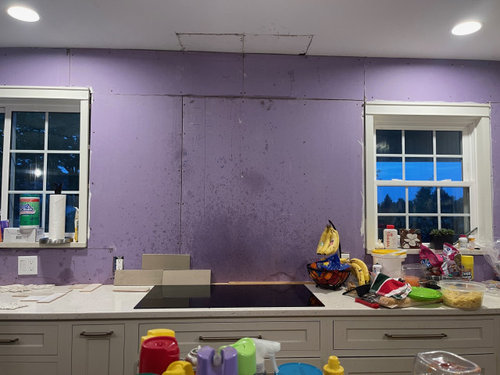
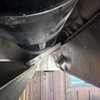
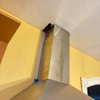
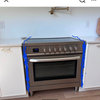
Here are a couple of photos of where the hood will be installed. I am looking at insert units with a box surround. The first photo if when the kitchen installer "finished" before we had to take all the drywall down and replace it for a variery of reasons.


Five years of use and that is all the grease that was absorbed. I don't think it is too bad considering the length of time.


Comments (21)

  • PRO
    9 months ago

    Any 36" induction will need more than 400 CFM. Physics shows you why it needs to be 42" wide. Duct transitons exist for all sizes of ducts. The expense of the hood and make up aire is just part of the overall choice of cooktop. You cannot spend a lot of money on one and then spend $1 on the others.

  • 9 months ago

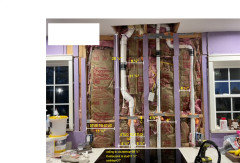
    This is the wall behind the cooktop and why we are limited with what we can do.


  • PRO
    9 months ago

    They make elbows for pipes too. You do understand that header span the window opening, and are what can span across behind the cooktop in order to give you room for an appropriately sized duct?

  • 9 months ago

    In my view, the bare minimum actual specific containment volumetric flow rate for induction is 60 CFM per square foot of hood entry aperture. Blower rated CFM needs to be about 1.5 times the product of 60 and the area (sq. ft.). More is usually better, but more expensive in various ways.

    Inadequate capture (hood entry aperture overlap) means greasy plume effluent not only attaches to walls and ceiling, but also drapes, furniture, clothes, etc. The 3-inch rule intends to roughly approximate the growth in the cooking plume as it rises. It may not be sufficient for cross drafts. As you may be CFM limited, larger entry aperture will still be better than the bare minimum.

    The duct size (or equivalent size) needs to keep the flow velocity (in round duct) to between 1000 ft/min and 2000 ft/min. Further, the equivalent circular duct diameter for a rectangular duct is given by the ratio of 4 times the sectional area to the duct perimeter:

    D_eq. = 4 x L x W / (2L + 2W); hence, 3.25 x 10 duct is about 4.9 inches round-duct equivalent.

    I think you will need to put some 45-degree elbows in one of the cavities, go out the wall, or go up to an attic and thence the roof with a larger round duct. Methinks you closed the wall too early. Going out the wall to a deck area is not advisable, although an external chase to a roof height is an option.

    Hood inserts are made undersized so that the surround can be a standard cabinet width. Whether the total surround size can act as the capture entry aperture somewhat depends on the local aerodynamics of the shapes.

    Wood exposed to the cooking surface will need a metal overlap below some height. Wood surrounds, particularly for marginal capture, will collect grease. Stainless steel is easier to clean.

    Whether a complex MUA system or a wall port with damper and filter is sufficient for MUA depends on combustion appliances that might be present and how they are supplied with their own MUA.

    Question 3 is not clear to me. Hoods and hood inserts may be fabricated to have top exits, rear exits, or both. Directional changes can be made in any direction, but elbows take up space. Rear exit hoods might not accommodate internal blowers. Offset rear exit hoods/inserts may need to be tailor-made from, e.g., Modernaire.

    A duct that gets to an attic, combined with an external blower, usually allows insertion of a silencer into the duct path considerably lowering hood noise.

  • 9 months ago

    "Five years of use and that is all the grease that was absorbed." You don't think that is bad? Yuck! That is just the grease you can see there. It goes other places like onto cabinets and elsewhere in the house.


    As far as the hood being larger or the same size as the range we have had the hood the same size as our range(48 inches) in 2 houses. It has not been a problem. We have cabinets on each side which I think helps to contain some of the effluent. My hood is 24 inches deep and 1200 cfm. I am always amazed how much grease it collects. I do not find any grease on my cabinets or anywhere else in the kitchen.

  • 9 months ago

    Minardi, I am not sure what you are saying. Can you please explain?

  • 9 months ago

    Ann Marks , I don't like the grease being there, but I definitely think that for five years accumulation, it isn't too bad. I don't find a lot of grease elsewhere. In a perfect world, we don't have any but I know we are limited with what we can do in the space considering the limitations on venting the hood outside.


  • 9 months ago

    kaseki , we had a kitchen installer who screwed up and we fired him. We know he closed everything too early but we now need to live and work with what we have available to us. We cannot go to the roof.


    "Whether a complex MUA system or a wall port with damper and filter is sufficient for MUA depends on combustion appliances that might be present and how they are supplied with their own MUA."


    Can you explain more about the wall port?


    And can you dumb it down for me? I don't follow a lot of what you are saying.

  • PRO
    9 months ago

    Seems like you need to hire a new GC and reopen that wall up. None of this is difficult for the right contractor.

  • 9 months ago

    McDonald Enterprises , for what purpose? Nothing can be moved due to so much strapping already being used. We have had contractors look at it and none have offered solutions that will significantly improve the layout. We seem to be able to place a vent in the 9" spot to the right of the 4" drain pipe.

  • PRO
    9 months ago

    Some people cannot be helped. Even when the solution has been presented to them. Waste of time here.

  • 9 months ago

    Minardi , because I don't understand the comment you first made means I do no want to be helped? I don't get what I am missing as the "Solution" that was presented.

  • 9 months ago
    last modified: 9 months ago

    And can you dumb it down for me? I don't follow a lot of what you are saying.

    Unfortunately, many appliance areas are highly technical. Fortunately for most applications, the required functional assemblies, e.g., refrigerator, stove, are engineered into compact shapes not requiring much action by the resident to install and operate. The hood system, and the usually needed MUA system, are not always in such a form. Residence architecture plays a strong role, as you have seen. Only recirculating hoods can be considered to be self-contained systems. Most hoods require someone 'engineering' the hood selection or construction, the duct and its path, blower selection and location, and all the counterpart MUA elements.

    Being an engineer, I can best try to explain things in the relevant terminology. I think it will be familiar to HVAC personnel, who may be able to help you.

    Can you explain more about the wall port?

    Make-up air systems have the function of regulating the house pressure against the suction effect from the cooktop hood. There are a few reasons this is desirable. The first is safety; lower pressure inside than outside can back-draft combustion appliances and thereby introduce carbon monoxide into the residence. Second, low pressure can pull moisture and/or dust through the walls, which is undesirable. Third, lower house pressure reduces the actual volumetric flow rate (CFM) of the hood blower, which in turn reduces performance in removing cooking plumes.

    We can separate MUA supply into two categories, which I will call passive and active. These differ in that the active systems contain their own blowers, whereas passive do not. All such systems will need a powered damper, an air filter, ducting, in much of North America a heater of some sort, and a means of introducing the MUA into the kitchen space such that it is non-turbulent when it reaches the hood area. Diffusers are best for this. An active system requires a blower and a control scheme that attempts to either match the hood flow rate, or maintain a minimal house to outside pressure drop. Thus, active systems are significantly more complex. Passive systems can be simpler, and in concept consist of a ducted hole in a wall or roof, with cap, a damper triggered by the hood, a filter, and heater.

    The issue with passive is that it will inherently have a pressure drop (loss) when the MUA passes through its filter. Some combustion appliances can back-draft on very low outside-to-inside pressure differences, hence the use of an active MUA system blower where needed.

    There is another option if architecture is particularly limiting -- a performance recirculating hood can be used. It will not be as good as an ideal exhausting hood system, but may be as good as an inferior one. No MUA is required. One example, and the only one adequately addressed in this forum, is the Vent-a-Hood ARS. See: https://www.houzz.com/discussions/2347276/vent-a-hood-ductless-ars-range-hood-update#n=181.

  • 9 months ago

    I should add that passive MUA can be used if the combustion appliances, where present, have their own MUA, either because they are in a ventilated room sealed off from the kitchen air, or because they have their own ducted MUA.

  • 9 months ago
    last modified: 9 months ago

    "I know we need a makeup air system if the CFM is over 400. It ain't too easy to find a 42" range hood with 400 or less CFM. Due to issues behind our wall, we are limited to units with a 7" round vent max..."

    • The Zline KBCRN-42 (build, Home Depot) has a 400 CFM blower, baffle filters, uses a 6" duct and you can add a 90-degree elbow to route exhaust to the rear if you provide at least a 12" vertical duct immediately above the hood.


    "Can range hoods with higher than 400 CFMs be reprogrammed before installation to not go over the 400 CFM limit?"

    BenjiBoi thanked wdccruise
  • 8 months ago

    So we are down to four range hood inserts for our kitchen. These are the specs on the four. I know there are more available but these fall within our budget and are below 400 CFM which meets code without makeup air. (Not an option--please don't suggest it.)


    To get SS baffles in 36" wide, these are our options:


    Trade-Wind VSL436319RC ($717.00)

    390 CFM

    Baffle Filters

    304 grade SS

    7” duct

    2.7-7.0 sones


    Cosmo COS-36IRHP ($249.00)

    380 CFM

    Baffle Filters

    430 grade SS

    6” duct

    45dB-?


    Zephyr Monsoon Mini II ($779.00)

    390 CFM with ACT

    Hybrid baffle

    304 grade SS

    7” duct

    1.5-6 sones


    Imperial C2036SD4SB-SS ($957.00)

    390 CFM

    430 grade SS

    Slim baffle

    7” duct

    2.5-7.6 sones


    While I know the Cosmo has a lesser grade of SS, for the cost difference, it seems to be a good choice. What are yout thoughts or experiences?

  • 8 months ago

    bump

  • 8 months ago
    last modified: 8 months ago

    The cheapest one, slap stainless steel behind the range, mud, paint, then pass inspection and no more time pressure from township. It’s a $250 hood. Cheap price to get yourself out from under that stupid deadline.

  • 8 months ago

    kaseki I have ruled out the Cosmo since it is only 12" deep.


    Here are my options now:

    Trade-Wind VSL436319RC ($717.00)

    390 CFM, 18" deep, Baffle Filters, 304 grade SS, 7” duct, 2.7-7.0 sones,


    Zephyr Monsoon Mini II ($849.00)

    390 CFM with ACT, 18: deep, Hybrid baffle, 304 grade SS, 7” duct, 1.5-6 sones


    Imperial C2036SD4SB-SS ($957.00)

    390 CFM, 18 1/8" deep, 430 grade SS, Slim baffle, 7” duct, 2.5-7.6 sones


    Vent-A-Hood BH134PSLD ($1,186.00+) is too expensive and too deep for us. Also concerns about cleaning it from several posters.


    I am leaning toward the Trade-Wind since it is the least expensive but has baffle filters, a better grade of SS, and is in the middle with regard to noise level.


    We will not go to a wider or much deeper due head space for aesthetic purposes.


    I am awaiting word from a local business regarding a Wolf chimney hood floor model they are selling. It is a great price but they cannot find the chimney extension. Buying a new one would add almost $400 from Wolf and put it out of our price range. But if they locate the extension by tomorrow, we may go with that. But that is doubtful.


    From the specs, what do you think?

  • 8 months ago

    I do not recommend hoods I haven't owned, which seriously limits the scope of positive comment. I can comment sometimes on features that degrade adequate performance. Further, hood systems that don't meet the requirements that I've asserted many times in this forum are not easily evaluated for which is least inadequate.

    The link that follows (at least the first dozen pages) sets the stage for what one wants to accomplish in a residential setting using residential grade equipment. Try for basic capture and containment of at least simmering foods.

    https://www.tagengineering.ca/wp-content/uploads/2015/02/KVSApplDesign_catalog.pdf

    It is also worth noting that a nominal 400 CFM (blower hanging in free air) is unlikely to move more than 200 CFM in a well sealed residence. There are cooking conditions for which this will be inadequate no matter what hood configuration is selected.

    On stainless steel: These materials are actually called corrosion resisting steels (CRES). Some, such as much of the 300 series, are resistant to staining. The 400 series may finger print given acidic skin pH. Removing prints without scratching the surface pattern will require phosphoric acid based cleaning, or some other product I don't know about.