Software
Houzz Logo Print
melissa_vanloan

What to get if you CAN'T have an induction range

last year

Dishwasher leak reparations from insurance and matching that with our own cash has allowed us somewhat of an upgrade to our kitchen.... but not enough to get a new electric panel to accommodate an induction range. Not too upset at that but going crazy trying to find a reliable, 30" electric slide in. Gas also out of the question as that would also require hefty cash to run gas line into kitchen. Contemplating Frigidaire Gallery, GE Profile and Bosch 800 series--anyone with experience of those? Thanks in advance!

Comments (40)

  • PRO
    last year

    WHy do you need a whole new panel for induction? You shouldn't. Ever. You just need a 40-50 amp circuit that the old range was operating on.

    MJ VL thanked Minardi
  • last year

    I guess the house is old, the existing panel is full and/or won't accommodate the additional power requirement for an induction range.. (thank you for responding though!)

  • last year

    There are induction ranges that use a battery and plug into a regular wall outlet. I don’t believe they’re all that much more than a regular induction range: copperhome.com


    I have no personal experience with these - just happened to remember reading about them somewhere recently

    MJ VL thanked theotherjaye
  • last year
    last modified: last year

    theotherjaye

    The induction range that uses a Tesla-style storage battery and can plug into a standard 120v outlet is the Copper Charlie. They are made to order in the San Francisco Bay Area with prices starting at $6000. You may have read about it here: https://www.nytimes.com/wirecutter/reviews/copper-charlie-induction-stove-review/

    MJ VL thanked jwvideo
  • last year
    last modified: last year

    " panel to accommodate an induction range. Not too upset at that but going crazy trying to find a reliable, 30" electric slide in. Gas also out of the question."

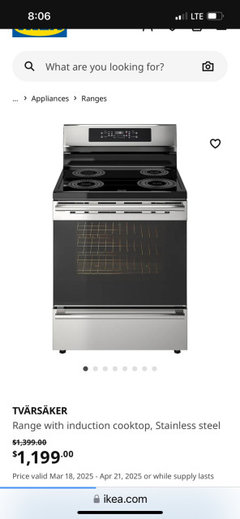
    Any electric range you had or are considering will use 220v. You can choose radiant smooth top off Facebook Marketplace for $250+ as people unload those because of incredibly slow performance and horrible surface cleaning. Or you can look at a Frigidaire slide in induction for $950. Years of good reviews. They both use the exact same outlet to plug in. Frigidaire 30-in 4 Burners 5.3-cu ft Self-cleaning Convection Oven Slide-in Single Induction Range (Stainless Steel) FCFI3083AS at Lowes.com There is a new model for $1500.

    MJ VL thanked dan1888
  • PRO
    last year

    I have this in my summer house and in many ways it’s better than my $3000 induction at home. Heats fast, auto size burners… either you have 220v or you don’t , you still haven’t explained why you can’t have induction.

    MJ VL thanked HALLETT & Co.
  • last year
    last modified: last year

    Thank you all for your informative responses. I honestly thought that induction ranges across the board were all too power grabby to run off the existing panel but now I realize that it depends greatly on the brand and that perhaps I can get an induction after all! We do have issues with the circuits going off if we have microwave and tea kettle running or toaster at the same time, and often the lights will dim when one or other of those are switched on--definitely a janky 1970s Brady Bunch house :) The other issue with our existing circuit breaker panel is that it would have to be moved if we needed to add to it as it is currently above a gas meter and the code has changed such that it needs to be a certain distance away, should the existing power prove not to be enough. That would be spendy. Sounds like we might squeak by though... Thank you everyone!

  • last year

    I switched from gas to induction in my 1971 built house. My DS is an electrician and he ran new wire from the panel and installed a receptacle behind the range. I think he added something to the panel, but I don't know, or understand, the details.

  • last year

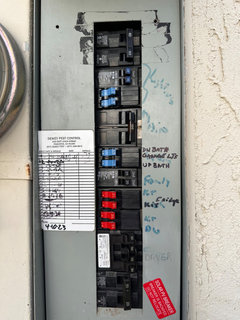
    Post a picture of your current breaker box for feedback.

  • last year
    last modified: last year

    MJ VL

    Re the problem with the microwave, electric kettle and toaster: Judging from the 1970s kitchens I've seen in my town, there seems to have been a common practice back then of putting all the 120v kitchen outlets as well as the lights all on one or two 15 Amp 120v circuits. (Most here at least had a separate circuit for the refrigerator.) So, simultaneously setting an electric kettle to boil while toasting something and also running the microwave all at the same time on the single circuit just pulls more power than a single 15 Amp 120v circuit can deliver and that's what trips the breaker for that circuit. And never mind if somebody has also wired in a dishwasher and garbage disposal!

    Be assured that this is a separate problem that is not affected by (and does not affect) what goes on with your 220v/240v stove circuit.

    The eventual solution will be a new electrical panel in a new location (as you note) but also will involve rewiring your kitchen to provide several separate 120v 20 Amp circuits. I understand wanting to defer that expense and disruption. In the meantime, it can be like living in an RV where you can have a bunch of devices but you have to learn to choose which one to run at any given time.

    MJ VL thanked jwvideo
  • last year
    last modified: last year

    "We do have issues with the circuits going off if we have microwave and tea kettle running or toaster at the same time"

    I'd suggest you do a circuit analysis. Turn all the circuit breakers off and then one-by-one turn a circuit breaker on and plug a lamp into each outlet (and switch on/off each light) to determine which share a circuit breaker. (As noted above, you probably have more than one outlet in the kitchen connected to the same circuit breaker which is why it "blows" when more than one appliance is turned on simultaneously. After you do your circuit analysis, you may be able to connect your appliances to different circuits so the breaker doesn't blow.)

    You probably have a 240-volt circuit for the stove. Look at the number on the double 240-volt breaker which will tell you its amperage. Once you know that number, you'll be able to select a range whose amperage is equal or less. Most 240-volt circuit breakers for an electric stove are 50 amps; most induction ranges are 50 amps.

    MJ VL thanked wdccruise
  • last year
    last modified: last year

    Good tip for determining which of the kitchen 120v outlets are on the same circuit.

    But, no need to worry about needing 50 amp power when you are looking at 30"-wide ranges from Frigidaire, GE Profile or Bosch as mentioned in your original post. All of those brands' 30"-wide induction and radiant electric ranges are all 40 Amp appliances.

    Wouldn't hurt to check on the circuit breaker, though, just for peace of mind if there is any chance somebody before you might have upgraded the breaker to 50 amps. Doesn't seem likely and If the breaker has a number "40" on it, all is well.

    If it does happen to have 50 on it, then you should make sure the wire to the stove outlet was also upgraded to the proper gauge (thickness). 50 amp circuits require a thicker gauge wire than 40 amp circuits. If you find "50" on the breaker and don't know how to id the gauge of the cable to the stove's outlet on your own, hire an electrician to do it for you.

  • last year

    I think you would be happier if you save up until you can upgrade your electric & get an induction range. Nobody likes sinking $$ into their houses' infrastructure (except me, but I'm odd that way), but modern electrical works pay off in safety, efficiency, & future expansion , & is a nice selling point if you move. Modern lives need more electricity than the Brady Bunch era did. Plus you'll love induction. It's worlds better than radiant or coil.

  • last year
    last modified: last year

    There certainly are excellent arguments to be made that it would be "better" to go ahead with renovating the house electrical now, but, to avoid confusing people coming to this thread later, can we all be clear that MJ VL can get a pretty good induction range that will work right now before any of that work is done? Also, that it will work just fine after the work is done, too? Even a double oven Cafe Induction range like the Cafe CHS950P4MW2 only specs a 40 amp circuit. It will work just fine after the wiring upgrades, too.

  • last year


    😂 Ya it’s not pretty.. Will do the circuit test and see what’s where.

  • last year


  • last year

    Thank you everyone for your help —much appreciated!

  • last year

    [oops I signed in under a different email--those last two posts are from me]


  • last year

    Whether you make any changes to your electrical panel or not, it is certainly worthwhile to take the time to determine what is one each breaker. Most breaker box labels have vague "zones", but those aren't always consistent.

    When we remodeled our kitchen last year, we turned off the breaker to the range hood when we removed the old one - and found a number of outlets (one in the dining room) on the same circuit. So I tested all the outlets in the kitchen area, and mapped which outlets were on each breaker. During the remodel I wrote the breaker number for each outlet on the wall (which would be covered by backsplash). That made it a lot more convenient for the electricians when they came in to wire the undercabinet lights, and for the hardwood flooring contractor who plugged in equipment in different parts of the house. I put tape over the outlets that were on the same circuit as the range hood.

    MJ VL thanked AnnKH
  • last year
    last modified: last year

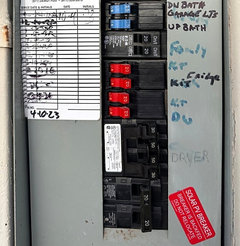
    Re the photo of the panel -- 😒

    Only 100 amp service and an outdoor panel just to make things inconvenient when you trip a breaker.

    At least your photo (a little hard to read) confirms that the range circuit (the topmost breaker) is indeed 40 amps. Getting one of the 40 amp slide in ranges from GE Profile, Bosch or Frigidaire is not going to make anything any worse than it already is. That's true whether you choose one of their radiant electric or induction models. ETA: See below comments & Dadoes's enlargements of the photo.

    If and when you narrow down your choices, you may find it helpful to search here on the model numbers or make a new post with questions about choosing between particular models.

    MJ VL thanked jwvideo
  • last year

    jwvideo: "At least your photo confirms that the range circuit (the topmost breaker) is indeed 40 amps."

    I don't see a 40-amp breaker anywhere.

  • last year
    last modified: last year

    wdccruise: I thought the top breaker had "40" on it but, on rechecking, I'm not so sure and Houzz/gardenweb just won't let me enlarge this photo. On my screen, it looked like it said 40 on the handles but it might be something else. Maybe 80? Hopefully, you can see it better than I can and I'll stand corrected.

    Also, can you make out what is on the four lower-down breakers (the ones with "dryer" handwritten on the panel next to the middle ones)? On my screen it looks like it could be a 30, 50, 50 and 30. Not sure what to make of that.

    Ever seen anything like this panel?

  • last year

    it's a doozie lol

  • last year

    Can't make it out too well, but the top ones look like they say 60.

    I also can't quite read the diagram next to those bottom breakers, but I would assume the two 30 amp breakers are tied together.

    To the OP: it is easy enough to tell what breakers feed your current stove. If the stove has lights, just turn on the stove, then turn off the breakers one at a time to see which one turns off the lights. If there aren't any lights, then switch all of the breakers off, with the stove off. Then turn on the breakers one at a time and test a burner after switching a breaker on to see if that breaker controls the stove..


  • last year
    last modified: last year

    When testing the breakers, I think you may have to switch on the two-pole breaker that is about 1/3 of the way down and seems to have 100 on the bar that joins the switches. There is a handwritten word that looks like "main" scribbled on the face of the panel next to it. That's probably a clue that it is the mains power switch/breaker which has to be on before any of the other breakers will work.

  • last year

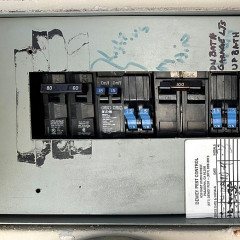
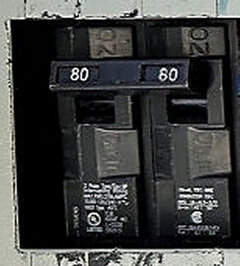
    Upper appears to be an improbable 80 and a 60 tied together, so I would assume 60.

    Is 60 even likely for a range? And the tape residue looks like it was kept in one (probably OFF) position for a long time, suggesting whatever it connects to wasn't fully wired up for a period sufficient for tape adhesive degradation.

    Agree lower one ("dryer") is 50/50.

    Note breakers precede GFCI requirements.

  • last year

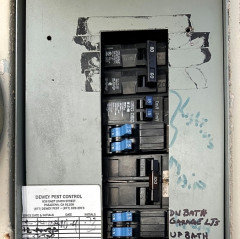
    There is a way to get a larger view of a photo, depending on whether and how much Houzz shrinks it. This edited split/crop/rotation hopefully won't shrink when posted.


  • last year

    Turn on your existing stove. Have a second person click off circuit breakers one at a time until the stove loses power. Identify the capacity of that breaker.

  • last year

    Thanks @dadoes, I'd say definitely an 80/80 up top. Musta started with an impressive stove, maybe with electric salamander adjunct. :) Or heated swimming pool?

  • last year
    last modified: last year

    Dadoes -- Thanks for the photo extraction and enlargements. Can you share how you did that?

    kas -- maybe instead of a former "impressive stove" with an electric salamander, maybe it originally ran to subpanel in the kitchen for powering a separate cooktop and wall oven(s) back in the Brady Bunch days? Maybe some prior resident DIY-ed a backyard hot-tub in the '90's? But maybe when MJ VL tests which breaker goes where, this won't be the one for the stove? That leaves the questions of which other one is for the existing range and did somebody use random scrounged parts to cobble together an 80/60 frankenbreaker for something else?

    A question for MJ VL to have looked at --- a lot of 1970s houses were wired with aluminum rather than copper cables. Was that the case in this house? Worse case scenario: there's an 80/60 frankenbreaker hooked to an old 10 AWG aluminum cable (gross mismatch and a real and present hazard.)

  • last year
    last modified: last year

    ETA: just realized I had a double post. The first one disappeared when I tried to submit it. I then generated this one and now see I have two posts. Sorry about that.

    Dadoes -- Thanks for the photos. Would you share how you did that?

    Kas - Another possibility is that maybe somebody ran a 60 amp circuit to a subpanel in the kitchen to serve a separate cooktop and wall oven(s). I had cousins in LA back in the 70's who had that kind of set-up. But maybe that breaker goes to something like a hot tub.

    MJ VL --- You still have to figure out what breaker serves the range. Beyond that, the photo of the panel is raising some serious, immediate safety concerns. Did somebody in the past cobble together a 60/80 amp twin pole franken-breaker? Maybe out of random scrounged parts? Hopefully its an 80/80 or 60/60, but if something else, then it is not safe. Whether it goes to the range or not, you also really need to find out what kind of cable is in the wall. A 60 or 80 amp breaker must be connected to very thick (gauge) cable. (Wire gauges (thickness) are like shotguns: the lower the number the bigger the diameter.) In this instance, the higher the breaker number the thicker the cable has to be. Also, a lot of 1970s houses were wired with cables with aluminum conductors and those can be an additional concern because aluminum wire is reputedly more prone to overheating than copper wire is.

    Worse case scenario here would be to find that your stove breakers are hooked to a 10 AWG aluminum conductor cable that runs to your stove outlet. For a 40 amp stove and 40 amp breaker, the cabling should be at least 8 AWG. Maybe you should get a professional electrician. If the wiring isn't bad, the fix might be as simple as swapping in a proper breaker or maybe it is fine as is. I make no claims to being an electrical expert but if it were my house, I would need to know how safe or unsafe it is and get a plan to deal with it ASAP.

  • last year
    last modified: last year

    I believe the twin breaker of question at the top of the panel is 80/80, not 80/60. (This image is cropped and enlarged 400%, size of 616px X 684px. Can't predict to what Houzz will resize it upon posting.)

    ETA: The thumbnail is 240x266. It displays at 616x684 when clicked to zoom.


  • last year

    Agreed 80/80. I await being dazzled by learning what it feeds.

  • last year

    kaseki: "I await being dazzled by learning what it feeds."

    I'll take a guess: heat pump or air conditioner.

  • PRO
    last year

    It likely feeds a subpanel somewhere. Like for a detached garage, swimming pool and hot tub, etc.


    All of that is pretty darn questionable.

  • last year

    It's for the spa! And yes, all very questionable--which is why I was doubtful I could even put an induction range in.. I realize now we can but it will probably mean we're taking the circuit breaker walk a lot more frequently.


  • last year

    "I was doubtful I could even put an induction range in"

    You still have to figure out which circuit breaker (or pair of 240-volt circuit breakers) controls the range circuit.

  • last year

    It seems like there is no range breaker, unless as suggested there is a subpanel somewhere, or the mains disconnect/circuit breaker is part of the meter housing.

  • last year

    I would...

    1. Verify that the range has power.
    2. Turn off all the circuit breakers.
    3. Turn on the 100-amp breaker; check the range for power.
    4. Turn on the 80-amp breaker; check the range for power.
    5. Continue turning on one breaker at a time until power is applied to the range. Then you know which breaker services it.
    MJ VL thanked wdccruise