Software
Houzz Logo Print
stillanntn6b

Rose Rosette appears yet again in my garden

5 months ago

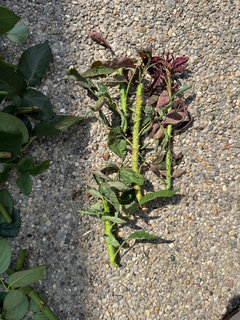
A R. multiflora was bird seeded in one of my flower beds that isn't a rose garden last year. We let it bloom this spring. It expressed its gratitude by putting up two new canes and the ends of them are nothing but Rose Rosette.

Most times, it's appeared with early spring growth or late summer/ fall. I wonder if our wonky weather this spring got the vector mites moving earlier than usual.

For old times's sake, my RRD ebook


Comments (27)

  • 5 months ago

    Oh, no, Ann. Thank you for the ebook.

    stillanntn6b thanked Sheila z8a Rogue Valley OR
  • 5 months ago

    Oh so sorry!

    stillanntn6b thanked jerijen
  • 5 months ago

    Ann, so sorry to hear that. I hope that newer folks who don't know about your research on RRV and ebook will take advantage of it.

    stillanntn6b thanked susan9santabarbara
  • 5 months ago

    I'm sorry to hear it!

    stillanntn6b thanked Melissa Northern Italy zone 8
  • 5 months ago

    Oh, no! That is the pits. I really hope it doesn't spread, and that it's an anomaly. Keep us apprised.

    stillanntn6b thanked rosecanadian
  • 5 months ago

    I tapped on the box entitled ”Ask Houzz AI Any Remodeling Question”, and typed in

    ”is rose rosette disease transmitted by rose seeds?”

    !

  • 5 months ago

    Seed transmission is not proved for RRv. The whole group of Emaraviruses are only just beginning to be studied. More is already known about a similar wheat virus that was studied for seed transmission (some people couldn't understand how their fields were infected so blamed the seeds) and thousands of seeds from infected plants were grown out. None appeared with the virus.

  • 5 months ago

    So sorry to hear this Ann, I hope the RRD situation in your area eventually abates. My friends in the Dallas area say that after all the public mass plantings of Knock-Out type roses have died out, they are relatively safe to plant roses again. I’ve seen some of their beautiful pics, so there’s hope.

    stillanntn6b thanked BenT (NorCal 9B Sunset 14)
  • 5 months ago
    last modified: 5 months ago

    Ann, thanks for compiling such extensive research material for our benefit. That's a lot of invaluable information you have assembled. What a nasty being that mite is. You would think the mite would just be content to have a home from which to gain sustenance from our roses, yet it infests its home with a virus that kills it. Rotten and ugly little creature it is!

    At least be grateful that you know what must be done with your infected bush. So many RRV infected bushes in public landscape sites become infected and die a miserable, slow death in situ, not a person in the world caring to put them out of their misery, and also stop the spread of further infections.

    Moses.

    stillanntn6b thanked Moses, Pitt PA, cold W & hot-humid S, z6
  • 5 months ago

    Ann you are such a gift to the rose community with the wealth of information about RRD and your willingness to share it with us. I'm more sorry than I can say that your wealth of information has to include repeated experiences with RRD yourself. You of course are expert at recognizing and removing the affected bushes, but it's heartbreaking to see it come back again and again.

    We share your frustrations and pain with this scourge.

    Cynthia

    stillanntn6b thanked HU-290063788
  • 5 months ago

    Ann, I'm so sorry. I lost one last summer ond one that I strongly suspected and removed this spring. They were the first after going several years without any.

    stillanntn6b thanked Karen Service
  • 5 months ago

    I am very sorry indeed

  • 5 months ago

    Ann:


    I recently contacted an employee of a nearby town for assistance in facilitating removal of rrd infected roses on a commercial property in that town. This is part of her emailed reply, which I received today:


    “It's important to note that although these mites can travel short distances via wind, transmission over a distance of more than a mile is considered extremely rare and unlikely under normal environmental conditions.”


    Thoughts?


  • 5 months ago

    Well hello Ann! This is Donna, about 2 hrs W of you, we used to talk on the phone a lot. Haven't seen much RRD in several yrs, but when my nice big 'Violette' first made leaves this spring, there was a whole long branch of it. I cut back to what appeared to be healthy wood, and fed the green stuff to the goats. It's a good place to put vegetation I never want to see again! (And more often than I like, vegetation I wanted to keep. They can defoliate a rose in moments.) The rest of the plant seems to have all come out healthy, tho what's high up in the tree I guess I should be using binoculars on.

    There's a damned row crop farmer nearby who keeps getting us with herbicide drift, but Violette doesn't look any stranger than all the other fast growing trees, shrubs, tomato and pepper plants. The beauties of Nature, as reinterpreted by 2,4D, are not very beautiful.

    I keep advising people to use plenty of Boron to metabolise Calcium and slow viruses. The whole SE US is deficient in Boron. Don't know if that's why RRD has stayed away from me. I see less multiflora in general the last few years (maybe RRD ate it all?) but my son just chopped a big plant on new property. Mind you, it's when you up the pH and the organic matter that Boron deficiency becomes acute.


  • 5 months ago

    Well hello Ann! This is Donna, about 2 hrs W of you, we used to talk on the phone a lot. Haven't seen much RRD in several yrs, but when my nice big 'Violette' first made leaves this spring, there was a whole long branch of it. I cut back to what appeared to be healthy wood, and fed the green stuff to the goats. It's a good place to put vegetation I never want to see again! (And more often than I like, vegetation I wanted to keep. They can defoliate a rose in moments.) The rest of the plant seems to have all come out healthy, tho what's high up in the tree I guess I should be using binoculars on.

    There's a damned row crop farmer nearby who keeps getting us with herbicide drift, but Violette doesn't look any stranger than all the other fast growing trees, shrubs, tomato and pepper plants. The beauties of Nature, as reinterpreted by 2,4D, are not very beautiful.

    I keep advising people to use plenty of Boron to metabolise Calcium and slow viruses. The whole SE US is deficient in Boron. Don't know if that's why RRD has stayed away from me. I see less multiflora in general the last few years (maybe RRD ate it all?) but my son just chopped a big plant on new property. Mind you, it's when you up the pH and the organic matter that Boron deficiency becomes acute.

  • 5 months ago
    last modified: 5 months ago

    Hi, Donna, long time....

    At the Rose Rosette meeting in Delaware, I brought up the use of Boron as something one of the major rose producers could try. This was just between him and me, and I have wondered if it would do good.

    Where I am we see less multiflora for a really disgusting reason: Japanese Honeysuckle has moved in massively. It's shading out all the good understory plants. I've seen a few multiflora grow very tall, but only where the soil is good and there's abundant water. Japanese is the one with three seeds at each leaf node where the very small blooms were in spring. It also stays green through early winter.

    Now about the spread of the mites and their transport: Jim Amrine (WVaU) recovered viable eriophyid mites from clouds. Thousands of feet up in the air. Distant transport is totally happening, and where they drop is a function of wind speed. I had one garden which was to the east of a row of trees. For at least ten years, no mites dropped on it. Then we had a really wet year and the trees grew taller, and changed the wind pattern. And the four big excellent climbers on the huge arbor all got RRD that same year. The trees continue to grow, the roses are now gone there.

    One of the things Dr. Mark Windham tested on one of his plots was putting grasses with lots of thrips in with his rose plantings. Thrips being a major predator of other thrips AND eriophyid mites. I think he found distances were also a determining factor.

    When we first found RRD in the rose garden at Lincoln Memorial University in Harrogate TN, the source of the infection was wild infected multiflora in a field upwind of the garden. The closest infected multiflora were over a tenth of a mile away. We read with Epstein and Hill wrote about distances (In a juried publication) and decided their tests were faulty, but they got the publicity they needed to go to some really neat meetings of the International Bioherbicide working group. (I got some really condescending emails from them.) (Didn't bother me much because I had already lost respect for their efforts to spread RRD.)

    Mites can be moved great distances. Lots of them die. But it only takes one to start an infestation (and they have some reproductive strategies that seem to work without interaction with a second mite.)

  • 5 months ago

    Ann, I cut Grande Amore’s stem out 3 days ago. Do you think this is RRD?


  • 5 months ago

    Eek! I'm no expert, but it sure looks like it to me.

  • 5 months ago

    Kentucky Rose,

    You may have caught it early enough. There is NO other genetic reason for a rose to throw out dense prickles when all the other canes are smooth with the occassional prickle. What I have seen in my gardens (and in canes I brought into my kitchen for observation, yes, I can be that wierd) is that a point of infection out on a cane moves down through phloem Movement isn't instantaneous, maybe the sieve cells slow it down. We saved some roses by cutting canes as close to the graft as possible. One local friend had several bad canes on one side of a rose and took a chain saw to the graft and removed that side of that climber. Ten years later the other side was still growing well with no sign of RRD (which we should be calling RRv, but my fingers type RRD from force of habit.)

  • 5 months ago

    Ann, thank you! I will go a little further and snip cane under ground.

  • 5 months ago

    When the RRD shoots showed up on one branch of my Violette this spring, I cut the cane it was on way back. I didn't see any sign of infection anywhere else. So, around June 1st everything is growing fine and then the signs of herbicide show up, esp in my peppers and some but not all of my tomato plants. Many native trees show it, but roses don't seem to. I decided not to drag the guy from the state to document the fact, because it didn't look all that bad - that's the problem, it never looks that bad to start with, and then leaves keep curling, plants you didn't notice being affected grow out with warped leaves. It was all totally hit or miss, as usual. The bushy willow under our bedroom window had it's leaves curl, and small trees near the kitchen window...the joys of industrial food production.

    So in Auguest, there's one looong branch of Violette with funny looking leaves at the tip, and a bunch of thorns stuck on where they don't belong. I cut that fast growing shoot way back, fed it to a goat, and then took a good long look up in the tree it's climbing.. Everything looked fine. THEN I thought to look over at the nearby peach tree, which solved the mystery. Growth is normal for both, then there is an interval of wavy leaves, then normal growth again. It's herbicide. Whew! I really do like my Violette., and with the real RRD on it this spring, was pretty terrified I would have to chop it. The tree it's in is coming down this winter, so it's gonna be smaller come spring no matter what.

    A guy I knew over near Woodbury TN had a lot of roses and was the source of some of my roses that have survived these 20 years or so. He'd be showing me around and I'd freak out, poinitng and saying "Rosette!" He'd say, it's Ok, it's just Roundup damage, and he'd point out where he'd sprayed and how it had drifted. It never did turn out to be RRD.

  • 5 months ago

    Whew, Pebcary. what a RELIEF to not have RRD!! I'm really happy it worked out for you. :)

  • 5 months ago

    Way back when Glenn Viehmeyer saw something wrong with his multiacre rose hybridizing program in North Platte Nebraska, several world famous rosarians wrote him that it was herbicide drift. (I know this because I have copies of his corresponsence that he left behind at the ag station there). He responded that he knew what herbicide drift looked like and this was very different.

    He eventually received a few letters of apology as the seriousness of the problem emerged further.

    RRD now RRv is much more than curly leaves. It's so many different facets of the growth rates, the total and irreversible ways that roses grow. Even the proliferation of multiple leaf axils.

    And now we know it's just one of a large group of viruses that are transmitted by microscopic mites.

  • 5 months ago

    RoseCanadian, observed not just by myself, others also having seen undeniable evidence of the disease upon potted nursery stock here within Alberta, in all likelihood some mites tagging along as well ... hopefully, though our winters too bitter for the little buggers to establish themselves, but hidden and protected under the winter snows, who knows!

  • 5 months ago

    Re Canadian roses.

    About a decade ago we saw it in Burlington Ontario at the big rose garden (west side next to the parking lot) and also at Gage Park. We talked with people up there.

    Historically, Glenn Viehmeyer wrote to Burt Harp at Morden Station that the new disease he was dealing with was very like the disease he'd seen on Harp's plants at Morden Station,

    There was also a report from one of the shelterbelt locals (it's late, I'll look it up tomorrow.)

    How cold can it survive? For a talk in Connecticut, I put together some of the northern data points and it seemed to exist sporadically as cold as zone 3. I have also talked to a grower in the Plains who said he has had it, and destroyed the plants and it didn't come back. I believe him, he knew what he was doing and I don't think he's selling at present.

    An early report from cold country in the US had it on a wild rose in Northern California that had been found by a Civilian Conservation Corps worker who was with a crew up at the snow line where they were clearing and cleaning to prevent future forest fires up where cold killed trees.

    Now TPTB will dismiss these as not proven by tests, but there were no tests at that time, and at least one of the recent (and expensive) tests failed to detect the virus in plants that were sent to Wasco, where it flourished until somebody noticed that, 'Wasco, we have a problem."


  • 5 months ago

    FrozeBudd - oh, no!! They could definitely overwinter in my garage on my roses. What a horrid thing!!


    Stillann - this is terrible. I thought we would be forever in the clear for RRD.

    stillanntn6b thanked rosecanadian
Sponsored
WellCraft Kitchen and Bath
Average rating: 5 out of 5 stars69 Reviews
Virginia’s Full Service Design-Build Remodeling Company