

Soil sifting, particle size, problem
Last month I had a dead tree cut down and the stump ground. I expected to use the area around the tree, including the stump location, for planting.
It turned out that when the house was built, the builders put a thin layer (a foot? six inches?) of soil over... something else. Either gravel that they applied for drainage, or very rocky original subsoil. Now the spot where the stump was contains a loose mixture of everything from clay particles up to gravel more than 1/4 inch across. If I dig very deep into the surrounding soil, I presumably will dig up the same stuff.
I've tried sifting this with a 1/4 inch mesh soil screen. It removes about 20% of the volume, but the remainder doesn't look much better.
I can get 1/8 inch hardware cloth and sift with that, but according to my research, garden soil should not contain a significant amount of particles larger than 2mm, or about 1/12 inch.
What do you think about this? Is there a way to sift the soil down to particles no larger than 1/12 inch (or preferably somewhat less)? Or can plants live happily with a lot of larger particles than my sources claimed?
Comments (42)
 last year
"Or can plants live happily with a lot of larger particles than my sources claimed? "
Most certainly!! And very well!!
Larger particle sizes general imply better drainage and that, together with a sufficient amount of organic matter, is key to good growing conditions. I would never bother to screen garden soil but I do pick out rocks or stones larger than a half inch or so.
Are you sure your research was not referring to container soil, which has much more stringent requirements?
 last yearlast modified: last year
Ggal is correct in that you are thinking of container soil. There is no need to sift the rocks. A bigger concern would be the wood chips from the stump grinding which may necessitate more N for your plants.
tj
Related Professionals
Gainesville Landscape Architects & Landscape Designers · Elizabeth City Landscape Architects & Landscape Designers · Chambersburg Landscape Architects & Landscape Designers · Georgetown Landscape Architects & Landscape Designers · Cape Coral Landscape Contractors · Manhattan Landscape Contractors · Columbus Landscape Contractors · Tyler Landscape Contractors · Fresno Landscape Contractors · Savannah Stone, Pavers & Concrete · Topeka Stone, Pavers & Concrete · Toms River Stone, Pavers & Concrete · Champaign Stone, Pavers & Concrete · Niles Stone, Pavers & Concrete · Lima Stone, Pavers & Concrete last year
As the others say. Think about it. If plants only grew in a certain particle size the surface of the earth would be bare. After all the tree grew there didn't it?
central_valley
Original Authorlast year@gardengal48 asked, "Are you sure your research was not referring to container soil, which has much more stringent requirements?"
Well, yes, I'm sure. The specific question I asked my AI agent was, "What is the largest size particle that can constitute a significant proportion of good garden soil?"
Its answer began, "The largest size particle that can constitute a significant proportion of good garden soil is sand, which is defined as particles between 0.05 mm and 2.0 mm in diameter. Any particles larger than 2.0 mm are considered gravel or rock and do not count as part of the soil's main mineral components."
It cited four references, two of which looked very reliable. I read those two. They talk about what should be in good garden soil, but don't say anything about what shouldn't be, which could be considered a pass for gravel. But that doesn't make sense. As particle size increases, the benefit to soil texture must decrease and finally vanish, and all the gravel does is displace real soil, reducing the amount the plants can reach.
If 90% of a garden soil sample consisted of rock, would it still be perfectly good soil? Obviously not. I'd estimate that 50% of my sample consists of rock, and my concerns are not allayed.
I'm allowing for the possibility that my AI went off in the weeds and your collective wisdom is superior, but before I accept that I'd need some more explanation of why lots of gravel is OK.- last yearlast modified: last year
Your question was "What do you think about this?"
We have told you what we think: there is no point in sifting your soil. Your plants won't care about gravel, especially since you say you have up to a foot of topsoil above it. Instead of expending energy on that you'd do better to spend your time and effort making compost and adding that along with the coming autumn leaves to your new planting area.
 last yearlast modified: last year
I wish the rocks in my garden were under 1/2"!
I think things about gardening that probably aren't true. That said, I think that small rocks add coolness and moisture to my soil.. I never got topsoil delivered here after construction, because I feel like it's kind of an unethical business. Consequently, I'm gardening in a ton of gravel and good-sized rocks. I do what Gardengal does: pick the larger ones out as encountered. I only sift my carrot rows.
Regarding plants surviving in rock. Maine lakes are filled with huge boulders, giant granite rocks that ladders are attached to so children can experience the exhilerating terror of jumping off a big rock into the lake. It is not uncommon at all to see trees growing on these rocks. I assume their roots extend into cracks, and that those cracks must trap nutrients. The largest rock near my camp has a patch of blueberries growing on it that have been there since I was a child. Because of rocks in my blueberry field, I had to use a pickaxe and a crowbar to install bluebird houses and No Trespassing signs. You can't stick a shovel into the ground in any blueberry field in Maine.
As Flora said, your time is waaay better spent setting up your new compost bins.
central_valley
Original Authorlast yearI don't think I need new compost bins. The ones I built when I moved here in 2009 are working just fine. :)
I said one thing that I don't think is getting through. The soil in the spot where the tree stump was ground out is about 50% gravel. I've heard about rocky New England soil, but I doubt that it often reaches that proportion.
I'm attaching a couple of pictures, one showing part of the spot where the tree was, and one showing a handfull of the "soil" spread out on the back of a concrete mixing tub. I hope that will clarify what I'm dealing with.
Trees grow on rocks in California, too. They look really cool because the difficult conditions make them so contorted. I bet that one seedling in a thousand sprouts on a rock and finds conditions that are favorabIe enough just to survive. I wouldn't mind having such a tree in a bonsai pot, but I don't want my garden to look like that.
But that's not the kind of rock I'm talking about, so it's really off topic.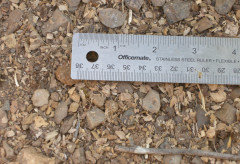
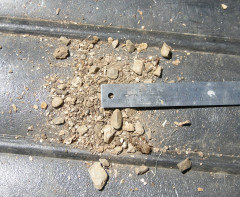
- last year
I'm kind of known for going off topic. : ) I get distracted easily.
I still think your best solution is soil building, not sifting. I did start this garden on fill, but it was 23 years ago and huge amounts of compost have been applied to it since then. I don't think your pictures are too discouraging.I'm glad to hear about your compost bins. I didn't know a polite way to bring it up..
central_valley
Original Authorlast yearI assure you, there's no need to worry about a polite way to bring up compost bins. I am not a delicate Victorian lady who would be shocked by the word compost. You do not even need to refer to a piano's limbs in my presence, or ask the location of the convenience when you need to go potty. (There! I even used a potty word! See how crude I am?)
- last year
My saints, yes!! You're terrible! I, myself, am somewhat refined---at least as it pertains to composting---never wanting to offend anyone's sensibilities.
My concern was about how to word the question.. I was going to say, "Do you have compost bins or are you a slaggard?' but I was afraid you might misread my tone.
You'll probably like it here, but you might want to work on your language, - last year
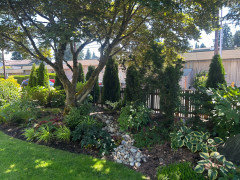
I’d mix in some of your compost and some topsoil and use that location to plant something that will be happy in the well-draining soil. I run into larger stones (golf ball size and larger) all the time in my garden, and just toss them into my growing dry creek bed. My neighbor donated a bunch of these, but that’s where my rocks go when not in the bottom of a container for added drainage. This area is in development but coming along nicely, rocky soil and all.
- last year
I’d mix in some of your compost and some topsoil and use that location to plant something that will be happy in the well-draining soil. I run into larger stones (golf ball size and larger) all the time in my garden, and just toss them into my growing dry creek bed. My neighbor donated a bunch of these, but that’s where my rocks go when not in the bottom of a container for added drainage.
central_valley
Original Authorlast yearlast modified: last yearAll the people telling me to add compost and plant things that like well-drained soil are probably giving me good advice. It goes against 75 years of ingrained thinking, though. (Well, maybe 67 years. It took me a few years to get interested in growing things.)
Maybe it's because I grew up in Chicago, on the edge of what used to be called the Great Plains. My gut instinct is that rocks in garden soil are Bad. When I'm planting things and I come across one, I pull it out.
The idea of adding compost to soil that is half dirt and half gravel and planting things in it is going to take a while to get used to.
- last year
I bet we all started out thinking that, but if you find yourself one day---as you have, and I did---with a very rocky bed, you resign yourself to picking out the most offensive ones and trying to plant in the rest. I promise you; I really do garden in a formidible amount of rocks and I can grow stuff. Although, after years of stunted, multi-rooted carrots, I did start sifting my carrot rows.
I was going to say that I didn't have theories about soil as young as you did, but I take it back. I had a Golden Book that I kifed from my cousin, Mark, I guess (because his name is inside the cover) that had an illustration of Bugs Bunny pulling carrots out of what looked like chocolate pudding. It's entirely possible that silky pudding soil sparked my early interest in gardening.
Do you have a truck? - last year
The soil type common to the Puget Sound area of the PNW is glacial till or exactly as the OP describes - approximately 50-50 actual soil (dirt) and rocks. Generally, it drains well, although some areas have more of a clay based soil component than others. In established gardens, the larger rock has been removed and mulching or compost provides additional aeration/pore space and necessary nutrients. We can grow just about anything here without too much concern other than providing sufficient irrigation in our dry summers. As stated, I would never bother to sift a garden soil and only concern myself with getting rid of the larger rocks.
Very few areas of the country have rock-free soil or a minimal, inconsequential rock content unless they have been heavily farmed or cultivated for decades.
central_valley
Original Authorlast year@annpat: No truck. The old pickup and the old sedan both died last fall, and I replaced them with an electric SUV. Not a vehicle I'd use for hauling compost, if that's what you had in mind. But I have a big pile of natural compost in the downhill garden, created this spring when I cleaned up the back patio after several years of neglect. It's easily enough to fill three pickup trucks.
You said that although you have learned to embrace rocky soil, you do sift it for carrots. That was my original question -- how do you sift it? I'm no longer dead set on sifting mine, but I still have no clue how to sift it fine enough for carrots, or for my conception of good garden soil.
In this particular area (just east of the house) I'm not inclined to plant anything edible. More likely I'll try to dig up the camellias that are growing halfway under the eaves and move them a few feet farther out.
I had a cousin Mark too, now deceased, I'm sorry to say. He didn't figure in my attraction to gardening, though. I probably got started by watching my father grow tomatoes and corn. I remember there was other stuff too, but don't remember what. Probably rhubarb. He liked rhubarb.
@gardengal48, I have "areas" of heavy clay too. I suspect that the heavy clay was my neighborhood's original soil, before all the grading and dumping that precedes homebuilding on hilly terrain. To prove it I have a two-foot-high pile of rock-hard "heavy clay" left by a construction project last year. Overall your soil and climate sound very similar to mine near Sacramento.- last year
You can sift soil using various methods, for example, chicken wire mesh affixed to a wooden frame would be affordable and effective. After you do a few wheelbarrows full, you might even decide to live with some of the smaller stones. 😊
central_valley
Original Authorlast yearJj J, I think you forgot what I said in the original post before you got to the end. (You did read the original post... didn't you?)
Of course I can sift soil with chicken wire mesh affixed to a wooden frame. I've been doing that for 30 years or more. But the finest chicken wire that's readily available is 1/4 inch mesh, and that simply doesn't do much for this mixture of half soil, half gravel. i explained this`. It catches a few bigger rocks, but the gravel goes right through.
I got a small roll of 1/8 inch mesh from Amazon at inordinate cost. I'm going to try that when the weather cools off.- last year
Let me repeat..........it is NOT worth the effort to attempt to sift 1/4" rocks or gravel from garden soil. You do not gain anything by it and it could conceivably adversely affect good drainage. Small rocks or gravel in garden soil provide aeration, especially in heavier soils, and contribute to good drainage.
- last year
I did, and with your 30 years of gardening experience, I’m sure you understand the benefit of good drainage that the small gravel can provide..
central_valley
Original Authorlast year@gardengal48 Yes, I certainly do gain something by attempting to sift 1/4 inch rocks or gravel from garden soil! I gain the knowledge of whether it works or not.
By now I'm inclined to agree that it's not worth the effort to sift a 3x3 foot section of ground (or more, if I go beyond the tree's location) past the depth that a spade will disturb. But the knowledge may be useful someday, and cannot be bad. This is not one of those things they talk about in horror movies... the things that Man was not meant to know.- last year
Does your new car have a trailer hitch? I guess you can sell the new car and get an electric truck, but I don't think that will be necessary if you have a hitch. Do you have a trailer?
A 3 x 3 section of rocky soil.? We need your address so we can come cuff your head! Wasting all that time for nothing when you could be installing your new hitch! central_valley
Original Authorlast yearlast modified: last yearNo hitch, although the old sedan had one. No trailer, and at this property, no place to park one.
I was speaking somewhat carelessly about a 3x3 section of rocky soil. It's a 3x3 section so thoroughly disturbed by stump grinding that the rocky soil has been churned up to the surface. I expect that the entire space in front of the house is the same, out to a distance of eight feet or so, but elsewhere it's concealed by a layer of heavy compacted topsoil. How thick a layer? I don't know; I've never tried to dig there. If I ever do, I'll need a pickaxe, not a shovel!
- last year
Hi,
I used Galvanized Steel Stucco Netting for sifting soil. It is sharp, be careful. I attached it to a 2'x2' wood frame, it is very handy. I'm not only sifting rocks by it , but shredding peat moss from my property, and rabbit manure, and etc.
The result of siffting/ shredding thru that mesh is very fluffy, fine particles. You could saw carrot in it, add to pot mix, or whatever you want to do according to your imagination.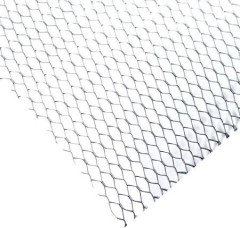
- last year
Hey c_v, do you have a septic tank with drain fields? That mix looks similar to drain tile. If it is, that opens a whole different can of compost.
central_valley
Original Authorlast yearstucco netting. Never thought of that. It's worth a try. I can get a piece for $18 at Home Depot. I'll put it on my list.
central_valley
Original Authorlast yearI got a chance to try out the 1/8 mesh hardware cloth today. I laid a piece cut to fit, loose, on top of my regular soil screen with 1/4 inch mesh. Somewhat to my surprise, it worked beautifully. What went through the screen was very nice looking somewhat coarse soil. What didn't go through was clearly all rock, with little or no clumped soil to break up.
As several people have pointed out, it's pointless to do this for the whole area I'd have to treat. It's a useful tool to have in my kit, though,
The stucco netting will go untried, since it couldn't be any better than what I've got.- last year
The worse part of sifting soil for me is all the worm debridement.
I hate to resort to this, cv, but exercising my seniority here, you are now forbidden from sifting soil. I thought we could deal with this reasonably, but you're a stubborn one. central_valley
Original Authorlast yearlast modified: last yearMy goodness, I never heard of worm debridement. I went right to Google and looked it up. I found:
«"While the term "worm debridement" is not standard medical terminology, it refers to maggot debridement therapy (MDT), a biosurgical procedure that uses disinfected fly larvae to clean non-healing wounds."»
This is either an attempt at humor that went completely awry, or a misuse of medical terminology to refer to hurting earthworms by disturbing the soil.
If you knew anything about Central Valley gardening, you'd never have written that. At this time of year air temperatures are in the 90s almost every day, and It probably hasn't rained since April. Where I haven't been watering, at least the top foot of soil is bone-dry to a depth of a couple of feet, so there are no earthworms. Egg casings, probably, but they'd be dried too, and so relatively resistant to damage.
As for soil sifting, it is one of my minor pleasures. I've reached an age where pleasures are starting to fail me, and I'm darned if I'm going to give this one up until my doctor tells me to.
central_valley
Original Author11 months ago" You sure do go off on tangents..."
Yeah, I have a tendency to believe what I read on whacky web sites like UK National Health Service and UCSF Department of Surgery. But that was what turned up when I Googled "worm debridement definition." Alas, I didn't find a single site that mentioned soil quality or earthworms.
The builders must have dumped a load of topsoil over the gravel, but they have gotten mixed together over time, and the top couple of inches seemed to be about half earth and half rock. But as I dug deeper in the hole where the tree was, less and less soil came through the screen. I wondered just how much soil I was getting. Now I have an answer.
I sifted a couple of screenloads of soil and weighed what went through the screen and what was left over. Result: 0.8 pounds soil, 22.6 pounds gravel and rock. It's 3.4% soil, 96.6% gravel/rock.
So you're actually right; except for the top couple of inches, I shouldn't sift it. If I want to improve it, and I'm not convinced it's worth the trouble, I should have it hauled away and replaced!central_valley
Original Author11 months agoMy plans: not sure yet.
My original plan was to transplant camellias there; they're currently growing in the same general area, but so close to the house that they hit the eaves when they grow high enough. I researched this and learned that camellia roots are rather shallow, so this should be feasible, although not easy.
The camellias must be growing in the same stuff now, so they shouldn't be any worse off, but... I think I'm going to solve the problem for the present by finding other problems that need to be solved first. Which won't be hard, in either the garden or the house itself.- 11 months ago
Yes! It's time for you to find out where your local leaf dump is, so you can go there and load your new trailer up. We have an annual contest here to see who can gather the most leaves and pumpkins for the compost pile each fall. (I always win, so it's kind of fun!)
central_valley
Original Author11 months agoWell, the local leaf dump is in one of my sanitary service's "organic waste" bins, which my landscaping service fills with leaves every couple of weeks. When the leaves start falling in earnest they will probably fill the bin every week for a while, and fill the second one that usually is left empty, too.
BTW, I moved several buckets of reclaimed potting soil today, and one bucket of soil that I sifted out of my gravel pit before I realized what it was. I didn't bother to weigh the a buckets, but I'd estimate that a bucket of potting soil weighed 15 pounds, and the bucket from the "gravel pit" weighed about 40 pounds. In other words: what wasn't coarse gravel stopped by the screen is fine gravel that went through the screen, laced with clay. Organic matter? In your dreams.
Yes, a tree grew in this stuff, but it was fully grown and its roots must have extended far below than any of this. And remember, it's dead now. :)
(Actually a wisteria killed it, not the horrid soil. My wife loved the wisteria and wouldn't let me cut it. Now that she's passed, the dead tree is gone and I'm fighting the wisteria.)central_valley
Original Author11 months agolast modified: 11 months agoYou're tapping a very large tank of memories!
We were both gardeners. I think she was a gardener from way back. I know I was... I bought my first house around 1979, not because I was starting a family or wanted an investment, but because I wanted a garden.
But we were very different kinds of gardeners. She only did container gardening, although it just occurred to me that that may have been because she had mobility issues the whole time I knew her, and used a walker most of the years we were together. She had a lot of flowering plants and plants that just look pretty. Allium. Some kind of fern whose name I forget. Jasmine. And fruit trees: peach, lemon, fig. She always wanted a cutting from a fig tree on the campus of Sierra Valley College, where she once took classes, but I felt uncomfortable about "stealing" a cutting from a tree on a campus where I had never been a student or a teacher, and I never got her one. She bought a fig seedling, which lives in a tub and isn't doing very well. I think it (and the peaches) need to go in the ground, but I haven't had time to deal with that yet.
There's a persimmon tree in the front yard, which I always pick about now. (See "Volunteer plant: discovery and mystery.") And a pear tree, which we always ignored because we didn't know how to ripen pears. This year I learned how to ripen pears, and also learned that I should have cleaned up the dead leaves last fall and sprayed the tree with sulfur before bud break this spring, to fight scab. Got to find time for that next year.
There's an apple tree that hasn't produced an apple in years, and a quince which produces masses of inedible fruit every year. I should dig both out, along some of the feral oak trees growing in the back of the garden, and plant some bearing fruit trees. Haven't had time yet.
I've always been a vegetable gardener. This year I'm growing tomatoes, eggplant, and peppers. Not enough time for more things. In the past I've grown peas and summer and winter squash, and at Kathy's urging, pumpkins.
I have grape vines which were planted by a previous owner, probably the original one. Some have died, and I need to replace them. Haven't found the time yet. And I need to learn to care for them properly. No time yet.
There are several olive trees on the property, which I believe are supposed to be ornamental, but which drop huge quantities of fruit each winter. Last year I collected a couple of quarts of undamaged fallen fruit and started curing it in salt water. I have always planned to take a few out at the end of September (four more days!) and see if they're ready. And I bought a fruit net to catch the fruit before it hits the ground, so this year I'll have enough olives to experiment with several ways of preparing them. And I'll have gallons and gallons and gallons of surplus olives to give away to anybody who wants them.
A few months ago I discovered that one of the tall skinny things in small pots is a bay tree. I had a bay tree at my second house in Oakland, and have regretted having to leave it ever since. And I've been watering this one for years without realizing what it was!
As soon as I finish getting ready for the estate sale, I'm going to do some serious gardening!
Oh, and I almost forgot... the feijoa! Can't forget the feijoa! It's also known as pineapple guava, and I think it's pretty unusual in America, although I understand that in New Zealand you can buy the fruit in supermarkets. It's a tall bush or a medium-size tree, as you prefer, that bears gorgeous flowers in the spring and clusters of green fruit in late fall. You scoop out the pulp and throw away the skin. They taste like... nothing else I've ever encountered. This isn't quite it, but I say they taste the way limes would taste if limes were sweet.
- 11 months ago
I now feel my life will not be complete if I'm never able to try pineapple guava.
feijoa:
Taste Profile- Fruit-like & Aromatic: The most common descriptions involve combinations of pineapple, guava, and strawberry.
- Floral & Rosy: Many people detect a floral or rosy, sweet aftertaste.
- Citrusy & Tart: You can also find hints of lemon or other citrusy flavors, along with a slight sourness, depending on the fruit's ripeness.
- Sweetness & Grit: The flavor is generally sweet, but some find the texture slightly gritty, particularly near the skin.
It sounds delicious. I wonder if I've ever seen the fruit sold here.
I had two misconceptions about you. I initially thought you were female and I thought you were new to gardening. Therefore, forget everything I ever said to you before (except the stuff I said about Klem) (and the stuff I said about sifting gravel).I hope you can get assistance with the estate sale. Everything sounds very overwhelming. I think you'll find some peace once you can get things addressed in an ordered way.
I love a good story and a little view into lives not mine. central_valley
Original Author11 months agoI wrote a long response yesterday, which appears to have disappeared into a black hole. I'll do my best to reconstruct it.
Many on-line nurseries sell feijoas in small pots for prices ranging from $30 to $150. You're supposed to grow it in zone 8-11, but I saw many posts by people who reported growing it successfully in colder climates.
I noticed one fruit vendor who was offering the fruit (in season, not now) for about $30/box. But when I went back to investigate, I couldn't find it.
If all else fails, you can book a vacation in New Zealand! I imagine a tour titled "Fruit Markets of the North Island": five nights, six ports, 29 markets.
The estate sale is going to be a problem. I'm getting the last bits in order, which is taking forever, because I'm scared about what will happen then. There are many estate sale companies that will take over the house when I move out, stage and perform the sale, clean up the remains, and turn it over to the real estate people. When I explain that I'm not moving out, they lose interest. They also seem unable to get their minds around my assertion that if I did move out, they wouldn't have room to unpack the stuff, much less stage it. My wife had trouble letting go of things. I've got stacks of boxes of stuff in almost every room of the house, and they fill most of the space up to the ceiling in the family room, parts of the living room, one of the two detached sheds, the workroom off the garage, and the fallout shelter (no kidding about that).
BTW, I mentioned an apple tree; I didn't mention that there are actually two of them: the one that used to produce small quantities of fruit, and the one that never did. Until this year; yesterday, while pursuing a fallen vegetable bag, I looked up and saw it offering me one somewhat dehydrated but otherwise perfect apple. It gives me hope for the future.- 11 months agolast modified: 11 months ago
I'm not quite clear whether you've got this estate sale organized or are still trying to do so. If the latter have you looked for decluttering services in your area? My SIL is also a hoarder and she's found someone who comes in and works with her, room by room, and finds the best way of disposing of items in return for a percentage of what she makes.
Regarding Feijoa, they're available here, though rarely seen. Mail order seems the most common way of finding one. - 11 months agolast modified: 11 months ago
Feijoa--I could grow it here if I overwintered it in my house.
I gather you have no family who are able to take things or help you?
I inherited thousands of dollars of postage stamps issued from 1970 on. The same people who left me the stamps also left me a lot of other odd stuff. I've decided to use the stamps to anonymously mail stuff to my cousins---like the hundred plus, hand-tatted handkerchiefs my great-aunts' patients expressed their gratitude with in the 1930s and 40s.
I took a native-dressed doll from Alaska---complete with seal skin coat---to a party once and left it in the host's guest room between the bed pillows. The host, my cousin, is herself native Alaskan, so who better to stick with it?
I go to a medical marijuana store that has a bench with a vintage suitcase placed beside it for decor. I'm always reminded of a train station. I thought, "If it were a real train station, though, it would have more suitcases," and now it does. I ended up with a very similar suitcase from the same era, so the next time I went to the store, I took my suitcase in with me and left it next to theirs. It was busy that day, so I left without explanation. About a year later, I asked if they noticed the suitcase I'd left. "Noticed it?!! We were petrified to open it!" I said, "Where is it?" and they said that their boss took it to his new recreational marijuana store next door for decoration there. I haven't gone back yet, but that sounds like two places that could use another vintage suitcase and maybe a hat box or two.
I filled my truck with stuff once when I was selling my mother's house and went to a restaurant where I'd become friends with two of the waitresses. I asked if they wanted to look at the stuff before I took it to Goodwill. They took it all.
I was in a restaurant once and noticed they were playing LPs. "Would you like a stack of albums as tall as I am?" Why, yes, they would, (although I'm sure they thought I was exaggerating.) They told me later that my Mothers of Invention album was issued in Germany and worth a little bit. Good enough!
I haven't done this yet, but I've thought about taking stuff to yard sales with a good price marked on them and just sliding them onto a card table.
Good luck. I'm thinking about renting a storage shed for the other handkerchiefs, the bisque figurines, the 6 foot tall statue of Venus, the other six hatboxes, etc.
central_valley
Original Author11 months agolast modified: 11 months agofloral_uk:
The estate sale is about 95% organized in the sense that I've discarded or recycled the junk, separated the things want to keep, sorted the remainder into labeled boxes ("Kitchen," "Housewares," "Electronics," etc.), and stacked the boxes so I can still live here. I will leave the job of staging (arranging everything for the delight of prospective buyers) to the professionals. Just where they will do that is an unanswered question.
I know that the services available for disposing of unwanted property are very different in Germany than in the U.S., and it sounds like the U.K. is very different, too. Here, when someone dies and their family don't want the stuff they owned (the estate), some responsible person often engages an estate sale company to dispose of it. Normally the house is unoccupied because the surviving partner, if any, has moved; the estate sale company spends several days arranging everything, assigning prices, and taking pictures which they post in ads for the sale. (See https://estatesales.net, for example.) They will sell everything from cars to individual pieces of clothing and pots and pans.
There are decluttering services here, but they aren't nearly as common. I haven't dealt with any, but I think they concentrate on helping people decide what they want to get rid of and deal with the emotions evoked by letting go. I imagine that some of them offer assistance in finding buyers for problem items like a collection of antique cigarette lighters or a life-size granite statue of a St. Bernard, but they won't deal with things at the pots-and-pans level.
annpat:
Feijoa--Mine is about 20 feet / 6 meters tall. I hate to think what size pot it would need. Moving it in and out would be problematic, and you'd need an atrium to put it in. I know there are several varieties, and perhaps some of them are small enough to bring inside. If you want to try it I'll be rooting for you, and the pun is fully intended.
Family--I have none that is physically or emotionally close. It sounds like yours is not only physically and emotionally close, but really interesting. I'm jealous.
I've thought about going the garage sale route: Set up card tables in the driveway each weekend, put stuff out there, and see what sells. A whole slew of things stops me. (1) Selling stuff to strangers all day is my idea of purgatory. (2) Watching for thieves all day is my idea of hell. (3) It would take many weekends to rotate everything through the sales, and I'd spend hours unpacking and repacking things, as well as attending to the sale itself. I probably wouldn't make enough profit to pay myself minimum wage. (4) Minimum wage or not, I'm 75 years old, and I don't want to spend that much of my remaining life unpacking boxes, moving stuff around, and standing by card tables. (5) An estate sale professional would know how to price things, and in particular, would know what is valuable. I don't have a clue. (6) I just don't wanna!



annpat