Software
Houzz Logo Print
chris_stillman

Kenmore Refrigerator Not cooling

12 months ago

Hello,

I have an old Kenmore model 253.67870503 (S/N BA61744447) that is not cooling at all. It's the "extra" of the house, so non-emergency here.

This is what I have done so far (not much). I cleaned the heck out of it. The coils in the back had to be cleaned up a bit. In my opinion not enough to cause anything other than inefficiency.

The fan immediately to the side of these coils turns on as soon as I power it up and seems to stay on. That's as far as I have gone. I have poked around this website, but the search feature isn't great so I am going to poke around a bit more here and elsewhere. If any of you have any suggestions, they can't hurt! However, skip the suggestions of trashing it or calling a repairman. This is kind of a hobby, no stress, and I've had some/read some negativity. All I know is this forum has been great to me for many years with the countless people who are helpful. Thanks to all of you.

Have a great day and Happy Labor Day.


Comments (30)

  • 12 months ago

    How bout compressor, does it "turns on soon as you power it up and stays on"?

  • 12 months ago

    Does the compressor run? The start relay may be bad if not. There is also a run capacitor on the compressor.

    Does the circulation fan run in the freezer section?

    Is there excess frost accumulation (failure to defrost, which impairs airflow, which impairs cooling)?

    You can find parts diagrams by searching the model at SearsPartsDirect.com

    The leading 253 on the model is code for Frigidaire as the manufacturer of it.

  • 12 months ago

    Thank you folks. I will check into all of that! Back soon I hope.

  • 12 months ago

    OK, more info, kinda...

    The compressor is a big topic. I really cannot tell if it is running but I don't think so. The manual you pointed me to says it may have a high-pitch hum or pulsating sound. Upon powering up the fridge the compressor has a slight vibration to it, but I can't tell if that's because of the fan a short distance away. Very slight. I can put a meter on it, but haven't. I don't know if I can reach in there with my probes. The manual doesn't show a start relay or a run cap. but I can probably identify those the next time I dig in.

    The fan in the freezer is running.

    There is no frost accumulation (things been powered down for weeks), doesn't cool in like an hour running.

  • 12 months ago

    You should be able to tell from vibration if compressor is running by putting a finger on either pipe 6" from compressor. Carful, if compressor is pumping one of pipes can be uncomfortably hot.


    Does manual show a defrost timer or do you see a clock/box ( behind toe kick cover)? Not all units have one but they can stall/stick which locks compressor out and/or turns heat strips on evaporator on. Move knob on defrost timer while listening for compressor to start..

  • 12 months ago

    The compressor start relay (#30, P/N 216954235) and run capacitor (#55, P/N 297286803) are shown on the System diagram.

    The defrost timer (#23, P/N 215846602) is inside the control housing which is mounted to the ceiling of the fresh food compartment, shown on the Shelves diagram. There may be a hole through which the timer can be turned with a screwdriver or some such without pulling down the housing. Turning it fully around should garner two clicks close together in the rotation ... one when defrost begins, another when defrost ends (they're typically spaced 20 to 25 mins apart).

  • 12 months ago

    Use your phone/camera or a hand mirror to examine the control housing to find the access for manually turning the timer.

  • 12 months ago
    last modified: 12 months ago


    Hey guys,

    If I haven't said lately, you guys rock.

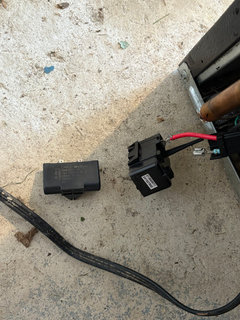
    OK, so I think this is the compressor start relay and run capacitor, and I am 99% sure this compressor is not running. None of the pipes on it are even remotely warm. So I am hoping one of these is bad, that I can change. The compressor is above my pay grade as a DIY.

    There is 120VAC coming into the blue/red wires, and where it plugs into the compressor (when they were together) there is nothing. I checked all three terminals with respect to one another and there is zero; AC or DC voltage. I also checked when I removed the cap, 120 IN and nothing out. Cap's I can't see failing unless they are blown up.

    Thoughts? I'm fired up. :-) but I tend to get ahead of myself.

  • 12 months ago

    Hello again, and thank you again for your posting.

    I’m sorry iI didn’t do anything with the defrost timer. I saw the starter assembly/Cap. and spent some time on that.

    So with the cap totally removed from everything there is no life to it. I set my meter up for current and across the two terminals was nothing. I then took a screwdriver across the two terminals and no life there either.

    If there was 120volts to this assembly and nothing on the output pins, doesn’t that tell us that this starter thing isn’t working? I’m thinking if the timer was the issue it would shut off the 120v to this assembly, no? That said I honestly don’t know, just throwing it out there.


  • 12 months ago

    Capacitors are tested either in resistance mode as I described, or in the specific/dedicated uF/capacitance mode with a meter that has it. Shorting across the terminal with a screwdriver or other such method is to ensure any stored charge is drained to avoid a shock when handling it.

  • 11 months ago

    Gotcha. Yeah my multimeter doesn't have anything to do with capacitance. So I ordered the starter device so I will circle back with you after I try it.

    THANK YOU!


  • 11 months ago

    Have you checked wires where they connect to compressor to make sure they are intact and secure?

  • 11 months ago

    Hello Klem1, and Thank you for the post!

    I think so. What I did before and after the CAP was connected to the starter was to check the 120V input to the starter. The wires were definitely clipped in there tightly.

  • 11 months ago

    Be carful with the cap, they've been known to give a feller a new hair-doo.

  • 11 months ago

    Gotcha! Thank you, I'll be careful!

  • 11 months ago

    OK Guys, I'm back with an update.

    So I put a new cap and starter combo in there. I mean it's not like a light bulb you just know it's working or not, so hard to tell. This is what I experienced with the new parts......first, there seems to be electricity on the copper tubing connected to the compressor, that is crazy. I put a meter on it and it read 0, but boy this seems like AC power! I kept the power on for maybe two minutes. The compressor turned on for like ten seconds, to me it seemed like it was trying to start but couldn't. Bear in mind I have no experience in this, so really I don't know what to look/listen for.

    So that's my update, any ideas? I'm hoping you guys are going to say it sounds like it is fixed, keep it plugged in. LOL, my instincts tell me otherwise.

  • 11 months ago

    Please clarify what you mean by "there seems to be electricity on the copper tubing connected to the compressor".


    There's a way to prove or disprove that tubing has current flowing through it ,,,BUT,,,,it's dangerous unless you TOTALLY UNDERSTAND WHAT YOU ARE DOING.

  • 11 months ago

    Hello and thank you for the note.

    I know the feel of AC current mainly be cause I’m too lazy to turn breakers off when I change a switch or outlet.

    I don’t say this with pride. What I feel on the tubing off the compressor seems extremely similar.

    Should the compressor stay on?

    I don’t want to do anything real dangerous but let me judge. I’m not going to mess with the compressor, I’ve already decided if I can prove the compressor is bad I’m done or would pay someone if it’s affordable.

    Electricity is not a problem, often in troubleshooting I run AC power to a suspected bad part to see if it runs (pumps from dishwashers for e xame),


  • 11 months ago

    PS I have a multimeter!

  • 11 months ago

    Ok I won't belabor it and "let you be the judge of what's dangerous".

  • 11 months ago

    Ok Klem.

    I still am at a stand still need your guys help!

    Throw be what you were thinking about. I’m sure it will be fine. I know my limitations 😊.

    So here is where I’m at;

    * Refrigerator not cooling

    * Replaced capacitor and starter

    * Compressor turns on but doesn’y stay on, should it stay on?

    * I did not let it run since I assumed the compressor should turn on and stay on.

    * Before the new cap and starter the compressor didn’t turn on at all.

  • 11 months ago

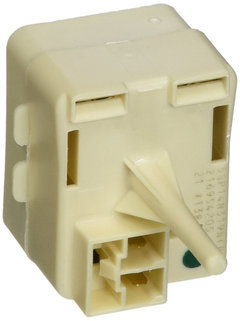
    I never saw a typical home refrigerator with a capacitor and odd to have one so had to look at the wiring diagram and schematic for your model. Yep, no capacitor and what you replaced was the motor starter with a built in overload protection device and looked like this, correct?


    The plug going into this controller has a Red wire, Green/yellow wire and a Light blue wire. Correct? The Red is power going into the controller, the Green/yellow wire is ground and the light blue wire is neutral.

    With the refrigerator powered on put you voltage meter across the Red wire (hot) and the Green/yellow wire (ground) and if you have 120 volts on the meter the POWER is getting to the compressor and should be running. If there isn't 120 volts running to the red wire the power is being turned off by the defrost controller or the cold control switch. There is nothing else with exception to a broken (open) wire that would prevent power from getting to the compressor controller.

    If there is power on the red wire the issue will be a bad compressor controller, a bad compressor motor, or the Light blue wire (neutral) broken or disconnected someplace in the unit and rare. It could be a corroded wire terminal.

    Since you replaced the compressor controller, It is probably the motor winding inside the compressor drawing to much amperage causing the overload protection device device (OLP) in the controller to disconnect power.

    The overload device is triggered to open when high current causes a high temperature that disconnects the power based on heat. When it cools down it will try again...and again continuously. It will take a few minutes or more to cool down between tries. A tech would clamp the red wire with an Amperage meter and wait for the overload device to cool and monitor the amperage. If it spiked well above the full load amperage listed on the compressor information plate the diagnosis would be verified and complete with the customer getting a quote for a new compressor.

  • 11 months ago


    Hi Kevin and Thank you. I think you are spot on, what you are describing makes sense. The photo here is what I replaced, so yes the device you provided along with what I thought was the capacitor. What I bought was labelled a capacitor from the part depot on line. Ah, whatever, I hope that's not critical.

    Other than that this model just a tad different than what you described in that there are only two wires plugging into this, in fact you can see where they go on both of our pictures. There is a constant 120V there.

    So 120V there, compressor not kicking on, these parts are new, seems the compressor is bad, correct? I think that's above my DIY paygrade in that I am not messing with freon. Remove and replace I can do, I can even solder pipes, but I don't think I want to get into soldering around where if there is a leak later it's freon. I don't want my dog to turn into a gargoyle. :-)

    Any further thoughts? I hate to give up!

  • 11 months ago

    No capacitor? This item is referenced on the System diagram at SearsParts for model 253.67870503. Also at PartsDr. Do they both have it wrong? Frigidaire Run Capacitor P/N 218909915 (substitutes to P/N 297286803)

    This item is also referenced. Start Device P/N 241527802 (substitutes to P/N 216954235)

    It does seems the compressor may be shorted to ground. Replacing a compressor isn't a job for a DIYer not trained/skilled in handling refrigerants (recover the refrigerant; cut or detach the lines; remove the compressor; set-in the new compressor, the refrigerant drier-filter might should also be replaced; seal/braze the refrigerant lines to it; vacuum moisture out of the system; restore the refrigerant, assuming it isn't contaminated and requires fresh).

  • 11 months ago
    last modified: 11 months ago

    Cris it's time to put the plug in the jug for this project and give fridge to the neighborhood scrap hauler. Kevin9408 did an outstanding job of parroting what he found on Google Search but unfortunately doesn't understand what he read and quoted.. Dadoes is correct, there is indeed a capacitor in start kit but that isn't the problem here. The compressor has "gone to ground" as professionals would say. I don't intend to abandon you but you will be better off picking up a free fridge off the curb and working your way through diagnosis of why it doesn't cool;.

  • 11 months ago

    Klem, 100% respect that, thank you. I gave it a good try, check that, we gave it a good try.

    Thank you all for all of the support you have provided.

    My next area of research is where to dump this thing, ha-ha.

    Thanks again guys, all the best to you.


  • 11 months ago

    Well it does appear there is a capacitor but it's not shown on the wiring diagram or the schematic and they inconveniently omitted the compressor wiring components. I work off of schematics and wiring diagrams exclusively to troubleshoot problems if available to save time and expense over shooting the parts cannon at a machine.

    Now Chris has a junk refrigerator and about $50 worth of useless parts sitting around, not exactly a win in anyone's book. Once a problem is narrowed down to a component it must be verified and what will determine the difference between a shotgun shade tree mechanic and a good mechanic.

    Chris, to expand your own troubleshooting skills verify the compressor winding is bad with your ohmmeter. Pull off the start device on the compressor, take your ohmmeter and connect one lead to the compressor case and touch the other lead to each of the three pins on the compressor to see if there is a short to ground. If there is continuity across any pin and the case you have a verified short to ground.

    If there isn't continuity to ground then the start and run windings need verified as good or bad, Use your ohm meter and measure resistance between the run and common, then start and common and finally start and run. The two lower ohm measurements should add up to the highest ohm measurements which is across run and and start. if they don't add up there is a open winding or a short between windings and verified. I do not assume without verifying.


  • 11 months ago

    Everybody be nice now! :-)

    I can do that. Thank you. I can also return the parts that I bought :-).

    I'm in no rush so I will ohm those out and let you know.

    Thanks to all you guys.

  • 11 months ago

    Hey guys, so it seems the compressor is cooked. With respect to the case of the compressor (after I scratched the paint) and the three pins on the compressor; the three readings are; 2/11/5 ohms.

    I also measured between the pins on the compressor and the readings are all low. I didn’t record them because at this point I didn’t think it mattered.