

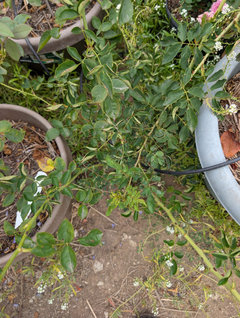
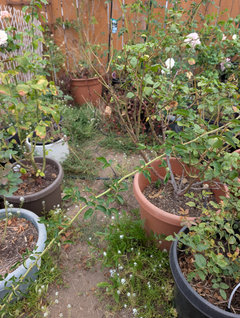
Any idea what this rose is?
I have many roses in pots and now I have a rose growing straight up from the ground and wondering what rose it is. I googled Dr. Huey and I think it looks like it could be that rose. Weird since most of the roses in that area I thought were on their own root.
Comments (28)
 11 months ago
I think you nailed it. That certainly does resemble the immortal Dr. Huey. His roots can lie dormant in the ground seemingly forever until something triggers it into growth. Often, it appears the only way to rid yourself of it is "Vitamin R" (Round Up), though that may not be a great idea as that sucker may well be attached to an existing rose in the garden instead of being a remnant of something long removed. It isn't uncommon for his roots to show up elsewhere in a garden, especially when the watering has been shallow or something damages it. Digging in the area to either remove other roses or to plant companion plants can easily result in Huey sprouts. You will also often see forests of Huey in rose gardens in Southern California due to "gardeners" creating "dust mulches" by "cultivating" around the roses with a hoe.
Related Professionals
Hartford Landscape Architects & Landscape Designers · Leamington Landscape Architects & Landscape Designers · El Paso Landscape Contractors · Monroe Custom Countertops · Taunton Landscape Architects & Landscape Designers · Manhattan Landscape Architects & Landscape Designers · Youngstown Landscape Architects & Landscape Designers · Albany Landscape Contractors · Coos Bay Landscape Contractors · Rolla Home Builders · New York City Home Builders · Williamsport Landscape Architects & Landscape Designers · Santa Rosa Landscape Architects & Landscape Designers · Rocky Mount Landscape Contractors · Houma Home Builders- 11 months ago
What a horror story of a rose, at least where it likes the climate. Here, it took us over 10 years to get rid of one which came up over and over after we removed the more harmless scion. I had no idea it lurks in the soil, and can spread all over and turn into "forests". We do see areas here in neglected gardens where every other rose is a surviving Dr. Huey. They get horrible mildew here and look awful. I can't believe that rose hybridizers and commercial nurseries are still using it as rootstock! It is, indeed "vigorous", but so are many invasive thug plants.
Jackie  11 months ago
@roseseek, wow! I hadn't heard that Huey was causing such turmoil in California, it sounds like it nearly qualifies as an invasive weed. It seems like you are describing shallow cultivation that triggers suckers, is that what you're saying? I do have a Huey that just sprung back to life after a couple of years. I've also noticed that I can easily propagate American Pillar (another wichurana) simply by digging (and presumably nicking) the roots.
Z10Socal
Original Author11 months agoOkay, I'm going to dig out the bad doctor then. Thank you for the confirmation it was him.
- 11 months ago
@roseseek we see a lot of Huey here in Oregon too, but only where it's been planted, no "forests." I don't see it suckering or turning into a thicket in our climate, so it's alarming to hear that it does this in yours.
I was actually referring to "shallow cultivation" not "shallow irrigation" - the dust mulches you describe causing the forests. I assume this is damaging the roots (which are close to the surface due to the shallow irrigation) and causing the suckering? Do you have a source for photos of this? I'm curious to know what this looks like, but I don't see any examples on HMF.
This whole "lurks in the soil and creates forests" thing might give me nightmares, ha ha! - 11 months ago
@ElfRosa yes, the "dust mulch" cultivation breaks the feeder roots which grow only a few inches under the soil surface and each broken root not only produces at least one new Huey shoot, but also provides perfect entry wounds for crown gall bacterium. Damaging or breaking feeder roots can easily cause both issues, which I why I personally don't encourage "companion plantings" other than possibly shallow rooted annuals which can be planted by seed and easily pulled up at the end of their cycles. I haven't any photos of the "forests" of Huey suckers, mainly because I hadn't a camera with me when I'd encounter them on garden consultations. Imagine roses spaced in a bed with numerous Huey shoots growing out of the ground around the drip zones of the plants. All because some "landscraper" decided it was better for his bottom line to turn a "gardener" loose in the rose beds with a bloody hoe rather than hand pulling weeds and putting down an organic mulch.
- 11 months ago
Roseseek, thanks for the history; it's interesting!
There's so much room for bad things to happen when practices suitable for the vegetable garden are applied to the ornamentals. Hoeing around roses, my goodness. Broadly speaking, I dislike any kind of soil disturbance, except for digging planting holes, a necessary evil given how awful our soil is. And digging out Bermuda grass, though even there, I've just been cutting and pulling our flourishing population of this dreadful weed. Oh, yes, and Johnson grass, which fortunately isn't widespread. Mainly I look on roots of annual or biennial plants as organic matter added to the soil that I haven't had to put there.
- 11 months ago
@roseseek that's interesting, thank you. I'll be keeping an eye out for photos of what this might look like, as I've never seen Huey sucker beyond the original planting space in my climate. Our climate is changing, and is becoming more like yours, so I guess I should start looking for this kind of thing.
I use hoes extensively in my garden. The only time I've encountered any surface root is with my giant wichuranas (the American Pillar example). I've actually tried to get Paul's Himalayan Musk to sucker in the same manner, but it absolutely won't seem to do it. Most rose roots grow straight down here - perhaps that's due to the climate, the soil, or because of my watering habits.
Your comments about landscapers, hoes and broken roots/crown gall also make me wonder about the spread of RRD among landscape roses.
This also leads me to wonder if it's irresponsible to continue to use Huey as a rootstock. I can't quite picture how much of a nuisance it has become in your state, since I haven't seen what you describe here. Are we irresponsible to even purchase roses grafted to Huey at this point, at least in some climates? I say this not in judgement of anyone here, while most of my garden is own root and mostly ramblers/hybrid musk/OGRs, I do have quite a few grafted hybrid teas.  11 months ago
Z10SoCal -- Generally speaking, IMHO, you're right about own-root. There are, though, some roses that just don't perform on their own roots. For those, you must just use plants budded to rootstock -- but there ARE other rootstocks.
- 11 months ago
Depth of soil and watering habits play a large part in whether roots penetrate deeply or remain close to the surface. Jeri wrote "there are other stocks", and that's true. Fortuniana is a decent one where it is suited. Fortuniana's roots remain high in the soil naturally, which is what makes it "nematode resistant". Its roots usually don't grow down to the level root knot nematodes inhabit, so it "resists" them. Yes, it's vigorous but that shallow root system also makes it more susceptible to freezes which penetrate the ground, AND mechanical damage from digging in the soil. No, it is NOT resistant to crown gall. Ask me how I know...
Jeri also wrote that not all roses grow well own root and that's completely true. I'd add that while a specific rose will grow well own root in one climate and/or soil type, it won't grow well own root everwhere. We have stocks not only to provide efficient and cost effective methods of mass producing plants, but also because the stocks generally grow well, if not better, in more places, soil types, climates than many cultivars. That extra vigor can be the make or break factor in challenging climates where own root may not have enough "oomph" to make it. Stocks have made it possible for growers to enjoy all of the weak, begruding growing, nasty plants whose "pretty faces" have made them market darlings for the past century-plus. We are to blame for all the ills of root stocks because WE MUST have all the pretty faces any and everyone shows images of and/or otherwise promote, whether they are healthy, easy to grow or grow well enough where we are. Too many are just terrible plants, many even as budded specimen. MANY locations have disease pressures which require chemical intervention and MANY roses aren't healthy own root. The extra strength of a suitable stock for the climate and soil help reduce the disease issues. Jeri lamented she loved Eugene de Beauharnais but it rusted terribly in her climate. The one I budded on Fortuniana and brought her DOES grow for her without rust. The extra strength and vigor of better roots, roots more suited to her soil and water, supported its natural immune system to allow it to resist the fungus.
Might it be irresponsible to continue using Huey for production? It's better suited to a greater swath of the United States than any of our other commercially used stocks. It permits what's left of our rose industry to produce what they push out each year. If they didn't bud on Huey, what would be the alternative? Huey does better in more soils and climates than multiflora and Fortuniana. It is much less susceptible to chlorosis in alkalinity than multiflora. It is much more freeze hardy than Fortuniana. Its roots grow deeper into soils than Fortuniana to hellp provide that greater freeze protection as well as being better suited to diving deeper to find deeper water than Fortuniana. Budding is a significantly more efficient method of production than rooting. A budded plant requires one growth bud from the mother plant and that bud CAN be removed from the parent without removing any stems. Of course, in production, stems are cut for bud wood and stored for use when stock condition is suitable. A bud stick might provide enough buds to produce five or six plants. That same bud stick, when used as a cutting, may only produce one or two own root plants.
We could eliminiate Huey, and all the other stocks, but that would seriously reduce the choice you have. Which is worse? - 11 months ago
@roseseek So when push comes to shove, Huey is perhaps not so bad? Yet your descriptions of the Huey forests and its ability to spread disease is truly alarming. I haven't spent time in California and haven't seen these things, but it almost sounds like it could be rising to the level of a noxious weed.
Fortuniana is not an option in the PNW climate due to its low tolerance for wet soils, poor draining and flooding. And Huey is not spreading/naturalizing here in the way you describe - at least not yet. Perhaps it's just some climates that should be discontinuing the use of Huey? - 11 months ago
@ElfRosa unfortunately, or rather, predictably, the climates in which Huey is immortal are those for which it is perfectly suited and the best alternative. I've grown Huey based budded plants for decades without any sucker problems, but I never "cultivate", nor do I promote digging in the root zones. Nope, Huey is not so bad and literally provides the opportunity for many to grow many types otherwise unsuited for where they are. It isn't any worse at spreading disease than any other rose. It's simply the fact there are so many of them that makes it seem as if it's a "Typhoid Mary". The spread of virus has been blamed on it, but if it wasn't Huey used as the universal stock, it would have been whatever else was being used instead. It wasn't Huey's fault, but that of the stupid propagation methods American producers chose to use in their push for "efficiency" and "cost savings". The standard for European production has been to use seedling stocks. We decided it was more cost effective to root this year's crop of stocks, bud the scions of the roses to be produced on them, probably infecting the stocks with infected scion material, then cross contaminate next year's crop by removing the tops of the budded stocks to root for next year's roots. That's how so many became infected with multiple virus types. This year's plant has RMV so next year's roots have it. The scion inserted in to the RMV infected roots carried PRNS so the resulting plant had RMV +PRNS and the stocks produced from rooting the tops of those plants also carried that combination so the next generation of roots from those tops passed them on to all the new budded plants produced from them. Huey happened to be the stock in use but it was the method at fault and not the stock. We'd been passing the viruses from one generation to the next for over half a century before any American producer actually paid attention. Jack Harkness wrote in his book, "Roses", in 1977 the US producers spread it around and when the Europeans complained, one major producer quipped he thought the virus added a "decorative quality" to the plants.
The traits which make so many hate Huey are precisely those which make it such a worthwhile commercial stock The vast majority of problems are usually due to bad cultural practices, whether by the producers who don't always properly de bud the stocks; the buyers who don't always plant properly; or those who maintain the plants who do stupid things such as "dust mulches". - 11 months ago
@roseseek, I know all this is true, but what to do about the Huey forests? The spread is the scary piece of this, IMO, but I can't picture the extent of it.
- 11 months ago
- @ElfRosa the Huey shoots rise from broken roots. Each one develops into a full sized plant if allowed. In those beds, you dig out what you can, but you know how immortal that plant is. Eventually, Round Up can take care of what refuses to die by shovel. It isn't like invasive thistle where it covers vast areas. It's confined to the root zone of the plant whose roots were broken by hoeing around them. I termed it "forests" because at its worst, I've seen a struggling original plant in the middle of straight shoots rising from often both ends of the broken roots. That feeder root system is the digestive tract of the original budded plant. Each time roots are severed, it reduces the ability of the original plant to search out and collect nutrients and water. After being hoed multiple times in a season, you can imagine the damage done to that root system. The original plants begin dwindling and the suckers continue maturing, even after being pruned off. You know how Huey suckers respond to pruning...it's a challenge and they are determined to WIN.
- 11 months ago
@roseseek it sounds like it's forming thickets, which is not dissimilar to spreading via runners. The closest example is multiflora, I suppose. Huey seems less likely to spread via seed, but it does seem to form some hips.
- 11 months ago
As a point of interest, the dominant rose stock in Italy is 'Laxa', a low-thorn form or close relative of R. canina. I suppose that it's suited to European conditions but not to U.S. ones, or hybridizers for the American market would be using it. Kim, is it ever used in the U.S.?
- 11 months ago
Laxa has been used in the US. Melissa, but not to a large extent. Historically, MANY things have been used. I've never found any sort of definitive listing, just odds and ends here and there over the years such as this.
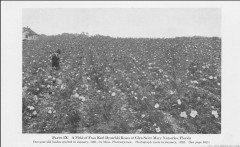
" 1922 American Rose Annual, A field of Frau Karl Druschki roses at Glen St. Mary's Nurseries, Florida. One-year-old bushes grafted in January, 1921, on Mme. Plantier stock. Photograph made January, 1922. From page 162, "Frau Kark Druschki by the Acre. The returns from our members show that "Druschki" is the most popular Hybrid Perpetual rose all over America. A new source of production appears in Florida, where roses are grown to remarkable vigor in a short time. Plate IX, facing page 73 (this image), shows a field of this great rose growing in January, 1922, at Glen St. Mary, Fla. Concerning it, Mr. Hume writes that the bloom was rather past when the photographer visited him! "
In Mrs. Foote's Rose Garden, way back "between the Wars", Mrs. Harriet Foote took it upon herself to import and grow MANY types of roses in hopes of weeding out all the terrible ones unworthy of being grown in the US. I remember statements about standards budded on Rugosa stems which ate gardens. Her rose book is WELL worth obtaining and a marvelous read. https://www.horthistoria.com/musings/musings_musings/musings_musings_mrs_footes_rose_book/ - 11 months ago
Mmmm, thanks. I had actually read somewhere about 'Mme. Plantier' being used as a rootstock, possibly specifically in Florida.
It's a great rose, incidentally. I had a massive plant of it by the front door of my house in Washington state; the first time it bloomed, I thought a miracle had occurred. I got hold of a plant of it here, too, and it's alive but has never thriven. Clearly not well adapted to our heavy poor clay soil and dry summers.
 11 months ago
Wow Kim- thanks for this wonderful tutorial of the history and impact of various rootstocks! I found this very informative and eye-opening, and a tribute to your wealth of knowledge. To clarify my own learning though, what's PRNS? I know that RMV is rose mosaic virus, which results in leaf discoloration and overall weakness of the plant but isn't invasive in the sense of Rose Rosette Disease (RRD). Do I also need to watch for PRNS?
Many thanks for your expertise.
Cynthia
- 11 months ago
@Melissa Northern Italy zone 8 you're welcome. I should add, I rooted a 4' whip of Cardinal Hume and budded four buds of Baby Faurax on it back in 1994. All four succeeded and it was wonderful! Hume was one of the few really dark "purple" roses which suffered no chlorosis in the mid California desert. Baby Faurax would frequently be chartreuse with lavender to white flowers but not on that whip of Hume! Plus, as it was an import directly from Harkness, when I had it virus indexed, it tested clean. And, the one time I was sent a plant of Hulthemia, not one of the modern "blotchers" but Hulthemia itself, it was budded to a rooted stem of Silver Moon. Why not? Wichurana climber producing yards of growth a season, perfect stock! The Silver Moon lasted, the Hulthemia didn't, but neither did the seedling my friends had germinated from the seeds which "appeared" in their mail box. And, Bill Grant, one of the California Old Roses from long ago, had early Hortico Austin roses which threw suckers of BRIDE'S DREAM. Hortico swore they never used it as a root stock, but I saw his Austins with those trees of Bride's Dream growing from under them. In Southern California, Bride's Dream was a real "Jack and the Beanstalk" plant. MASSIVE with HUGE flowers.
@nippstress - zone 5 Nebraska thank you! I'm glad you enjoyed it. Don't worry about PNRS. You probably had it in your garden for years and either never saw symptoms or thought it was simply Rose Mosaic. PNRS is Prunus Necrotic Ring Spot Virus. Google reports: " Prunus necrotic ringspot virus (PNRSV) causes rose mosaic virus disease, characterized by symptoms on rose leaves such as yellow or white lines, rings, mosaic patterns, and oak-leaf patterns. Other symptoms include leaf puckering, general yellowing, reduced flower production, and increased sensitivity to frost. Symptoms can vary depending on the rose cultivar, virus complex, and environmental conditions, but they are often more visible in the spring and can lead to decreased plant vigor." Those who test for viruses will specify what was found but all of us generally see the standard mosaic patterns and figure it's all RMV. From your experience, RRD is what you need to watch out for. The others are nothing in comparison. - 11 months ago
Kim, your stories are very entertaining; thanks for sharing them! It sounds like in your work you've had a lot of fun. You also have aroused my lust for 'Silver Moon' and--why not--'Dr. Huey', which is not ubiquitous here as it is in the U.S. The Wichurianas tend to do quite well in my garden, and I love them in return.
I have one pale and struggling plant of 'Rose Marie Viaud', a graying purple Multiflora rambler that would be charming if I could find a spot where it was happy. No doing, though it's alive. At least, for purple, there are all the Gallicas and their hybrids, giving me my hues of grape, lavander, and mauve.
- 11 months ago
Thank you, Melissa. I'm glad you've enjoyed them. Silver Moon is a wonderful thing. My maternal grandfather brought my grandmother a bouquet of their flowers from his friend's plant and she loved them. They lived in Birmingham, Alabama, in town and he raised chickens and rabbits to trade with his friend for food during the Depression. He had to trade with his friend because with three small daughters, you could NOT eat your own animals as they were always pets. He rooted Silver Moon to grow on a wire fence to shield his animal cages from the street. It grew toward the sun, creating a shady place for my mother and aunts to play when they were little. He was killed in an freak shooting accident when my mother was 5, back in 1935. She remembered they always took a bouquet of Silver Moon to his grave every Father's Day. That's what began my quest for Silver Moon. I grew it as a huge free standing mountain in the old Newhall garden. Give it room or it will TAKE it. If you're fortunate enough to have a year where spring is long, before the summer heat hits, or the heat is interrupted by a period of cool before the heat comes back, Silver Moon can appear to "repeat", though it's just confused by the change in weather. It would make a splendid "security" plant, grown on a fence. NOTHING is coming through it!
- 11 months ago
Thanks Kim for the additional information and fun discussion about rootstocks and diseases. Sounds like PNRS and RMV are inevitable if I buy some varieties from some vendors, but even in cold zones like mine they're not usually enough to weaken the rose so it doesn't survive the winter. I just put up with it or avoid buying from those vendors when possible.
You're right that it's not the scourge Rose Rosette Disease is. I had 3 roses I dug out this fall from sure RRD and another 9 or so where I cut back a cane affected at the tips but not yet systemic that I'm watching. StillAnn had said that it's possible to catch RRD that way if it hasn't yet traveled down the plant so I'm giving it a cautious try. As you and others have said, RRD is just something you have to stay vigilant about in susceptible zones of the country like mine. It's still worth it to grow roses and I appreciate the challenge as well as the beauty involved.
Cynthia
- 11 months ago
You're welcome, Cynthia. Hopefully, these days, you're most likely to receive virused stock from own root producers of older varieties at lower prices or cheap budded plants. Obtaining indexed stock from UC Davis or other sources isn't cheap, and, once received, may take a number of seasons before it's available in the quantities required for production. Think back to the Vintage Big Catalog. They listed the sources of their material, which pretty much clued you into the potential for infection. The only ones you could place any faith in the cleanliness of the stock were UC Davis or Dr. Manners. At least they provided those clues. I'd bet any of the cheaper bare root budded plants obtained from grocery stores, big box stores, etc. are very likely infected. There is really no motivation for those kinds of mass producers to do anything to eliminate it from their stock as production is focused on costs for price points.









roseseek