Software
Houzz Logo Print
logan_kellogg50

Help with Painting Skimcoated Walls

11 months ago

Hi All,
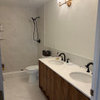
This last Monday, had my two bathrooms skim coated and textured by a local drywall guy. I gave the skim coat a full 48 hours to dry per his instructions.
I then, through my own negligence, began applying Behr Marquee paint on the walls. One bathroom rolled on really well with hardly any issue...the other bathroom, immediately into painting, had a small handful of sections of texture and skimcoat lift up onto the roller. Please take it easy on me, as I'm feeling bad enough about this already, but the gentleman came out and repaired the lifted spots free of charge, and had said ideally its best to SPRAY on primer and color of a renovation type skimcoat, as the rollers can lift the mud layer due to the stickiness of the paint.
I'd say approximately 70% of the bathroom wall areas have the Behr paint on the walls, and look good...I've completely stopped now that he'd repaired my lifted spots, to plan out my next steps.
He said that I wouldn't have to worry about the parts of the wall that had already accepted the Behr paint (Is this true?). He then said if I didn't want to spray the paint, that I should instead use a brush.
I'm absolutely mortified of doing anymore painting for fear of chunks continuing to lift with my brush strokes. I spent quite a bit of money on this job, and don't have the financial means to redo it.
So, question for you all, is he right in that the lifting of the mud layer isn't likely to be an issue moving forward on the already painted sections of wall? And my second question...do I need to be applying a PVA sealer over everything that's already got paint on it, and then REAPPLY my Behr paint on top of that?
Thanks for your time and input.

Comments (7)

  • 11 months ago

    You should have used a good bonding sealing primer on the walls before painting. I wouldnt worry about the ones you didnt. Just be thankful, you didnt mess up both bathrooms. I might be tempted though, to wait a week, and put a coat of bonding sealing primer on it too, and then repaint it once the primer is dry.

  • 11 months ago

    Thanks for your feedback. I assume that the areas that lifted (while rolling) could be a direct result of not having used a standalone primer?


    There are a few parts of the already painted walls that need a very light once over. I plan to do those areas gently with a brush.


  • 11 months ago

    Wait for the skim coat to be good and dry, then prime with Zinsser Gardz. It is clear and you may wonder why you bothered when you don't see any difference after applying it, but it is the best sealing primer and will keep all the flashing and burnish marks from appearing. Apply over everything,


    Photo from a painter on Paint Talk showing 2 walls - top with one coat of paint only

    bottom 1 coat of paint over gardz.


  • 11 months ago
    last modified: 11 months ago

    I've seen recommendations even for smaller drywall repairs that the best result is to use a primer before touch up paint on the repair.

    My sister decided to paint some of her ceiling in her home before putting it up for sale. The ceiling is popcorn, but at least a lighter coat of popcorn. She went to the paint store and asked for recommendations on how to paint, what to use. She was afraid that in the process of painting she would get spots that the popcorn comes off and end up with a mess. It was recommended to use a oil based primer. The reason for that is the acrylic is water based and the moisture from acrylic would be absorbed by the popcorn and loosen it. The oil based would not be absorbed but would coat. I've heard good things about Kiltz primer but don't personally know.

    With all the work you had done I would pay the extra money and go to a paint store (like Sherwin Williams or other) and get recommendations from a place more knowledgeable.

  • 11 months ago

    Oh, and by the way, you do not need to use a brush. Sheetrock mud that was used to skim and texture, is water based. Latex type paints will disolve the finish, as you found out. Thats why any new sheetrock, or any repairs to your existing sheetrock, should have a primer sealer on them, before you paint. I do prefer that primer to be oil based. Gardz mentioned above is a good primer. Be aware, that there are different kinds of primer, and some of them are latex, and will also disolve the newly applied texture. If you have any popcorn ceilings, that havent previously been painted, they also need a good coat of a sealing bonding primer, and again, I prefer oil based. You can use a roller, once its all primed correctly.

  • 11 months ago

    Thanks, so we've got the bathrooms pretty much all painted at this point. Whatever unpainted area there was yesterday, I applied some PVA primer to before paint.


    Overall, it looks pretty good.


    Do you still think I'll be fine (albeit lucky) now that I've got paint applied the walls?


    Also, say we come back in 2 years and decide to change the color, anything special that I should do before hand, or would a roller likely be safe to use by that point, with minimal chance of pulling up the skimcoat like I was experiencing initially?


    This has all been a valuable learning experience for me. And I again thank you for your input. My hope is that what is up currently will be ok, and that we don't have to do this all over again 😔. Money is one thing, but the disruption of everyday life by having bathrooms all gutted was the worst of it. (Bathrooms are very small, 8'x5')

  • 11 months ago

    You will know soon enough. Bathrooms have a bit of humidity. If walls bubble, or peel, etc, then you will know.